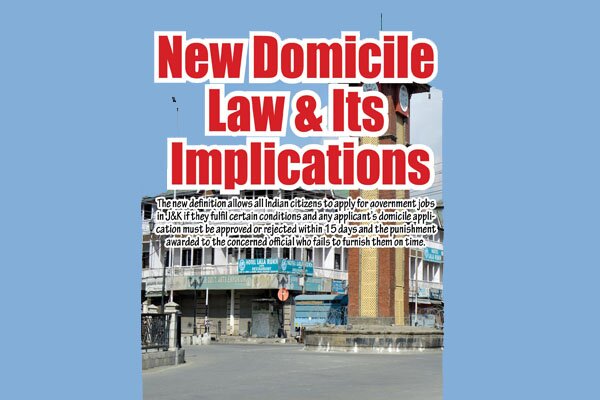
The new definition allows all Indian citizens to apply for government jobs in J&K if they fulfil certain conditions and any applicant’s domicile application must be approved or rejected within 15 days and the punishment awarded to the concerned official who fails to furnish them on time.
Until last year, J&K enjoyed a special status under the constitutional provisions of Article 370 and 35A, which didn’t allow anyone from the rest of India to obtain domicile status there. This meant outsiders couldn’t apply for jobs in the local government (this rule didn’t apply to central government postings) or own property there.
However, both these provisions were scrapped on 5 August last year. Earlier this week, the central government introduced a new definition of domicile in the union territory through the Jammu and Kashmir Reorganisation (Adaptation of State Laws) Order, 2020.
Through its Tuesday order, the Modi government also repealed 29 laws from the erstwhile state of J&K and amended 109 others that had not been struck down last August. The rest of the laws exclusive to J&K and its constitution ceased to exist when Article 370 was scrapped.
After the Ministry of Home Affairs amended the domicile law in the Valley, the Jammu and Kashmir administration, on Monday, issued an order, allowing the issue of domicile certificate as per the newly amended law. As per the order, any person fulfilling the criteria as per the new law can apply for the domicile certificate online or in person, with appropriate documents. Any applicant’s domicile application must be approved or rejected with 15 days.
The order states that if the applicant is neither approved or rejected within 15 days, he can approach the Appellate authority. Once the applicant succeeds in his appeal, the Appellate Authority will direct authorities to issue a domicile certificate within 7 days. If any authority fails to comply within the stipulated time, the appellate will recover Rs. 50000 from the authority’s salary, states the order.
On April 4, the Centre issued a gazette notification defining the domicile of the newly bifurcated Union Territory of Jammu & Kashmir. It states that a domicile of J&K is one ‘who has resided for 15 years in J&K, or has studied for 7 years and appeared in Class 10/12 exam in J&K, or is registered as migrant by the Relief and Rehabilitation Commissioner.’ The order also includes ‘children of government employees who have served in Jammu and Kashmir for a total period of ten years or children of parents who fulfil any of the conditions in sections’. The Centre had abrogated Article 370 & Article 35 A which defined the permanent residents of the erstwhile state of Jammu and Kashmir.
The special status of the erstwhile undivided state of Jammu & Kashmir had its roots in laws made during Dogra ruler Maharaja Hari Singh’s regime.
The laws, notified in 1927 and 1932, defined citizenship, property rights, and privileges of state subjects. When Jammu & Kashmir acceded to India, these laws were preserved under Articles 370 and 35A of the Constitution, which restricted local property rights, government jobs and scholarships to permanent residents. Outlining the definition of a permanent resident was also the sole mandate of the state legislature.
The domicile rule makes all local government jobs available to non-natives, including those in police and administration, which means they will now be able to serve in such positions as station house officers and senior superintendents of police, besides secretaries, head of departments, deans and professors in state-owned universities.
As a result, the immediate implication of this change will most likely be reflected by the administrative set-up, which has so far been dominated by J&K natives.
CRITICISM
NATIONAL CONFERENCE
National Conference on Tuesday vehemently opposed Jammu and Kashmir Reorganisation (Adaptation of State Laws) Order, 2020 and Jammu and Kashmir Grant of Domicile Certificate (Procedure) Rules 2020.
In a statement issued here today, the Party said: “Both the S.O 1229 (E) Domicile law and S.O 166 prescribing the procedure for grant of Domicile Certificate have been made in exercise of power under the Jammu and Kashmir Reorganization Act 2019, which is under challenge in a number of petitions before the Supreme Court and the hearing of these cases before the Constitution Bench of the SC has commenced and is proceeding ahead.
This apart, the party said, the Domicile Order as well as Procedure are “anti people as not only because these are ambiguous and misleading opening floodgates, but these would also push the people with valid state subject certificates to uncertainty and hardship as the benefits would not be available unless they obtain Domicile Certificates under the Rules”.
The Party while reiterating its resolve to continue its struggle through all peaceful means for realisation of political aspirations of the people of Jammu, Kashmir and Ladakh, has asked the Government of India to immediately revoke the Domicile Order and Procedure as “these measures will widen the gulf between the people of Jammu and Kashmir and the rest of the country and add to alienation.”
Framing of rules ‘inappropriate’: JKAP
Jammu Kashmir Apni Party (JKAP) on Tuesday termed framing of new Jammu and Kashmir Domicile rules as “inappropriate” and “untimely” in absence of a popular government in J&K.
In a statement issued here, a spokesman of JKAP said the new rules have been framed at a time when the whole country especially Jammu and Kashmir is “battling to reduce the number of deaths caused due to COVID19 pandemic”.
“The timing of framing of these important rules is not only inappropriate but grossly unethical. There is no popular, elected government in place in J&K wherein the legislature could have thoroughly discussed and deliberated upon
“With the constitutional validity of the Act impugned and the petitions under consideration of the Court, the Government of India in tune with the universally accepted principle of ‘constitutional proprietary’ is under an obligation to desist from exercising powers under the impugned Act including the power to promulgate Domicile law and Rules in question.”
The party said it has taken a principled stand on the floor of the Parliament and outside that the decisions of 5th August 2019 abrogating the special status of Jammu and Kashmir and dividing and downgrading it into two UTs “are unconstitutional, unilateral as also against the federalism which forms the basic structure of the Constitution.”
It’s a betrayal with JK youth: Congress
The Jammu and Kashmir Pradesh Congress committee(JKPCC)e has said that domicile law “has opened floodgates for outsiders and enabled large number of outside residents to avail and share all the rights at par with original natives and residents of Jammu and Kashmir”, contrary to repeated claims and assurances, during and post abrogation of special status.
In a statement, JKPCC chief GA Mir termed it a “betrayal” with the people especially youth of J and K, who were promised complete protection of rights to jobs and land, even post abrogation of art 370.
“The ruling BJP time and again misled and befooled those who opposed the abrogation of special status, to allow the outside people to become eligible for all limited government jobs and land as well all other resources, hitherto availed by the locals of J and K,” it said.