

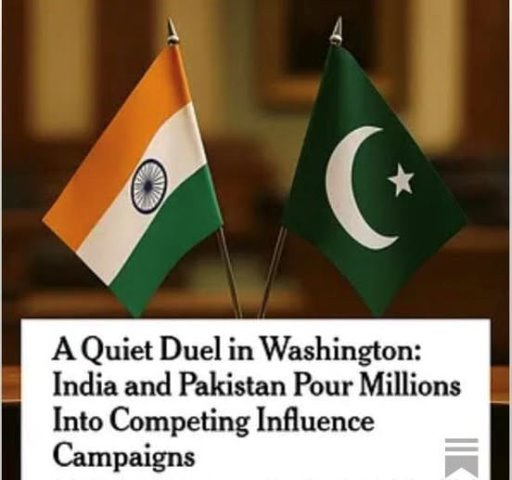
Not in Kashmir or Kabul: India and Pakistan Pour Millions Into Competing Influence Campaigns in Washington, DC. How Washington Became the New Battlefield for South Asia’s Old Rivals
Millions of dollars, shared lobbying firms, and a changing US political climate are redefining how South Asia is discussed in the power corridors of Washington. The Trump factor adds a new layer.
YASSIR AHMED
A surge in high-dollar lobbying contracts, overlapping firms, and shifting political signals has turned Washington into the latest arena of South Asia’s rivalry. Pakistan is spending three times more than India—and the effects are now visible from Congress to the White House.
For years, South Asia’s fiercest rivalry unfolded along mountain ridges, diplomatic platforms, and international forums. Today, much of that rivalry has quietly migrated to a different battlefield. It stretches across the polished hallways of Capitol Hill, the policy rooms of the Senate and House of
Representatives, the think tank corridors of Massachusetts Avenue, and the guarded offices of the White House national security staff. A new contest is underway in Washington, not through armies or intelligence agencies, but through high-priced lobbying firms that shape policy one conversation at a time.
This shift did not happen overnight. It is the result of a regional landscape in transition. Pakistan, seeking renewed relevance with the United States after years of strategic drift, has poured fresh resources into lobbying. India, long comfortable with bipartisan goodwill in Washington, has discovered that influence is never permanent. The result is what several American newspapers have recently described as a parallel proxy competition in the heart of Washington.
What makes the situation unusual is not that both countries are lobbying. Many nations do. The unusual part is the intensity, the financial scale, and the unexpected overlap of interests between certain lobbying firms engaged simultaneously by strategic rivals. Internal records and mandatory filings under the US Foreign Agents Registration Act (FARA) reveal something else: Pakistan is now spending three times more than India on lobbying in Washington. And that spending is beginning to shift the mood in parts of the US political establishment.
Against this backdrop, Indian intelligence assessments have reportedly flagged a noticeable shift in the public language and private posture of Donald Trump, who remains one of the most influential political figures in the United States. The question emerging in both New Delhi and Islamabad is simple. Is Washington witnessing a new phase of strategic persuasion from South Asia, and if so, who is gaining ground?
The Rise of Pakistan’s Lobbying Effort
Pakistan’s renewed lobbying push began roughly two years ago, but the acceleration became visible over the last twelve months. After years of relying on personal military contacts, intelligence channels, and sporadic diplomatic outreach, Islamabad decided to formalize and scale its influence campaign. This decision was driven by several factors:
1. A deteriorating economic situation that required external support
2. A cooling of relations with Beijing
3. The need to counter India’s diplomatic successes in Washington
4. A desire to reposition Pakistan as a key player in any discussion involving Afghanistan, counterterrorism, and regional stability
According to FARA filings reviewed by US media, Pakistan contracted several well-established Washington lobbying firms at significant cost. Individuals familiar with the matter estimate the combined contracts to be worth millions of dollars per year. In some cases, these firms were known for their access to influential Senate committees or foreign relations staffers who help draft key policy language.
Multiple American newspapers have confirmed that Pakistan is now outspending India at a ratio of roughly three to one. For comparison, countries like Saudi Arabia, Qatar, Turkey, and Israel have historically poured large sums into Washington lobbying. Pakistan’s current spending level is still far below theirs, but the recent spike is unprecedented for Islamabad.
What has surprised observers is the effectiveness of this spending. Several US think tanks have recently released position papers or forums where Pakistani perspectives were represented more prominently than before. Policy briefings to Congressional staff, closed-door meetings with Senate aides, and targeted public relations campaigns have increased noticeably. Washington’s political class, which had largely shifted its attention away from Pakistan after the US withdrawal from Afghanistan, is once again engaging with Pakistani diplomats, business delegations, and policy intermediaries.
For Pakistan, this visibility is an achievement in itself. For India, it is a concern that must be taken seriously.
India’s Response: Catching Up Rather Than Leading
India’s presence in Washington has traditionally been shaped by three pillars. The first is the strength of the Indian American diaspora, which wields significant influence across business, technology, academia, and parts of the government. The second is the strategic logic of US–India cooperation in the Indo-Pacific, where both countries view China as a long-term challenge. And the third is India’s own diplomatic outreach, which has grown consistently for two decades.
Because of these advantages, India often relied less on paid lobbying and more on strategic alignment, reputation, and long-term relationships. But in Washington, influence is fluid. Complacency creates gaps, and gaps are filled by competitors. Several reports indicate that in the last year, Indian officials realized that Pakistan’s renewed presence on Capitol Hill was influencing conversations related to Kashmir, counterterrorism, human rights, and South Asian regional policy.
The response was swift. New Delhi increased its own lobbying budgets, hired new firms, and began quietly evaluating the very same firms Pakistan had contracted. This is where the story becomes unusual.
Public filings revealed that one lobbying firm working for Pakistan had also been contracted by organizations linked to India, including one associated with the RSS. This dual engagement raised eyebrows, not because it was illegal but because it signaled a pragmatic, businesslike approach from firms willing to work for both sides of a regional rivalry simultaneously.
The discovery sparked political commentary in India and mild strategic discomfort in Pakistan. For India, it served as a reminder that influence in Washington cannot be taken for granted. For Pakistan, it was proof that it had successfully entered a space from which it had long been absent.
Washington’s View: A Region in Flux
From the vantage point of US policymakers, the lobbying surge is a symptom of deeper shifts. Three developments are shaping Washington’s attitude toward South Asia.
First, Afghanistan remains unstable. Dialogue with the Taliban has stalled, border tensions with Pakistan remain unresolved, and no regional power currently enjoys full access to Kabul’s decision-makers. This uncertainty has revived Washington’s interest in Pakistan as a traditional gateway to Afghan politics.
Second, the Turkmenistan Afghanistan Pakistan India (TAPI) gas pipeline has returned to US conversations. American officials have expressed renewed interest in the project as part of a broader conversation about energy security and mineral access. The United States is exploring how to maintain a regional footprint without deploying military assets, and economic corridors offer one potential opening.
Third, the United States has started to treat South Asia and Central Asia as a single strategic space, a trend formalized when the US ambassador to India was also assigned responsibilities for the broader region. That shift has elevated Afghanistan, Pakistan, India, and Central Asia into a connected policy framework, increasing the value of influence from any of these states within Washington.
Within this reconfigured landscape, lobbying is not simply about shaping opinion. It is about securing space in a policy ecosystem undergoing recalibration.
The Trump Factor: A Subtle but Visible Shift
Among the political developments drawing attention is the change in Donald Trump’s tone toward India. During his time in office, Trump maintained a largely positive relationship with New Delhi, driven by shared concerns over China and a personal rapport with Indian leadership. But recent statements from Trump have shown a degree of recalibration.
Analysts offer several explanations. Some highlight Trump’s unpredictability and transactional approach to foreign policy. Others point to Pakistan’s increased lobbying presence that has reintroduced Islamabad’s narrative into Washington circles Trump interacts with. A few observers note that Trump values negotiation leverage. Being perceived as balanced between India and Pakistan could allow him to position himself as a potential mediator if he returns to office.
The shift is not dramatic, but it is noticeable enough that Indian policymakers have taken note. Trump’s comments on regional issues reflect a willingness to hear perspectives that were previously marginal in his policy orbit. The timing of this shift, coinciding with Pakistan’s expanded lobbying campaign, is unlikely to be dismissed as coincidence.
It would be an exaggeration to say Pakistan has “won” influence over Trump. But it would be equally inaccurate to say India still enjoys the same uncontested access it once had. The playing field is leveling, and both sides are adapting to that new reality.
Why This Lobbying War Matters
Lobbying is often misunderstood. It is not a matter of simply paying a firm to say nice things. High-level lobbying firms perform tasks like:
• arranging meetings with Congressional aides
• drafting policy suggestions
• preparing talking points for lawmakers
• securing slots in hearings or forums
• influencing the tone of committee briefings
• shaping media narratives
• organizing roundtables with think tanks
• connecting foreign governments with US interest groups
These actions help shape the information environment. And in Washington, where perception often shapes policy, the information environment can determine the direction of legislation, sanctions, aid packages, military cooperation, and diplomatic messaging.
For India and Pakistan, the stakes are particularly high. The future of Kashmir policy discussions, counterterrorism cooperation, defense agreements, and energy corridors may be influenced by the impressions lawmakers form today. Both countries understand this, which is why this lobbying surge is unlikely to slow down.
Final Glimpse : A Quiet Contest With Long-Term Consequences
The corridors of Washington are witnessing a new chapter in South Asia’s rivalry. There are no slogans, no public speeches, no military parades. There are only quiet conversations, closed-door briefings, strategic narratives, and influence campaigns written into the fine print of FARA contracts.
For Pakistan, this is an opportunity to regain diplomatic relevance and leverage its position in conversations about Afghanistan, energy corridors, and regional stability. For India, it is a reminder that global influence never remains static and that even longstanding goodwill requires constant upkeep.
For Washington, it is a signal that South Asia remains a region of strategic competition, not only between India and Pakistan, but also between the United States, China, Russia, and various regional blocs. How the US navigates these overlapping interests will shape the political landscape for years to come.
And for Donald Trump, should he return to a position of influence, the perspectives he encounters now will shape the choices he makes later. The lobbying war underway today may be one of the quietest contests in South Asia’s long rivalry, but its consequences may prove to be among the most enduring.
Copyright © 2025 Yassir Ahmed Mir. All rights reserved.
No part of this article may be reproduced or distributed without written permission from the author. For permissions or syndication, contact yassirahmed001@gmail.com.
Disclaimer:
This article draws on verified public sources and research available at the time of writing. The views expressed are solely those of the author and do not represent any government or institution. While accuracy has been prioritized, some details may rely on incomplete or evolving information.
Author Note: Yassir Ahmed is an Indian journalist covering national security, defense, and Asian–Middle Eastern affairs.
First published by Kashmir Pen, Srinagar, Jammu & Kashmir (www.kashmirpen.com)
© 2025 Yassir Ahmed Mir. All rights reserved. Published with permission.

