

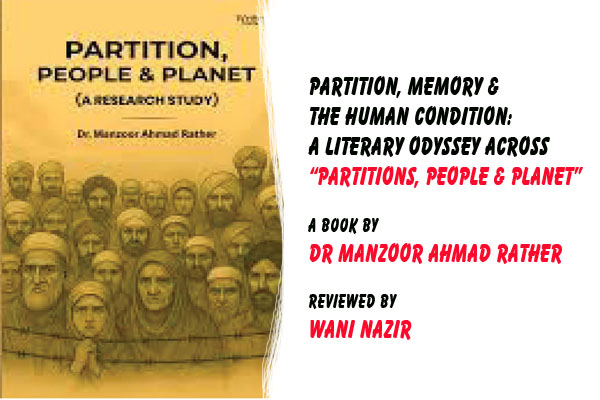
In his seminal book, “Partition, People & Planet”, Dr Manzoor Ahmad Rather – a young research scholar and also head of the Narvaw Literary Society, a dynamic voice on Kashmiri Literature – gives readers a rich and haunting account of one of the most cataclysmic events in South Asian history – the birth of independent India and Pakistan in August 1947. More than just a historical and political investigation, the book, the result of intense and personal inquiry, is a literary lament for the trauma, resilience and memory that inhabit the unhealed collective soul of the subcontinent. Interlacing literature, history, gender studies, sociology, and nature writing into one narrative, Dr. Rather builds a powerful interdisciplinary examination of human suffering and survival, and a meditation on violent rupture and sustained global disaster.
Focussing on Khushwant Singh’s classic, Train to Pakistan, this chapter, entitled Partition, Migration & Violence in Train to Pakistan, presents the novel as a literary memorial to the unprecedented brutality, displacement and psychological devastation of 1947. The chapter begins sharply and urgently by posing the question: “Was it safe to migrate in trains during the partition, and the aftermath of the religiosity and communal violence depicted by Khushwant Singh in Train to Pakistan?” This is the crux of the Partition experience as witnessed by a witness. Singh, “a lawyer and practiced in Lahore High Court till it was Partition,” was likewise a refugee—“migrat[ing] to Delhi like the hundreds and thousands of Hindus at the time.” What gives Singh’s narrative, based upon personal experience, soul-stirring depth, is the epitome of a nation decimated by religious hatred and political treason.
And the bookends of “the trainloads of dead arriving at the beginning and end of the novel” becomes a chilling metaphor for the era’s brutality. These loads are not just loads of trains but of horror, indicative of the breakdown of human society and the destruction of the social contract. So too do these hideous arrivals, as Dr. Rather poignantly puts that these arrivals “mirror a sea change that takes place in the atmosphere of the village as in the attitude of its inhabitants.” The suspenseful, empathetic tenor of the novel adds to this emotional heft: Readers are pulled into a world in which war and violence are not merely hypothetical, but distinctly familiar.
Among the most heart-wrenching of the imagery in this chapter is that of Muslims, “who came out by the bullock carts with their baggage… to be taken to Lahore by train,” compelled to abandon not just their homes but also their identity, their right to place and privilege, and their archetype of belonging. For all that chaos, a glimpse of humanity is offered in Lambardar’s soft assurance: “We will not touch our brother’s properties.” This small statement speaks volumes about the long-term ethical connections which can still exist in the face of enormous division. By situating Train to Pakistan in a larger historical context— twelve million people uprooted, and the largest migration in history—Dr. Rather offers close-up detail of the tragedy it contributed to and the long march, human by human, that it is comprised of. Moreover, it is a reality — as is his concluding reminder that “India-Pakistan relations remain complex and hostile,” and that “violence, then as now, is not the answer—‘it can be solved through talks on a table’” — which constitutes an earnest plea for conversation, compassion, and peace.
Chapter 2, Partition Survival and Post Memories, refocuses this on women who are too often side-lined in historical narratives. Here Dr. Rather unearths the unspeakable traumas women experienced in the Partition, documenting the forced suicides, the sexual maiming, the after-trauma silence. The legend of Hindu women “jumping into the well… to protect their honour from attacking Muslim mob” is among the most tragic and haunting instances of how women came to symbolize not only the honour of the community but also its battleground. But Rather does not merely cauterize these women into mere symbols; he provides a gendered prism through which their lives were lived, illuminating the myriad ways women were “doubly victimized—by attackers and their own kin.” Amarjeet’s account, a seventeen‐year‐old elite Hindu from Peshawar, is a heart‐breaking testament: that “it was loot and plunder, it was time of 1947, the helter skelter was at peak”.
Dr Rather’s sensibility and scholarly voice meticulously brings out the interior world of women caught in the external storm, describing poignantly: “For a woman her home…is her world, her soul roams around her home.” With the loss of homes, women share in a spiritual homelessness as well as a physical one. The chapter also probes the social and emotional disintegration of communities in places like Lahore and Amritsar, riven by communal tensions—“a political decision reflected chaos… confusion sparked into hatred. ” As he stresses, “Women faced multiple cuts despite of her innocence. ” Theirs was, in other words, a two-handed violence — a beating not only of the body, but of self-respect, a lay-waste of worth, a violation not just of the physical, but of the soul. This chapter is more than history of a violent time; it is a plea for ethical memory of the suffering, courage, and survival of women.
Introduced by Dr. Rather, in chapter 3, Hindu Muslim unity and Communal Riots – Dr BR Ambedkar’s View, we see an intellectual heavyweight like Dr B.R. Ambedkar, whose views born from a complex understanding and insight of history can provide us philosophy to comprehend myth and history that we term as religious rifts in India. Using pre-Islamic Indian history, Ambedkar posits Punjab and Kabul as areas with Vedic and Buddhist connection to India, depicting a civilizational and historical continuance interrupted by subsequent conquests. He emphasizes how historical fissures have deepened Ayodhya like suspicions between communities, and contends that religious provocations end in violence when social solidarity is absent. In rebutting the majoritarian discourse of Aryan supremacy and acknowledging indigenous credentials of Shudras and Ati-Shudras, Ambedkar provides an alternative view of identity that straddles critique of Hindu and Muslim communalism.
Foremost among them, Dr. Rather highlights Ambedkar’s chilling observation on India: that there is no “social unity,” without which “political unity” is fragile. Ambedkar compares India with Western nation-states and finds the absence of a common feeling of nationality the greatest obstacle to their unification. His judgment that the “deeply entrenched religious divide between Hindus and Muslims” makes unity an unattainable ideal is not a pessimistic one, but a realistic assessment. It is a sign that India’s future is not in papering over these divisions but in addressing them openly and reconciling them.
One of its chapters, The Contribution of Survey Method in English Literature to Bring out Feminine Psyche during the Partition of India introduces a novel approach that combines literary criticism and social science. Rather reflects on the ongoing impact of Partition’s gendered violence on the female mind, and examines the ways literature and survey-based research can contribute to preserving the archive of these usually hushed experiences. The Radcliffe Line, penned quickly with an “emotional detachment” that can only be detached for those who will never cross it, is reimagined not merely as a geopolitical demarcation but as a cultural and emotional rift. The chapter interrogates the trauma which women and girls face in the process of migration, in relief encampments and in the aftermath of communal violence. It raises fundamental questions: How did women endure? What were their support systems? What strategies of survival and resilience did they devise?
Ahmad’s critique calls for a thoughtful and compassionate self-examination. In recognizing the “intimate ruptures” such events cause in women’s lives, he posits the need for ethical documentation that is not predicated on the exploitation of suffering, but on its honour. Literature itself becomes not only a means of expression, though, but a moral archive of memory and pain. This scholarly intervention challenges us to move beyond nationalistic stories and explore the lived, gendered truths that are often hidden at the edges of history books.
The book evolves still more into a meditation on the condition human in the age of pandemic, detention and isolation when the chapter on pandemics, detention and isolation comes up. Dr Manzoor’s exploration of aloneness, solitude and loneliness constitutes a novel and challenging philosophical reflection of what it means to be human in crisis. By comparing the psychological cost of the COVID-19 pandemic to historical episodes of isolation — like the isolation endured by Shakespeare during the plague or Martin Luther King in Birmingham Jail — he connects the dots between private torment and artistic creation. Pregnant and breast-feeding mothers, migrants and people mourning dead relatives are made emblematic of that pandemic-induced vulnerability. These experiences, though deeply personal, resonate collectively, speaking to how isolation can splinter but also uplift.
With figures like Behrouz Boochani and Antonio Gramsci in mind, Dr. Rather emphasizes that even in the darkest moments of confinement, the human spirit manages to narrate, to protest, to build. He moves on to Indian English writers such as Amitav Ghosh and Suketu Mehta, who deploy language as a bridge between cultural silos and global stories. Instead, isolation—linguistic or otherwise—is reconceived as on-board space for connection and creativity. The chapter demonstrates that isolation, while frequently painful, can also be a source of revelation, revealing depths of the human ability to endure, contemplate, and transcend through art.
The last chapter analysed here, City of Literature: Exploring United Nations Sustainable Development Goals fits in the category of the global initiatives and ecological awareness. Grounded within the UN’s Sustainable Development Goals (SDGs), and in particular SDG 11, or “Make Cities and Human Settlements inclusive, safe, resilient and sustainable,” Dr. Rather examines the ways in which literature serves as an emotional and cultural gateway to these goals. In referring to both Friedrich Engels’ The Conditions of Working Class and Meg Mundell’s The Trespassers, he twice invokes attentiveness to past realities of urban life and displacement, as well as to current environmental reality.
Unesco’s City of Literature programme is portrayed as an emblem of creative potential, with literature as a participant in the politics of sustainable urban development. Drawing examples from cities such as Durban, Manchester, and Baghdad, Dr. Rather emphasizes the role of literary culture in moulding our common memory and motivating inclusivity and action. The chapter argues that literature is not only reflective, but immensely generative of possibility, that it can envisage and create a more human and sustainable world.
In conclusion, Partition, People & Planet by Dr. Manzoor Ahmad Rather is a great scholarly feat that blends historical search with literary vision, gender perspective with political theory, and personal narrative with world outlook. This multichapter dissection of Partition, migration, communal violence, women’s trauma, isolation, sustainability, yields a nuanced empathetic understanding of the human condition. By way of writers, by way of survivors, by way of thinkers, by way of the silences between the lines, the book transcends beyond academic literature – it becomes a moral compass that shows the way to readers everywhere, the path to memory, justice, and peace. In holding on to both the mourning and the vitality of the past, Dr. Rather asks us not only to remember but also to re-imagine a future in which the dignity of humanity transcends borders, ideologies, and histories.
ABOUT THE REVIEWER
A Kashmir University Gold medalist in English Literature, Wani Nazir from Pulwama J&K India, writes poetry and prose in Urdu, Kashmiri and English. His poetry and prose has been published in a slew of National and International journals of repute. He has been receiving laurels for his beautiful writings. He was awarded with The Nissim Excellence in Writing Award 2018 for Poetry and Criticism, The Kashur Qalam Best Poet Award 2017. He is the author of a collection of poetry, “… And the Silence Whispered”, the collection of poems that has been received well in the literary circles.

