

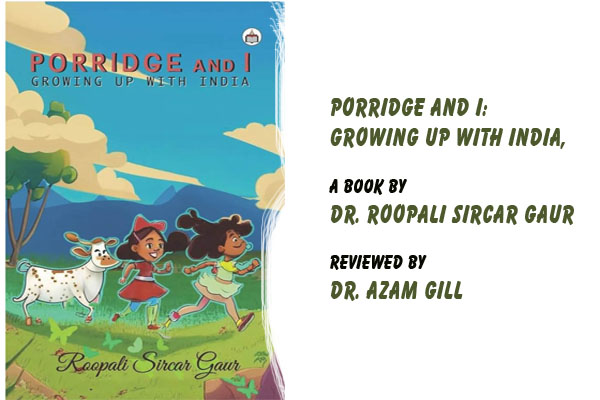
PORRIDGE AND I: GROWING UP WITH INDIA, Dr. Roopali Sircar Gaur’s masterpiece of satire within a meticulously crafted bildungsroman of biographical fiction, splits the dawn with a lightning bolt.
“Miss Dorris is English. That is why her skin is so white. When Miss Dorris laughs her teeth shine like stars and her cheeks look like pink roses dipped in cream. When Miss Dorris makes mother angry, Mother says, “Dorris is not pucca, that is why her English husband didn’t take her back to England. Daddy says ‘pucca’ means you are real English.”
The sub-title of PORRIDGE AND I: GROWING UP WITH INDIA, mirrors the work’s symbiotic beginning and ending. With,’ bridges the title and sub-title. ‘‘In,’ would evoke a situation, an object or a period of time within a defined enclosure. R. K. Narayan, Balli Kaur, Deepa Anappara, Arundhathi Roy, Anees Salim and many others have crafted their Bildungsromane within an Indian framework.
India is not a picture frame in Sircar Gaur’s PORRIDGE AND I: GROWING UP WITH INDIA, but a significant actor. ‘With,’ implicitly recognizes togetherness of place and act, adding India to the twinning of siblings in a Bildungsroman of triplets. Porridge, the Reliable Narrator and India itself come of age together, sharing bruised knees, broken hearts, tears, laughter, love, jealousy, kindness and cruelty. They all adjust to each other with dignity, comic relief, mock heroic prose, irony and satire dexterously enhancing one of the world’s richest sensory tapestries.
Circumstances, situations, time and perception, glide in harmony. PORRIDGE AND I: GROWING UP WITH INDIA overcomes linear constraints, to harness and orchestrate time, going beyond the stylistically fragmented chronology in Willilam Faulkner’s THE SOUND AND THE FURY. A child seats minuscule events of great import in its life next to the UN’s Security Council and memories of Paradise Valley, maneuvering 16/17th century Mughal Emperor Jahangir in reverse gear from adulthood.
The dawning of India’s independence shines over two spunky sisters, daughters of an army officer and a highly educated mother, transiting from subjecthood to citizenship. The parents and other characters also fulfill their role of Wayne C. Booth’s Reflectors, infusing a child’s perception with adult rephrasing, without recourse to convoluted literary acrobatics.
The girls’ perception roams the vivacious cultural, social, ethnic and lingual diversity of India, gurgling in the poisoned chalice of the English language which contributes to demarcating social class by the opportunity and skill of Indo-Anglians. These are the anglophone/phile middle and upper classes, schooled in fee-paying English medium institutions preponderantly Christian managed by Christians (reference below). The Indo-Anglian Reliable Narrator — the Principal Eiron — benignly stirs the cauldron of characters to accentuate evolving situations which serve the science and art of satire.
The eiron of Classical Greek Comedy, defined by Aristotle, was a stock character, understating its own abilities, to humble the unvirtuous, thereby contrasting expectation and ground reality, to achieve irony, like the Reliable Narrator’s reaction to disrespectful public exhibits of multimillennial corpses.
“The old museum in the city…two big colorful boxes … inside two glass cases (with) faces painted in yellow and red and black on the cover … (we) stared at the dead Egyptian Mothers dead for a million years. And yet alive… a bit of a foot wrapped in miles of bandage … The museum halls also screamed the screeeaaam like the time Doris shouted she was the Queen of England.””
Doris was the Reliable Narrator and Porridge’s nanny of doubtful Englishness.
A child’s stream of consciousness reliably navigates diverse subjects, roping a Bollywood actor to the UN Security Council, next to a titillating reminder of male-domination in erstwhile news broadcasting, while reducing reams of blood-soaked, ineffective United Nations paper-work to comic inversion.
“Raj Kapoor … very popular in Russia. If others like our things we feel very happy. The radio continuous to tell us in man voices that there will be a war. The UN and the Security Council are forever meeting and talking about what is ours and what is theirs.”
Then, seemingly of its own volition, the Reliable Narrator’s innocence conjures a narrational gem where an adult’s retrospection slithers back into a child’s perceptiveness to interpret the space race, the Cold War and the contemporary fretting about space overcrowded with orbiting gadgets, breaching national sovereignties and individual privacy.
“The Russians shouldn’t poke about in the sky. That’s what they’re all saying. The Gods live there. They will get very angry… The Moon doesn’t send anything anymore. The Americans and the Russians are sending up too many things. Daddy says.”
The narrational brilliance of a child’s diction submits Kashmir to reductively chilling flippancy, calling out colonial avarice.
“All sorts of people are angry all the time. WE are very angry with THE ENEMY and THE ENEMY is very very very angry with us. The Security Council is angry with us and with THE ENEMY for not slicing Paradise Valley into two pieces like an apple. America and England also want Paradise Valley. They always want other people’s stuff.”
Dr. Sircar Gaur’s sixty-one words neutralize the rantings of ideologues, politicians, civil servants, wordsmiths and journalists, while the soil of Paradise Valley keeps soaking up blood from the time a king’s versification anticipated the compacted wisdom of the Reliable Narrator, who goes even farther.
A child’s unblemished insight processes backpackers in Kashmir to distill an entire movement seeking atonement and wisdom via cheap cannabis and sexual freedom. The grown up seeks the child within and resurrects P. G. Wodehouse’s continuing relevance in India!
“The real coolies drink tea and wait for rich Americans to hire them to carry their stuff up the upside down ice cream mountains but the rich americans want to be like the poor coolies and carry their own house and bed on their own backs. They are true friends of Gandhiji. This is how the poor coolies have become poorer. And the rich Americans have become poor.”
“There are also so many funny books about an English butler called Jeeves and his master Bertie Wooster. We know Jeeves. His English snobby behaviour reminds Porridge and me of Cook. Like Cook, Jeeves is also always angry with his master Bertie Wooster for not behaving like a rich Englishman.”
Dr. Gaur’s versatile plume orchestrates the core similarity between the sniffs of a nameless lungi / pajama-clad Cook with those of a tailcoated British valet, to synthesize language, pronounciation, class, self-esteem and, social mobility.
“He is now known as matric fail”
Inverted scholastic failure becomes a medal in a society venerating education and knowledge. Society grants prestige to certified learning, yet tolerates low attainment levels and even outright exam failure does not go waste.
India’s modern learning process comes from the British, who borrowed it from the Prussians. In 1763, Prussia’s King Frederick II issued a decree structuring the school system, to instill obedience and prevent his young soldiers from deserting the ranks at harvest time! Obedient subjects, and low-cost, entry-level cannon fodder were the goals, and not a ‘knowledge society.’ Nobel laureate Rabindranath Tagore knew better and Dr. Gaur’s Reliable Narrator gleefully flourishes Tagore’s legacy to scale the restraining architecture of formal education in a convent.
“We know how England ruled us and what Gandhiji said and what they are saying every day at the Security Council. We know what gifts Jesus got when he was born who came to see him and where Krishna was born. We can fly kites and we can make them. We know about the Sputnik and of the yellow rain in Hiroshima.”
The narration continues to fill the bubbling cauldron, from the inversion of Gandhiji’s words to the gap between Jesus’ teachings and the ritualization of Christianity by its appropriating purveyors.
“I told Porridge how I cut Miss Brown’s hair. I couldn’t answer her ‘Why?’ All I know is that I have done what no one else could. She says she is going to tell Miss Brown. Gandhiji says we must always speak the truth…
“…Jesus haunts us everywhere. Either we will go to heaven or we will go to hell. You must be dipped in a tank of water and throw a big party and have your family sing and pray and eat cake and chocolates and feed the poor and give gifts. It all costs a lot of money.”
Christianity is an oriental religion born in the Middle East. The Western takeover and then ‘God-is-an-Englishman’ appropriation by dog-collared Anglicans, and the Reliable Narrator’s bald “Carmelite” Penguins deploy Jesus’ teaching to exact worldly obedience.
The picture of Mother Mary with baby Jesus smiles softly… Through a small skylight we are going to get a cheel’s view of what the Penguin’s eat…. Soup and chicken curry and rice and daal and salad and custard pudding. The Penguins … are all bald. I am no longer afraid of the Penguins.”
Other Gods and faiths serve their turn.
“Why are Gods like Krishna and Hanuman so devilish? Krishna broke milk pots and stole butter and cream and the clothes of some bathing gopis. Hanuman set fire to the city of Lanka with his tail. And Daddy’s office peon Mohammed Rasul said his son is a shaitan.”
Anglo-Indians and Indo-Anglians are among the fixtures of India’s diversity, their situational irony eloquently insightful of the Raj through themselves.
“The Williams are all going away to Australia
“Don’t they love their country? Porridge asked Daddy.
“What country? They have never felt at home here. They are products of history. Nobody wants them. Not England, not India…
“But we are Indians too. …We too are both Indian and English… There is nothing worse than a kala Indian trying to be like a white Englishman.”
“‘Only junglee Indians can’t speak English,’ Porridge yelled”
“didn’t look happy … the ugly smile across (Prem Singh)’s white Pinnochio nosed face and the look in his eyes is just the way Dhobi and Cook’s eyes would become when they talked about English Memsahibs and their silk underwear …”
Chronology in PORRIDGE AND I: GROWING UP WITH INDIA, ignores linear markers filtering through a child’s eyelashes. It reverses time by adult recall through a child in the present, without recourse to Hilary Mantel’s contrived present tense in WOLF HALL. Blue mountains, Jhansi, Gwalior and Kashmir waltz in temporal ease.
Porridge, her sister and their India blossom, merging strengths and foibles honed for their incredible New World, while history conducts Doris and the Raj to their origins.
India’s abundant sensory images, exert their incredible beauty and power over a unique landscape.
Time is arbitrary, but its movement and duration are only perceptible in the effect, wielded by the untarnished mysticism of an innocent and endearingly cheeky child. Dr. Gaur conducts a symphony of different narrative tones within the main narrative voice, each appropriate to the situation, character and Reliable Narrator’s perception.
Repeated adjectives within the Indian diction of pink-gulabi English effortlessly intersperse the lingual and literary scope of PORRIDGE AND I: GROWING UP WITH INDIA, without excluding non-practitioners of this naturalized, metalingual, colonial phenomenon.
The delightful irreverence of pointed satire does not breach the integrity of sacred spaces. It provides intellectual nourishment and mental stimulation to instruct within an entertaining framework, as suggested by Sir Philip Sidney in The Defence of Poesie.
The grown-up Reliable Narrator in Dr. Roopali Sircar Gaur’s PORRIDGE AND I: GROWING UP WITH INDIA, reaches back to the beginning, transforming this biographical fiction into a thunderbolt celebrating Aristotle’s prescribed synergy between the beginning and the ending of a work, blatantly plagiarized by Roland Barthes over two millenia later! The Narrator’s coming of age merges into Chudamani Chintamani Chondrobhan Goswami’s ghost who benignly smiles from a rising mist at the fadeout of rosy cheeks and porridge, leaving Indian Baggry’s and American Kellog’s to corner the 26% share in India’s breakfast cereal market, yoked to the English language which refuses to go ‘back home’!
Reference:
- “the Christian community which makes 11.54% of the total religious population, contributes to 71.96 % share of total religious minority schools of the country” “https://www.education.gov.in/sites/upload_files/mhrd/files/parliament_annexure_en/2258_eng.pdf
- GAUR, Dr. Roopali Sircar. Porridge and I: Growing up with India, Author’s Press, Bharat, 2024, pbk. https://shorturl.at/mmjtv
Biographical Note Dr. Azam Gill
Dr. Azam Gill, novelist, analyst and retired tenured Lecturer of Toulouse University, France,
has authored nine books, including four thrillers — BLOOD MONEY, FLIGHT TO PAKISTAN, BLASPHEMY and JADINY. He also writes for The Express Tribune, The International Association of Thriller Writers, and blogs at https://writegill.com/. He served in the French Foreign Legion, French Navy, and the Punjab Regiment. JADINY: Just Another Day in New York, his latest novel, is a counter-factual / alternative history thriller about the 9/11 Twin Tower attacks.
Biographical note Dr. Roopali Sircar Gaur
Dr. Roopali Sircar is a poet, travel writer and social justice activist. A former Professor of English Literature at Delhi University, and a Creative Writing Professor at IGNUO, she is a widely published academic and creative writer. Her Book TWICE COLONISED: omen in African Literature, is a seminal text on women’s socio-political empowerment. She has co-edited several poetry anthologies, the latest of which is KURUKSHETRA: Between War and Peace.
ABOUT THE REVIEWER
Dr. Azam Gill is a noted Teacher, Writer, Novelist, Editor, Blogger and columnist. His articles on different subject are published in national and internationl magazines and news letters.

