

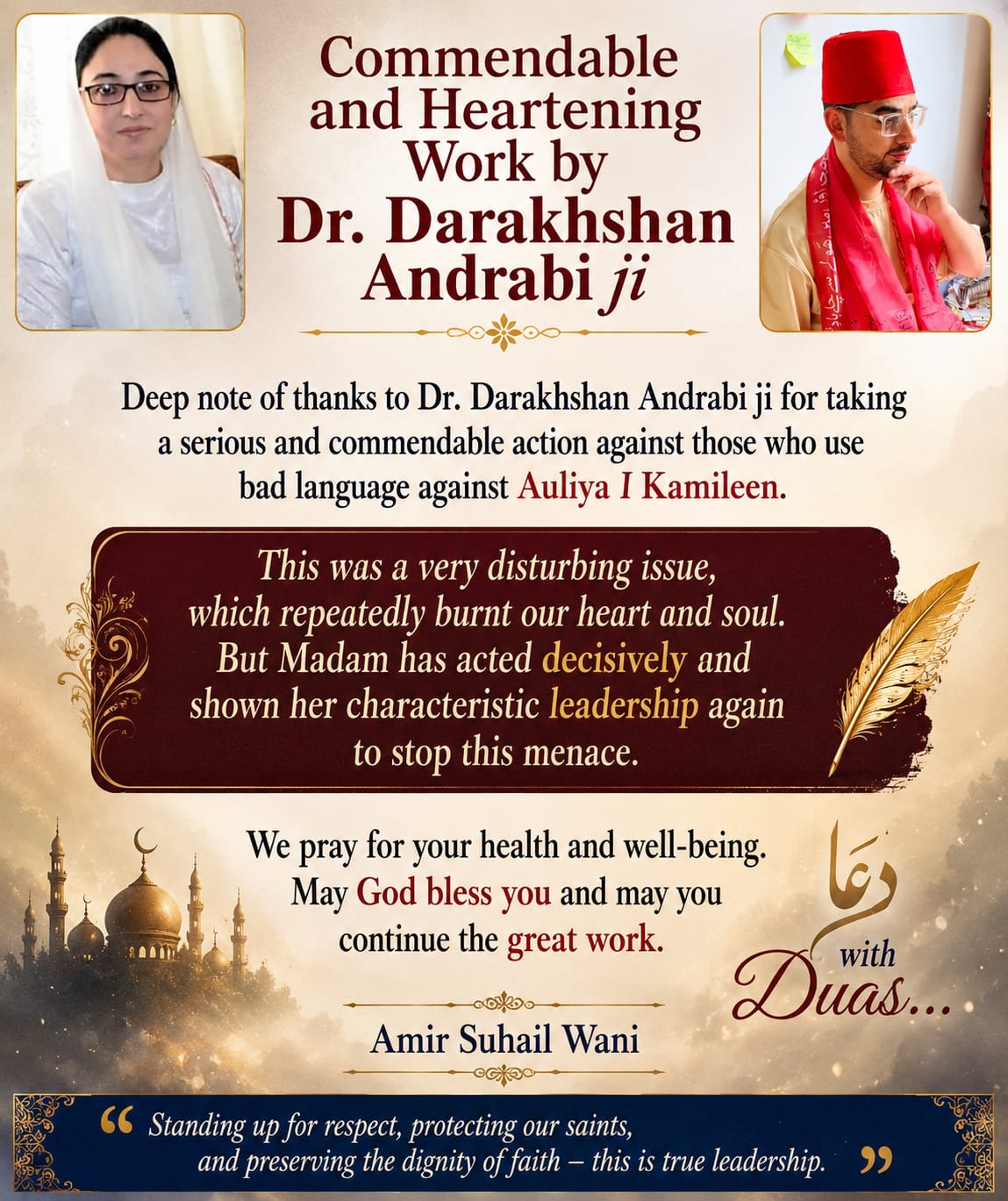
Amir Suhail Wani
Srinagar 23 Jul : In every civilization, sacred spaces embody two inseparable dimensions. The first is tangible—the domes, minarets, courtyards, manuscripts, relics, and centuries-old architecture that testify to a people’s history. The second is intangible—the reverence, spiritual traditions, ethical values, and collective memory that transform stone and mortar into living centres of faith.
A shrine can be restored after a fire, but its sanctity cannot be rebuilt if respect for its spiritual legacy is allowed to erode. Likewise, devotion alone cannot preserve heritage if historic structures are neglected or left vulnerable to natural or human-made calamities. Recognizing this dual responsibility, the Jammu and Kashmir Waqf Board under the leadership of Dr. Darakhshan Andrabi has undertaken initiatives that seek to preserve both the structure and the spirit of Kashmir’s sacred institutions.
Among the most noteworthy recent measures is the decision to insure shrines and Waqf-managed religious properties against unforeseen disasters. This initiative reflects a forward-looking understanding of heritage conservation. Historic shrines are repositories of priceless architectural, cultural, and religious wealth. Fires, earthquakes, floods, vandalism, or other emergencies can inflict damage that may take decades to repair.
Insurance does not diminish faith in divine protection; rather, it embodies the Islamic principle of responsible stewardship (amanah). The Prophet Muhammad (peace be upon him) advised believers to “tie your camel and trust in Allah”—a timeless reminder that prudent planning complements trust in God. By introducing institutional safeguards for sacred properties, the Waqf Board has embraced a modern administrative practice that secures the material foundations of Kashmir’s religious heritage for generations to come.
Equally significant has been the Board’s clear position that abusive or derogatory language directed at the Auliya Allah—the revered saints whose lives shaped Kashmir’s spiritual landscape—will not be tolerated within Waqf-managed institutions.
The shrines of Kashmir have historically been centres of compassion, education, charity, and reconciliation. The great saints nurtured an ethos of humility, service, and coexistence that transcended sectarian boundaries. Their teachings contributed immensely to the region’s distinctive spiritual culture, where devotion was inseparable from moral refinement.
Scholarly debate has always been a legitimate feature of Islamic intellectual tradition. Respectful disagreement, grounded in evidence and scholarship, enriches religious understanding. However, deliberate insults, provocation, or inflammatory rhetoric directed at personalities held sacred by millions undermine both the dignity of religious institutions and the social harmony they seek to cultivate.
By drawing a clear distinction between legitimate theological discourse and abusive speech, the Waqf Board has sought to preserve the sanctity of spaces dedicated to worship and remembrance.
Taken together, these initiatives reveal a coherent philosophy of governance. Protecting buildings without protecting their spiritual atmosphere leaves heritage hollow. Protecting sentiments without preserving historic structures risks losing the physical symbols of that heritage. Effective stewardship demands both.
This integrated approach reflects an important evolution in the management of religious institutions. Modern administration is no longer confined to maintenance and finances; it also encompasses heritage conservation, disaster preparedness, ethical governance, public accountability, and the preservation of the values that define sacred spaces.
Across India and the world, many religious trusts are increasingly adopting professional management practices to protect historic places of worship while strengthening transparency and long-term sustainability. The emphasis on risk management, heritage conservation, and respectful public conduct aligns with broader trends in safeguarding religious and cultural institutions for future generations.
Kashmir’s shrines are more than monuments. They are living symbols of a civilizational tradition that has inspired spirituality, social cohesion, and moral reflection for centuries. Preserving them requires protecting both the visible inheritance of architecture and the invisible inheritance of reverence.
The recent initiatives under Dr. Darakhshan Andrabi’s leadership underscore a simple yet profound truth: sacred institutions endure when both their walls and their values are safeguarded.
Insurance protects the stones. Respect protects the soul.
In preserving the structure and the spirit together, these measures represent an important contribution to ensuring that Kashmir’s rich Sufi heritage continues to inspire future generations with the same message of faith, peace, compassion, and human dignity that has defined it for centuries.

