

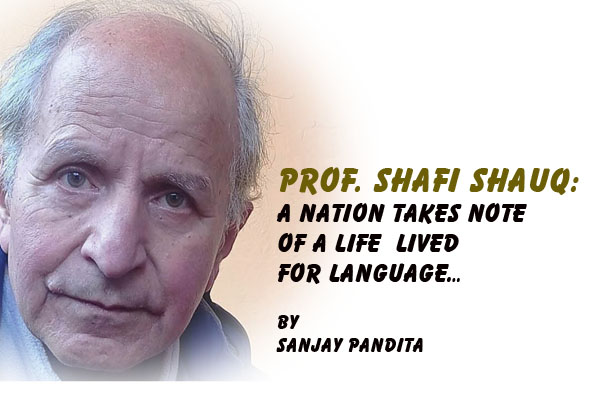
SANJAY PANDITA
There are lives that move quietly through time, leaving behind no spectacle, no noise, no urgent demand for attention—and yet, when history pauses to look back, it discovers that such lives have altered the course of collective memory. Prof. Shafi Shauq’s life belongs to this rare category. His journey has unfolded not in the glare of public acclaim but in the patient intimacy of words, manuscripts, classrooms, and long conversations with a language that has struggled to survive the pressures of neglect, marginalization, and historical upheaval. When the Government of India named him among the recipients of the Padma Shri Award 2026 for his contribution to education, language, and literature, it was not merely an honor bestowed; it was a belated acknowledgment of a life that had already become an institution in itself.

In the story of Kashmiri language and literature, there are many voices—poets who sang, mystics who whispered, scholars who recorded—but there are only a few who assumed the lifelong responsibility of holding the entire tradition together. Prof. Shafi Shauq is one of those custodians whose work cannot be confined to individual achievements or isolated publications. His life’s labor represents a continuous act of resistance against cultural amnesia, a refusal to let the Kashmiri language be reduced to folklore, nostalgia, or ceremonial remembrance. His recognition by the nation thus feels less like a personal milestone and more like a moment of collective vindication for a language and a people long relegated to the margins of national discourse.
Language, especially in a place like Kashmir, has never been a neutral medium. It has carried the weight of history, spirituality, trauma, and resilience. It has been the voice of saints and peasants, of lovers and exiles, of resistance and surrender. Kashmiri is not merely spoken; it is lived. To serve such a language is to enter a moral contract with generations past and unborn. Prof. Shafi Shauq understood this intuitively. His work was never about preservation for preservation’s sake; it was about safeguarding a worldview, a way of thinking, feeling, and seeing the world that is encoded in words, idioms, metaphors, and silences.
Born in 1950 in the lush village of Kaprin in Shopian district, Shafi Shauq came of age in a Kashmir where oral tradition still thrived, where poetry circulated as speech, and where spiritual ideas were not confined to texts but flowed naturally through everyday life. The rhythms of village existence—the seasonal changes, the cadence of folk songs, the moral clarity of Sufi thought—left a deep imprint on his consciousness. Kaprin was not merely a geographical location; it was a formative landscape where nature and language conversed constantly. That early exposure to an unbroken cultural continuum would later inform his scholarly sensitivity and poetic restraint.
His academic journey began, intriguingly, in the sciences. He earned a Bachelor of Science degree from Degree College Anantnag, a path that suggested analytical discipline rather than literary immersion. Yet literature soon asserted its quiet dominance over his intellectual life. He turned toward English studies, completing his Master’s degree and PhD from the University of Kashmir. This grounding in English literature did not estrange him from Kashmiri; instead, it equipped him with comparative tools, critical frameworks, and a global perspective that enriched his engagement with his mother tongue. He learned how literatures speak to each other across cultures, and how local traditions gain strength when they are understood in conversation with the wider world.
What distinguishes Prof. Shafi Shauq from many contemporaries is the seriousness of purpose with which he approached Kashmiri language. For him, writing in Kashmiri was not a sentimental gesture or a regional obligation; it was an ethical choice. Over decades, he authored, edited, and translated more than a hundred books across Kashmiri, Urdu, Hindi, and English. Each work, whether creative or scholarly, reflects a consistent commitment to intellectual integrity and cultural responsibility. His output is remarkable not only for its volume but for its range—poetry, linguistics, literary history, translation, criticism—each domain reinforcing the others in a coherent vision.
Translation occupies a particularly significant place in his legacy. Prof. Shafi Shauq understood that translation is an act of interpretation, empathy, and trust. It demands not just linguistic competence but cultural humility. Through his translations, Kashmiri literary and spiritual texts found audiences beyond the Valley, allowing the philosophical depth and ethical nuance of Kashmir’s intellectual tradition to travel across linguistic borders. In a time when Kashmir is often reduced to political headlines, his translations quietly asserted an alternative narrative—one rooted in thought, spirituality, and aesthetic refinement.
His contributions to the study of Kashmir’s mystic tradition stand among his most enduring achievements. Through works like Lal, Nund, and Kashmiri Sufi, part of The Best of Kashmiri Literature series, he brought renewed attention to figures such as Lal Ded and Sheikh Noor-ud-Din. These were not merely historical personalities but moral philosophers who articulated a vision of spirituality grounded in self-realization, compassion, and social harmony. Prof. Shauq’s scholarship restored these voices to their rightful place, stripping away mythologization and presenting them as thinkers of profound relevance to contemporary moral discourse.
Alongside his scholarly rigor runs the quieter stream of his poetic sensibility. His collection Remembering the Skies reveals a poet deeply attuned to silence, memory, and impermanence. His poetry does not seek to astonish; it invites reflection. Nature in his verses is never decorative—it is symbolic, inward, resonant with emotional and existential undertones. The skies he remembers are not merely physical expanses; they are metaphors for loss, longing, and continuity. There is a gentle melancholy in his voice, but also a dignified acceptance that speaks of inner balance rather than resignation.
His linguistic works constitute perhaps his most foundational contribution. Keeshur Lugaat, his Kashmiri dictionary, is not just a lexical compilation; it is an archive of lived experience. By preserving idiomatic expressions, contextual meanings, and emotional textures, it safeguards aspects of Kashmiri life that formal histories often overlook. Similarly, Keeshryuk Grammar provides Kashmiri with the structural clarity necessary for academic engagement, pedagogy, and institutional recognition. These works ensure that Kashmiri is not confined to oral nostalgia but stands confidently as a language capable of rigorous analysis and modern expression.
Towering above even these achievements is his monumental work Kaeshir Zaban ti Adibuk Tawaariekh—a comprehensive history of the Kashmiri language and literature. In this magnum opus, language becomes a historical witness, recording the intellectual and emotional journey of a people across centuries. Prof. Shauq traces how Kashmiri responded to shifts in power, faith, and social organization, revealing literature as a mirror of collective consciousness. It is a work that future scholars will consult not merely for information, but for perspective.
As a teacher at the University of Kashmir for over three decades, Prof. Shafi Shauq shaped minds as much as texts. He encouraged students to approach Kashmiri with confidence, to see it not as a relic but as a living medium capable of articulating contemporary thought. Many of his students today occupy important positions in academia, journalism, and cultural institutions, extending his influence far beyond the classroom. His pedagogy was marked by patience, rigor, and an unwavering belief in the transformative power of language.
His contributions have been recognized through numerous honors: the Sahitya Akademi Award for Creative Writing in 2006, the Sahitya Akademi Translation Award in 2007, the Bharti Bhasha Saman Award, the Ahad Zargar Award for Kashmiri Sufi poetry, and the Best Teacher Award in 2009. His participation in international literary forums, including his visit to China as part of an Indian Writers’ Delegation, affirmed his role as a cultural ambassador who represented Kashmir not through grievance, but through intellectual dignity.
Against this vast backdrop, the Padma Shri Award 2026 acquires a deeper resonance. Literary Centre Kamraz (Adabi Markaz Kamraz), one of Kashmir’s most respected literary institutions, described the honor as a moment of pride for the entire region. In a statement issued from Baramulla on 25 January 2026, its President Mohammad Amin Butt emphasized that the recognition celebrates decades of tireless service, scholarly integrity, and unwavering commitment to Kashmiri language and literature. It acknowledged not just an individual, but a tradition sustained through devotion and sacrifice.
The organization offered prayers for Prof. Shafi Shauq’s health and long life, expressing hope that future generations would continue to draw inspiration from his legacy. In many ways, this recognition already fulfills a larger purpose. It reminds us that work done in silence, far from centers of power, can still shape national consciousness.
In an age when languages disappear quietly and cultural memory erodes under the pressures of globalization and neglect, Prof. Shafi Shauq’s life stands as a testament to moral courage. His Padma Shri is not merely an award; it is a symbolic affirmation that devotion to language is devotion to humanity itself. Whether remembered as a scholar, poet, teacher, or translator, his true legacy lies in having ensured that the Kashmiri language continues to speak—not as an echo from the past, but as a living voice of thought, dignity, and endurance.
The writer can be reached at: sanjaypanditasp@gmail.com

