

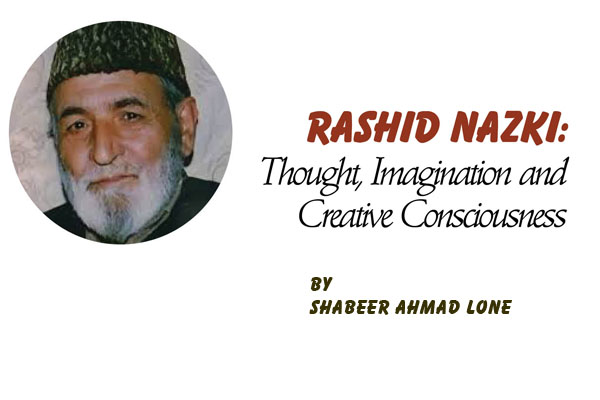
Shabeer Ahmad Lone

Beneath the dome of His majesty, men reside,
Hunting angels, snaring prophets, capturing the Divine.

“Within the vast wilderness of my frenzied passion, Gabriel is but a lowly, feeble prey; O manly courage, cast your lasso upon the Divine Himself!”-Allama Iqbal
Human culture, literature, and creative expression constitute a living, dynamic architecture in which thought, style, and reflection continuously intertwine, shaping and reshaping one another. In the oeuvre of Prof. Rashid Nazki, this architecture achieves remarkable coherence, demonstrating that literature emerges not as ornamentation, abstraction, or mere aesthetic play but as a morally, spiritually, and socially responsive act. His work refuses the temptation of transient intellectual fashions-modernist experimentation, radical political abstraction, or postmodern relativism-and instead pursues a perennial vision in which historical memory, ethical responsibility, and spiritual insight converge with aesthetic and imaginative creativity. In Nazki’s hands, the act of creation bridges lived experience with universal human concerns, intertwining local specificity with cosmopolitan resonance, and personal reflection with communal memory. Creativity, in this sense, is simultaneously ethical, cultural, psychological, and spiritual, its depth inseparable from the moral and existential stakes of human life.
Nazki situates himself within a universal lineage of literary and ethical thought: Homer, Dante, Shakespeare, Hafiz, Khayyam, Kalidasa, Rumi, Iqbal, and Jami. Like them, his poetry flows from concrete lived experience into reflection and universalization. The ethical audacity of Rumi, the existential courage of Iqbal, and the mystical and ethical insistence of Jami find intimate, localized embodiment in Nazki’s Kashmiri context. When Iqbal exhorts humanity to “cast your lasso upon the Divine Himself,” Nazki renders this audacity existentially tangible: confronting suffering, historical rupture, and ethical responsibility in the immediate realities of Kashmir, he demonstrates that courage, reflection, and creativity are inseparable from engagement with life’s profoundest mysteries. Literature becomes an ethical act, a vehicle for communal consciousness, and a bridge between temporal and eternal concerns.
His thought emerges at the intersection of history, psychology, social reality, and mysticism. Modernity, in the Freudian sense, mourns the unrealized promises of reason and human progress; postmodernity emerges as cultural processing of this melancholia, producing fragmentation, multiplicity, and provisionality. Against this backdrop, Nazki’s perennialism asserts that truth, justice, moral courage, and ethical discernment endure, though their application must be sensitive to the complexities of historical and social context. His Kashmiri poetry, especially in Vahrath, demonstrates this integration:
“Acher Awazi Garan Kaech Shabeeh
Preth shabihas zabaan bayan tanha
Tath shaharas az te narus gul folan
Khabri cha vead nazri hind yaven golab
Naz parverdeh chukhneh kham khanuk
Hoshi roostoi be kos sharab dimie
Bael vana chokh hato be chos tanha
Saeth chee saseh baed sehra.”
Letters cast their radiant reflections,
speaking truths the lips cannot hold.
From the city’s fires, unseen roses rise-
delicate, resilient.
Khabr whispers; Nazr gathers their hidden bloom.
Without awakened consciousness,
who tastes the soul’s ecstatic wine?
Do not name my solitude:
thousands of deserts walk with me-
each emptiness a sacred path,
where absence turns to grace.
Letters shape their own radiant reflection, speaking truths beyond words. Across Sanskrit Shabda, Arabic Kalam, Chinese calligraphy, and Western mystical poetry, language functions as shabeeh-a mirroring that carries moral, spiritual, psychological, and historical meaning rather than mere information.
From the fires of the city, flowers rise-resilient beauty born of trial. This alchemy echoes Sufi transformation and the philosophies of history articulated by Ibn Khaldun, Vico, Spengler, Toynbee, Sorokin, Hegel, Marx, Plato, and Gibbon, for whom crisis is a condition of renewal. Stoic ethics, Buddhist dukkha, and Sufi suluk likewise affirm growth through hardship.
Within this vision, Khabr (subtle insight) and Nazr (contemplative gaze) operate together, resonating with Buddhist mindfulness, Christian contemplative sight, and Taoist awareness. Without awakened consciousness, ethical discernment and historical understanding remain inaccessible.
Sharab, the ecstatic elixir, names this awakening-known across ritual, art, meditation, poetry, and states of creative flow-deepening empathy and social responsibility.
“Thousands of deserts accompany me” redefines solitude. From prophetic journeys (Moses, Muhammad) (pbut) to Christian monasticism and Stoic retreat, deserts mark thresholds of illumination. Socially they signify displacement; psychologically, inner voids-yet never emptiness, but landscapes where isolation ripens into insight and hardship into moral clarity.
Rooted in Kashmiri experience yet universally resonant, the verse unites mystical union, psychological awakening, historical consciousness, and ethical responsibility, calling for radical attentiveness to perceive the unseen and find beauty amid crisis as a shared human task.
Style in Nazki’s poetry is inseparable from thought and ethical reflection. Language, rhythm, silence, and imagery are not ornament but instruments for ethical discernment, spiritual illumination, and historical awareness. In his depiction of the Haft Khaneh, the Seven Abodes of consciousness:
“Keate haftkhaneh cheteth chai banith yeth vaches
Shiv zan vare rotom Parvatee seenas saeth
Gindon aabus te aatish peyou jahanas
Sarooruk noor peyou Ayean khanus.”
How many of the seven abodes of consciousness are truly built within the heart? When I beheld Shiva embraced by Parvati, water and fire-symbols of purification, trial, and transformation-danced across the universe, and the radiant light of the Absolute illuminated the innermost sanctuary of being.
How many of the seven abodes of consciousness can one truly build within the heart?When I beheld Shiva in embrace with Parvati-like the Taoist yin and yang in perfect harmony, or Isis and Osiris entwined in the cycles of creation-water and fire, symbols of purification, trial, and transformation, began to dance across the universe.The radiant light of the Absolute-like the Atman of Vedanta, the Ein Sof of Kabbalah, or the luminous stillness that Rumi, Laozi, and Meister Eckhart speak of-illuminated the innermost sanctuary of being.
Shiv and Parvatee dwell in the human heart, symbolizing the union of power and compassion, destruction and creation, asceticism and nurturance. Fire and water-the transformative gindon aabus and aatish-represent purification, trial, and ethical-spiritual growth. Divine or ethical light (nooruk saroor) illuminates the reflective chamber of consciousness, making moral, psychological, and mystical insight perceivable. Consciousness itself becomes a living architecture, ethically and spiritually embodied.
Achchrus Achchrus soorat daej / Harfas harfas
lani hajr
Khuda zanaan zi kati full yousfistaan / Zulikha
vare voshlon Aasmanas
Every word bends beneath destiny, each letter trembles with separation. Yousuf’s hidden garden embodies truth and divine insight; Zulaikha’s restless pursuit traces the soul’s striving. Across Sufi mysticism, existential philosophy, psychology, and literary traditions-from Rumi, Iqbal, and Jami to Greek myths, Shakespeare, and Romanticism-Nazki’s trembling letters and curving words mirror consciousness, longing, and moral awareness. Language becomes an ethical, mystical, and socially resonant act, uniting the temporal with the eternal, the personal with the universal.
Historical and existential suffering, moral responsibility, and mystical illumination converge in Nazki’s portrayal of universal trials:
“Jani Isa, salaib, karb o bala
Preth akha chee saraan saraan tanha,
Mean paethin agr wajood labakh
Zoon kyah kath chie aaftab dimie
Daeeg gov nooraneh sahruk shaam peo
aasmaneh waes
Royeh nazus peth gindaan yelle kookli
pehchan voth.”
From Karbobala to the crucifixion, suffering is simultaneously particular and universal. Partial illumination-the moon-becomes fullness-the sun-through conscious, ethical, and mystical engagement. Darkness, vulnerability, and historical trauma are transformed into insight, demonstrating Sufi existentialism and ethical awareness: suffering is both test and teacher, personal and collective, ephemeral and eternal.
Truth emerges delicately amid upheaval:
“Lach qayamtch te karb o bala
Noozkan parde thoov izharun
Naeun karamath sarem sahr waqten
Paez haqqiqat wochim khabeak paeth
Bus Khuda yaar etibar kaeriv.”
Cataclysmic trials, veiled insight, and early dawn symbolize the fragile, provisional nature of human perception. Reliance on the Divine sustains courage, moral clarity, and creative agency. Mystical illumination, historical consciousness, existential reflection, and cultural specificity converge: insight is accessed through patience, trust, and ethical engagement.
Postmodern perspectives-Saussure’s structural linguistics, Barthes’ intertextuality, Derrida’s decentering, Bakhtin’s dialogism-illuminate the socially and historically situated nature of meaning. Yet Nazki integrates multiplicity with moral and spiritual clarity rather than relativistic drift.
“Vate peth pruchnum beyeh tem maet
Chaane khamooshi kathun pun heove tulaan
Bay zabani meaani hath izhaar raech.”
Lit.Trns:On the path, the dervish asks again how distant the world is.
Silence answers-weightier than speech.
What I cannot voice blossoms into countless truths, each echoing the unspoken depth of being.
On life’s path, the restless seeker/dervash, reflective philosopher, like Sufi mystics, Rumi, Ibn Arabi, or poets such as Rilke and Agha Shahid Ali-asks, “From here, how far is the world?” Not in miles, but in meaning, in connection, in consciousness. Silence answers, weightier than speech, yet in voicelessness a hundred truths bloom, luminous with insight. The human spirit is nourished not by words, but by stillness, reflection, and the courage to dwell in the spaces between them, where longing, beauty, and understanding converge.
Multiplicity and ambiguity coexist with moral attentiveness.Even amid provisionality, ambiguity, and historical flux, ethical and mystical vision persists. This inward vigilance culminates in Ehsaas
Ehsaas:
Thass Thass
Kos choo
Yeth basti manz thas chona jayiz
Yati cho shahun hind pardi chenaan
Koos vatheh kemi sar mushkith aamut
Yeti chi kathan hinz chadr vonaan
Absith apzeov
Koos cho
Yeti che malaamath dobh, dobh، dobh,dobh
Kos cho
Chenun vaele chi radaro saeth
Niyeth chenaan
Kos cho Kos cho
Hamud…khudaya kahn chona
Shayid boey chos(Ehsaas)
Trans.Knock, Knock
Who waits at the threshold of silence?
Here, within these shadowed precincts, even
a knock is forbidden.
Every gesture is weighed,
Every breath measured,
Every flicker of life traced by unseen eyes.
Stories unravel quietly,
Talks fold into themselves,
Truths hidden, woven into the fabric of lies.
The heartbeat stammers dobh… dobh… dobh…
A body constrained, yet insistently alive.
Eyes pierce the unseen,
Scanning intentions, tracing thoughts,
Measuring the pulse of consciousness itself,
As if the self must justify its being.
Hamud… Khudaya… none is.
No voice answers.
No echo reaches back.
And in that absence,
Amid all observation and silence,
I recognize myself.
Perhaps… it is I.
(Ehsaas)
“Knock… Knock…Who waits at the threshold
of silence? Perhaps… it is I.”
The poem unfolds at the threshold of silence, where a simple knock becomes a profound inquiry into being itself: Who may appear, who may speak, who may be recognized? The repeated “Kos cho?” turns the question inward, dissolving the boundary between the observer and the self, echoing the philosophical tradition of self-examination from Plato to modern reflections on identity, conscience, and responsibility.
Historically and socially, the poem reflects conditions shaped by vigilance, moral regulation, and collective unease, where gestures, breath, and intention are weighed. The faltering heartbeat-dobh… dobh…-captures the psychology of constrained life, revealing how external pressure becomes internal discipline. Silence here is not absence but a charged medium in which truth survives by retreating, waiting for discernment rather than declaration.
The invocation “Hamud… Khudaya…” opens a mystical horizon rooted in Sufi and apophatic traditions, where the divine is encountered not through assertion but through withdrawal. The unanswered call redirects the seeker from outward authority to inward awareness, suggesting that ultimate recognition arises within consciousness itself.
Psychologically, the poem culminates in Ehsaas-an awakening where the self becomes both witness and conscience. Solitude is transformed from isolation into insight; fear gives way to ethical clarity. In this convergence of silence, reflection, and recognition, literature emerges as a moral and spiritual act-where attention becomes responsibility, presence becomes resistance to numbness, and consciousness itself is revealed as the ground of human dignity and shared meaning.
Through the Haft Khaneh, Ehsaas, and interweaving of Karbala, Isa, Shiv-Parvatee, and elemental imagery, Nazki creates a symphonic integration of the ethical, mystical, historical, existential, and cultural. Every word, sound, metaphor, and verse is charged with conscious engagement, moral reflection, historical resonance, and spiritual insight. Solitude, suffering, historical memory, and mystical experience are interwoven into the architecture of collective consciousness, connecting local Kashmiri experience to universal human concerns.
Rashid Nazki’s Vahrath also mirrors tapestry of Consciousness, Resilience, and Spiritual Vision.
Rashid Nazki’s Vahrath unfolds a luminous architecture of human resilience, where mystical insight, ethical consciousness, and social awareness converge. From gardens to deserts, from cage to cage, every line alchemizes limitation, suffering, and compulsion into awakening, reflection, and moral courage. Its poetic grace transforms personal and collective experience into enduring illumination, guiding the reader toward spiritual insight, ethical engagement, and a profound understanding of existence.
Naz parverdeh chukhneh kham khanuk
Hoshi roostoi be Kos sharab dimie
Tender thoughts bloom in secret chambers;
without awakened consciousness, no true
spiritual ecstasy offered.
Chi Gulro sade lovhan vade thavaan
Em saeth rung khoot preth dastaanus
Faithful to the innocent heart, every tale bursts
into radiant life.
Wuchh tha chashman hanz vahrath
tarakh nab heth bon vetch raath
You beheld the eyes’ Vahrath as the star-strewn
night fell upon hushed earth.
Mean pathin agr wajood labakh
Zoon kyah Kath chie aaftab dimie
Experience Being as I do, and the moon pales;
I offer the blazing sun.
Sahra Sahra koos mangi treash
Pannoie dil chum zum zum
Desert after desert, I sought hidden traces;
my heart drinks murmuring drops like secret streams.
Chamun ta Chamun zaal vahrith thook
Qafs ta qafs aes chi Maazoor haz
From garden to garden, snares lie in wait;
from cage to cage, we wander, powerless yet aware.
Jawaan khoon, asmat te biye kya neh diyut
Khuda sabeh bas yee chu maqdoor haz
Youth’s blood, honor, innocence-fate measures
all; only God knows the scale.
Wanov kyah aes chi majboor haz
Zameen taeng gy aasman door haz
Compelled we are; earth contracts, heaven recedes.
Temis rukhsat karith oosh qatreh kinh pei
Shameh sholeo muqadus Aastanus
Departure leaves tears down; the evening fire
lights the sacred shrine.
Faresh Lalwaan chu miyaani khoonech dug
Arsh gulnaar, Aetibar Kariv
Earth cradles my blood’s pain; heavens blaze,
demanding trust and witness.
Achen Manz vouch vothun hinz lash shoolan
Nazr mahrum te chandaan naav bavath
Within, eyes perceive lifeless lips; vision longs
for expression.
Vojooduk Un wates mehshr Vonull Ghaen
Hayaatuk yup te Adum Khav Bavath
Being clings to hidden abodes; life rises
and falls, consuming itself in expression.
Lach qayamtch te karb o bala
Noozkan parde thoov izharun
Countless cataclysms and Karbala-like trials
veil tender truths, awaiting awakening.
Hamidi Kashmiri perceives in preface of “Vahraath” (titled Rashid Nazk-Akh Poshwun p,7-18 /The Blossoming Forest)of collection that ,an aesthetic vision of life forms the essence of Rashid Nazki’s poetic being. His inner depth and authentic sincerity give his poetry its emotional force, as he rejects commissioned verse, performative social consciousness, and compromise of the self. Writing in full intellectual freedom, he confronts the world with honesty, unbound by transient fashions. Poetry that merely arranges social awareness forfeits its truth. Nazki did not become a poet-he is one by essence-and the luminous sincerity of his verse is his enduring legacy, a spring of true wealth in the garden of imagination:
Gulrokhan saeth Akh damah roozith
Proon Auden Khumar Pherith Aaw
Tim thaeve royus moyik thaher
Hang mung go mandiyun shaam
Roy chous fulwon azluk noor
Moi chous rangeen ghazluk shaam
One can immerse here, in the enduring enigmas
of ancient mystical wisdom , rendered in a
contemporary voice
Bu sar-e hayattuk qulzumah, ari vari che ciyah posh
Bombra vothoos bael gind n’e chihik paeth
barem rath
Vomraten kor chashman zool
kaanh kaanh satha’h go maqbool
Husn-e beparwa’e loelus iztirab
nyaye chehn’e ka’e bord tala anzrav to
Shabnamuk qatre kend hangus peath choos
Jalwa diyouth thum me aaftabek paeth
Chha’we roudim kathn hind’e posha won
ho’we roodim athen hind’e aftab
He immerses in his aesthetic and spiritual ecstasy, where the soul’s rapture, worldly awareness, and existential aliveness converge, transforming perception into a luminous interplay of beauty, consciousness, and the infinite.
His mastery extends to a rich synthesis of Urdu and Persian expressions-Sarwocharagaan, darya-i-muheet, qaaf ta qaaf, murg baad numaan, yader rikaab, gull andaam, yazdaan wa ahermun, sanum gari-and to intricate metaphorical constructs-kale sar, subhuk naag, soor phul fizhus, harfarchi haangni, echer ambr, gashi choor, rang wal janawaar, poshi saler, raqsi rouf, gulael yawon, mushke sar, parde dug, maswel gazel. His language is never ornamental; it is a deliberate architecture of layered imagery, symbolic depth, and aesthetic sophistication that defines his singular poetic universe.
Asra: The Masnavi of Mirāj, in Asra, Rashid Nazki renders the Mirāj as a celestial and inward journey, where the Prophet’s ascent mirrors the soul’s quest for the Divine. Merging Kashmiri poetic idiom with Qur’anic symbolism and profound mystical insight, he illuminates the unity of cosmos and consciousness, knowledge and gnosis, the temporal and the eternal. Each line invites meditation, dissolving ordinary perception and opening a contemplative space where aesthetic, spiritual, and philosophical dimensions converge, transforming the Masnavi into a passage to the infinite.
In Vahrat- Nazki presents a poetic and metaphysical narration of the Mirāj, from commencement to culmination, blending Kashmiri poetic diction with Qur’anic symbolism and mystical insight:
Arsha ki raaz kiya karo ghouga
Paneh rub yeth wanan chhu ma awha
Gasheh Ambr Ratin Athan andar
Chha yiwan yuth safar kathun andar
Arsh o kursi ta āsmān o zamīn.
Wird khwān ism-e Ahmadak imshab.
Chun gul rukh chhu bulbulan awraad
Seyud Woh thakh thoud te kham gachun shamshad
Haertuk waqt ilm o irfanus
Fatadalla khumar wijdanus
Harfrostoy kalam goyo paeda
Abd o mabood akh akis shaida
Izn waqtus sapun zi khoar thehrav
Preth maqanus vonukh zi Gardish band
Prath nuzoolas wunukh saooduk ser
Prath batounas wunukh sapun zahir
Khabar aao wuni nazar hend gul chhav
Nazri aao wuni had-o-lahad terav
Amr-e-haq chhu darood daalih aniv
Shesh jahtan sapun kunoie yaksaan
Achh wozis manz ghaab gaye aasman
Nindar zan vouth zameer kun fayakoon
Az azal ta abad kunie jesiehoon.
Mukhtasar waeat ghayatul al-quṣwa
Did man wachukh ayat al-kubrā
Nazukas tēr bakht qismat chum
Akh chhuha zan, sa’ādatak imshab.
In this essential synthesis, Rashid Nazki constructs a living architecture where thought, imagination, and creative consciousness converge with ethical, mystical, historical, social and existential awareness. Literature becomes simultaneously personal, social, and spiritual; ephemeral yet eternal; local yet universal. Through awareness, courage, and reflection, human life-though fraught with suffering, ambiguity, and isolation-attains moral clarity, spiritual illumination, and transformative engagement. Creativity, consciousness, and ethical responsibility are inseparable: Nazki’s vision affirms the capacity of literature to preserve memory, illuminate insight, cultivate moral imagination, and sustain hope across generations and cultures.
The author can be reached at shabirahmed.lone003@gmail.com

