

–
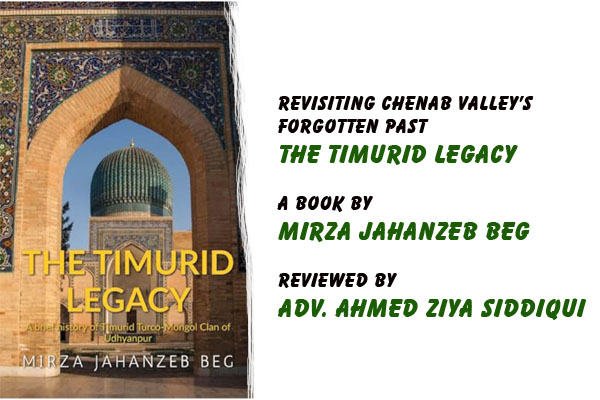
In the historical imagination of Kashmir, certain regions often dominate the spotlight, while others remain on the margins, their stories passed down in fragments or not at all. The Chenab Valley is one such overlooked region. In The Timurid Legacy, Dr. Mirza Jahanzeb Beg attempts an ambitious and timely intervention. What begins as an exploration of his ancestral lineage, the Mirza Begs of Udhyanpur, soon expands into something much more vital: a rare, rigorous attempt to document the complex sociopolitical, spiritual, and cultural histories of the Chenab Valley. The Timurid Legacy stands out as one of the few serious scholarly efforts to archive the region’s past through credible and carefully sourced references. In an era where oral traditions face the threat of erasure, Dr. Beg’s work assumes archival urgency. It is a painstaking project, the result of years of combing through rare books, Persian and Urdu manuscripts, Important Oral anecdotes and forgotten historical literature. The author’s commitment to substantiating oral narratives with documented material elevates the book from personal memoir to regional historiography. In this sense, The Timurid Legacy becomes not just a story about the Mirza Begs but a foundational text in the historical literature of the Chenab Valley. It captures a lineage, yes, but more importantly, it preserves an entire region’s memory, threading together themes of power, spirituality, resistance, and cultural evolution. That Dr. Beg has managed this while maintaining scholarly discipline marks the work as both a labour of love and a vital cultural document. Adding further depth to the work is the author’s rare positioning, he is both a trained academic and a spiritual inheritor. Having received Khilāfat and Ijāzat in the Qādiriyyah Sufi order, Dr. Beg represents a tradition of scholar-mystics now nearly vanished. His writing is informed not just by academic method, but by lived spiritual heritage, allowing him to interpret the region’s mystical history with rare insight and legitimacy.
The book opens with Udhyanpur, a village often excluded from mainstream historical narratives. Yet as the author shows, it was once a militarily strategic and politically significant settlement. With its fortified homes, fertile orchards, and proximity to trade and military routes, Udhyanpur became the seat of the Mirza Begs, descendants of Timur and the Mughals, who carved a space for themselves within the matrix of Dogra administration and local Rajwaras. The book profiles several notable historical figures from the clan, among them, Mirza Rusul Beg, who fought alongside General Zorawar Singh in military campaigns that extended to Ladakh, Baltistan, and even Tibet. Mirza Amirullah Beg is remembered for his contributions to local governance and justice, while Mirza Zorawar Beg earned literary acclaim, receiving a poetic tribute from the renowned 19th centure Kashmiri romantic poet Rasul Mir, often referred to as the “John Keats of Kashmir,” who composed a Qasida in his honour. It is almost unimaginable today that warriors from this modest village once marched across formidable terrains, conquering regions such as Ladakh, Gilgit, and Baltistan, and pushing the frontiers of battle into the highlands of Tibet. These accounts are not framed through the lens of ancestral pride alone; rather, they are contextualised as part of the wider geopolitical history of the region, connecting local stories to larger imperial shifts.
The second half of the book marks a clear pivot from politics to mysticism, capturing the spiritual life of the Chenab Valley with equal depth. The narrative turns to the towering figures of Hazrat Shah Fareed ud Din Baghdadi (RA), a descendant of Sheikh Abdul Qadir Jeelani, and Hazrat Shah Asrar ud Din Baghdadi (RA), both of whom continue to be venerated across the region. Their teachings, influence, and miraculous deeds form the spiritual spine of the book. Dr. Beg recounts tales and miracles attributed to these saints that have lived on in regional memory, told not to provoke belief, but to illustrate the power of symbolism, devotion, and communal narrative. These are stories that resist reduction into binary categories of fact or fiction. Instead, they exist in the space where myth and memory meet, shaping the moral and metaphysical frameworks of those who carry them forward. The author’s approach here is marked by balance. While the tone is reverential, it avoids sensationalism. Instead, it acknowledges the sociological significance of such narratives, treating them as living traditions rather than historical curiosities. A particularly valuable contribution is the detailed accounts of various families and clans of Chenab Valley region. There are mentions of Historical figures, important personalities and families of the region, e.g. the Qasimiya family of Kishtwar, descendants of Hafiz Abul Qasim, a scholar and Qazi from the lineage of famous Sufi Master Shehab ud Din Soharwardi, who migrated during the Mughal period. The author includes accounts from the historical manuscripts like Gulshan-e-Asrar and Rozatul Arifeen, texts rich in mystical imagery and anecdote. These chapters help position Chenab Valley not merely as a site of forgotten royalty, but as a crucible of Islamic scholarship and Sufi transmission.
Woven into the historical accounts are moments of personal reflection—particularly around the impact of post-independence land reforms, which saw many once-prominent families, including the Mirza Begs, lose their estates and positions. Dr. Beg does not offer this as grievance, but as meditation: a reminder of the shifting nature of power, and the need to preserve heritage beyond material status. The Timurid Legacy is a rare kind of book. It resists academic detachment without sacrificing scholarly rigour. It presents oral history with care, while backing it with documented sources. And perhaps most importantly, it does justice to a region long left out of the historical record. For historians, cultural scholars, and general readers interested in subaltern regions, Sufism, and forgotten dynasties, this book offers a deeply informed and emotionally resonant journey through a past that still quietly shapes the present. In rescuing the memory of Udhyanpur and its people, Dr. Mirza Jahanzeb Beg has made a valuable and enduring contribution, not just to regional history, but to the broader tapestry of Kashmir’s plural heritage.
(The writer, Adv. Ahmed Ziya Siddiqui, is an advocate at the High Court of Jammu & Kashmir and can be reached at aziyasiddiqui@gmail.com.)

