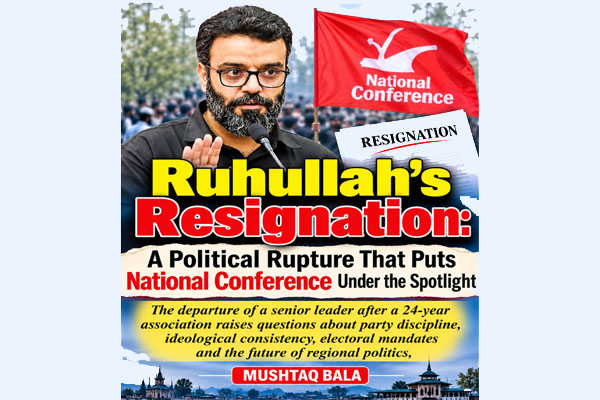
The departure of a senior leader after a 24-year association raises questions about party discipline, ideological consistency, electoral mandates and the future of regional politics, MUSHTAQ BALA
Mushtaq Bala
The resignation of Aga Syed Ruhullah Mehdi from the National Conference and his announcement to relinquish the Srinagar parliamentary seat mark an important moment in Jammu and Kashmir’s evolving political landscape. It is not merely the departure of an individual leader from a political organisation; it represents the culmination of a prolonged disagreement within a party that has historically occupied a central position in Kashmir’s political narrative.
uhullah’s decision, announced at a public gathering in Budgam on November 3, has brought to the surface differences that had been developing for over a year. His disagreements with the party leadership, particularly Chief Minister Omar Abdullah, revolved around the restoration of Article 370, statehood, reservation policy and what he describes as the National Conference’s failure to honour its electoral commitments.
These are serious questions, and they deserve public scrutiny. However, the circumstances surrounding his departure also invite a larger examination of political responsibility, party loyalty and the nature of democratic representation.
The National Conference is not an organisation that can be understood merely through the political fortunes of one individual. It has a history extending across generations, a distinct political identity and a substantial organisational base. Its leadership, workers and supporters have remained part of Jammu and Kashmir’s political journey through changing circumstances, difficult periods and successive electoral contests.
The party’s position must therefore be examined in the context of the responsibilities that accompany governance. Winning an election and running a government are two different exercises. A political organisation may retain its ideological commitments while also having to navigate constitutional realities, institutional limitations and the practical demands of administration.
This distinction is particularly important in the present circumstances. The restoration of Article 370 remains a deeply contested political issue, while restoration of statehood has emerged as an immediate constitutional and administrative demand. The National Conference leadership has maintained that it continues to pursue the restoration of statehood and has raised the question of Jammu and Kashmir’s constitutional position through democratic and institutional forums.
Whether its approach has met public expectations is a legitimate matter of debate. But political differences cannot automatically be equated with an abandonment of an entire political legacy.
Ruhullah, meanwhile, has chosen to interpret the party’s approach as a departure from its ideological commitments. In his resignation letter, he expressed disappointment over what he considers an alteration of the political direction promised during the 2024 elections. He also argued that the party had failed to sustain the struggle for the restoration of constitutional rights.
His concerns cannot simply be dismissed. A representative elected with a public mandate has every right to question the leadership of his organisation. Equally, a political party has the right to defend its decisions, explain its constraints and expect collective responsibility from its elected representatives.
The question, however, is whether the differences could have been addressed through continued dialogue rather than culminating in a complete political separation.
Ruhullah’s association with the National Conference spans approximately 24 years. He entered electoral politics under the party’s banner, represented Budgam in the Assembly for three consecutive terms and subsequently secured the Srinagar parliamentary constituency in the 2024 Lok Sabha elections.
That political journey was not an individual exercise alone. It was also connected with the organisation, its electoral machinery and the support of its workers.
The question of the parliamentary seat is therefore significant. Ruhullah has indicated that he would rather relinquish the seat than continue representing the party under circumstances he considers inconsistent with his convictions. That is a political choice he has made, but it also returns the debate to the electorate, whose mandate must remain central to democratic politics.
The National Conference, for its part, has reacted sharply to his departure. Its criticism reflects the leadership’s dissatisfaction with the manner in which the separation has unfolded. Yet, the language exchanged between the two sides should not become the defining feature of this episode. Kashmir’s political discourse needs arguments, explanations and accountability more than personal accusations.
There is another dimension that deserves attention. The National Conference today carries the responsibility of governing Jammu and Kashmir at a particularly challenging juncture. Expectations regarding employment, development, restoration of statehood, reservation reforms and administrative accountability remain substantial.
The government cannot afford to let internal political disagreements overshadow these responsibilities. Nor can the party leadership expect that questions raised by its own elected representatives will disappear through organisational criticism.
At the same time, political dissent must also be accompanied by clarity about the alternative being proposed. Ruhullah has spoken about the need for a different political approach and has indicated that he is exploring possibilities for bringing together people who share his convictions. Whether this eventually takes the shape of a new political platform or another form of public engagement remains to be seen.
Kashmir has witnessed several political experiments in the past. Their success or failure has ultimately depended on public confidence, organisational credibility and the ability to translate political rhetoric into meaningful action.
For the National Conference, the immediate challenge is to demonstrate that its political identity remains intact despite the departure of a prominent leader. Its strength will be measured not by the intensity of its response to dissent but by its ability to remain connected with the people, address legitimate grievances and deliver on the commitments made to voters.
For Ruhullah, the challenge is equally considerable. Leaving an established political organisation is one thing; building a credible alternative and sustaining public confidence is another.
Ultimately, this episode should not be reduced to a contest of personalities. It is a test of political institutions, leadership accountability and democratic maturity.
The National Conference has a responsibility to explain its political course, while Ruhullah has a responsibility to explain the path he intends to pursue after relinquishing the platform that brought him to Parliament.
The people of Jammu and Kashmir have heard enough political declarations over the years. What they deserve now is a politics that is consistent, accountable and capable of delivering results.
In the final analysis, neither a party’s historical legacy nor an individual leader’s personal conviction can substitute for public trust. That trust must be earned continuously.
Mushtaq Bala is Editor-in-Chief of Kashmir Pen, an award-winning filmmaker, cultural commentator, and advocate for peace through narrative media.