

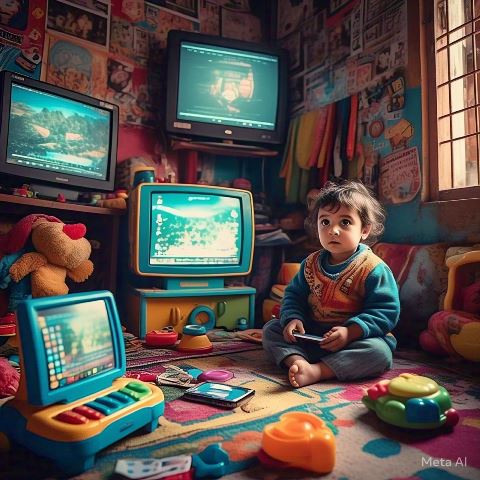
Kashmir used to be full of life. The fields, the streets, the orchards—all alive with the sound of children. Running, laughing, shouting. The world was wide, and it seemed like anything was possible. But today, you don’t hear that. Not like before.
Instead, you see them. The children. Their heads down, faces lit by the soft glow of their phones. Their fingers moving, scrolling, swiping. Eyes locked on games and apps. No one seems to notice it, but the sound of life in the streets is fading. The games that used to echo through the lanes—Chhupan Chhupai, Kun Ghar, and the rest—are disappearing. The kids don’t play them anymore. They’re too busy with their screens.
I saw it myself, a few weeks ago, at my friend’s house. His son, maybe ten, hunched over his phone, his fingers moving in a rhythm I couldn’t follow. I called out to him. “Come outside,” I said. “Play for a bit. The sun’s still up.” He didn’t respond at first. I could hear the soft hum of the phone, like it was the only thing in the room. When he finally looked up, it was brief. A quick glance, then back to the phone.
I tried again. “Come on. Let’s play something. We can go to the field.” But he didn’t move. His face lit up by the screen again. A soft click of the buttons. A sound of indifference. I realized, then, that he didn’t know how to play anymore. At least, not the way we did.
Children used to be everywhere. You couldn’t go anywhere in Kashmir without hearing their voices, their laughter. But today, they’re inside, glued to their phones. The world outside? It doesn’t matter anymore. They’re not running through the orchards, kicking footballs in the alleyways. They’re not talking to their friends in person. They don’t even need to.
It’s hard to admit, but it’s happening. Slowly, but it’s happening. The playgrounds are quieter now. The parks are empty. The air is still, when it used to be filled with energy.
We’ve all heard the talk—phones aren’t bad, a little screen time here and there is fine, right? But it’s not just a little anymore. It’s too much. Hours a day. And it’s taking something away.
I thought about it. We didn’t have screens when we were kids. We had fields and trees, and the dirt beneath our feet. We made up our own games, our own rules. It wasn’t about what an app told us to do. It was about what we wanted to do. We didn’t need much. A ball, a bat, maybe a few friends. But we created memories—real ones, the kind you don’t forget.
Now, all that’s left is a screen. The games, they’re not the same. The world is smaller on a screen. Everything is controlled, pre-packaged, ready-made. The imagination that once flowed freely is now boxed in, trapped behind the limitations of an app.
And it’s not just the creativity that’s slipping away. The kids aren’t outside, not enough anyway. They don’t run like we did. They don’t climb trees, don’t chase each other through the fields. They sit. Their bodies still, their fingers moving.
And it shows. They’re growing weaker. Obesity is becoming a real problem in Kashmir, something you didn’t see before. These kids aren’t moving, not in the way they should. They’re not building strength, not learning how to endure. They’re not learning resilience, either. They’re learning how to tap a screen.
The social skills that came with playing, with talking to each other face-to-face, are being replaced by text messages and emojis. There’s no real connection. No real eye contact. The laughter, the banter—gone. All replaced by hollow interactions in the digital world.
Parents think they’re protecting their kids. “It’s safer,” they say. “They’re indoors, not outside in the streets where there’s danger.” They’re missing something. Safety isn’t the whole picture. Safety is just one part of it. What about everything else? What about the joy of running down the street with friends? What about feeling the wind in your hair, the sun on your face? What about learning how to lose and get back up again?
Parents don’t see it. I hear them say, “At least they’re safe inside.” But is that all? Is that enough? What about the childhood that’s slipping away? What about the experience of being outside, of touching the world?
The trees, the rivers, the mountains—they’re all still here. Waiting. But the kids don’t see them. They’re lost in the glow of a screen. Their childhood is slipping by, unnoticed.
You can try to talk to them, but they won’t hear you. Not really. They’re too caught up in the world that’s in their hand. And it’s hard to blame them. It’s everywhere. It’s hard not to get sucked in. But when you realize what’s happening, you want to stop it. You want to pull them away from the screen and show them what they’re missing. You want to tell them, “There’s a whole world out here. A real one.”
It’s not too late, though. It’s never too late. There’s still time to bring it back. We can’t erase screens from their lives, but we can balance it. We can take back the outdoors. We can teach them how to play again. We can set rules. “No screens on weekends,” or “Let’s go for a walk after school.” We can bring back the parks, the playgrounds, the fields. We can make time for real play, for real connection.
Imagine a Kashmir where screens go dark for a day, just once a week. A day where kids play outside, where the laughter rings through the streets again. A day when the world beyond the screen matters again. It’s possible. It’s simple. It’s just about making a choice.
The digital world isn’t going away. It’s not. But it shouldn’t replace everything else. Kashmir’s beauty, its fields, its rivers—they’re still here. We can remind the kids of what’s out there. We can show them the world they’re missing.
We can bring childhood back. It’s not too late.
—
Author Bio
Gowher Majeed Bhat is a writer and educator from Kashmir. He writes about everyday life and the small moments that shape us.

