

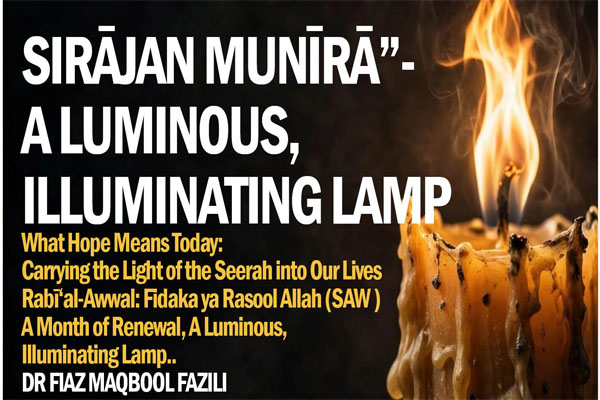
What Hope Means Today: Carrying the Light of the Seerah into Our Lives
Rabī‘al-Awwal: Fidaka ya Rasool Allah”SAW A Month of Renewal,
A Luminous, Illuminating Lamp..DR FIAZ MAQBOOL FAZILI
Dr.Fiaz MAQBOOL FAZILI
Rabī‘ al-Awwal turns Muslim hearts toward the life, mission, and character of Prophet Muhammad saw, a Messenger who led humanity from darkness toward light.Fidaka ya Rasool Allah”is an Arabic phrase meaning “May my life, soul, or parents be sacrificed for you, O Messenger of Allah”. It expresses profound love, deep devotion, and ultimate loyalty to Prophet Muhammad (saw).Authentic traditions tell us that the Messenger of Allah saw was born on a Monday. The deeper lesson is not to let debate about a date overshadow the Messenger whose arrival transformed human history.The greater question is not simply, Why was he sent but what have we done with the light he brought?
The Prophet saw described by the Lord of universe Himself in QuranCh Ahzab, Sirājan Munīrā”—a luminous, illuminating lamp for every darkness . The Qur’an describes the mission of Prophet Muhammad saw in powerful words: “Yaaa aiyuhan Nabiyyu innaaa arsalnaaka shaahidanw wa mubashshiranw wa nazeeraa,Wa daa’iyan ilal laahi bi iznihee wa siraajam muneeraa.) O Prophet! Indeed, we have sent you as a witness, a bearer of glad tidings, and a warner; and as one who calls to Allah by His permission and as a luminous, illuminating lamp.”- (Quran) . The image is profound: a lamp is needed where there is darkness. The Prophet saw was sent into a world burdened by ignorance, injustice, cruelty, division, and moral confusion. His message called humanity toward the light of divine guidance. Yet darkness does not belong only to the past. It can exist in modern cities, brightly lit homes, and conversations behind glowing screens. It appears when dignity is destroyed, when people are mocked, when accusations are forwarded without verification, when difference becomes hatred, and when forgiveness seems almost impossible. Our streets may have electricity, but our hearts can still grow dark. Our phones may carry the world’s knowledge, while our societies remain short of wisdom. We may discuss religion endlessly while becoming impatient with one another. We may send thousands of salutations upon the Prophet saw while failing to let his character transform our own.There can be darkness in modern cities, in brightly lit homes and behind glowing screens. There can be darkness in our words, our relationships and our public conversations. There can be darkness when dignity is destroyed, when people are mocked, when accusations are forwarded without verification, when differences become hatred and when forgiveness becomes almost impossible.
Taking the Seerah as a living transforming force and urgently relevant because the Prophet saw cannot remain only a subject of speeches, gatherings, and books. His life must become a living force in our homes, workplaces, communities, and public conversations.The Qur’an commands believers to send blessings and peace upon the Messenger saw, but remembrance should naturally lead to imitation: love expressed through character, devotion expressed through conduct, and salawat reflected in mercy, honesty, patience, and humility.This Rabī‘al-Awwal month, we should ask whether remembering the Messenger saw has made us more merciful in our homes, more honest in our work and dealings, more patient in anger and hardship, more humble in achievement, more forgiving in broken relationships, more compassionate toward the weak, poor, and rejected, wiser in disagreement, and more careful in how we speak about others. These questions move the Seerah from history into daily life. Putting prophetic character into society.
To honour the Messenger saw, we must carry his mercy into our homes, his honesty into our workplaces, his justice into our institutions, and his wisdom into our public conversations. We must also bring patience to moments of anger, humility to achievement, compassion to those who are overlooked, forgiveness to strained relationships, and beautiful character to our mu āsharah—our social life and society.In present times, when corruption, immorality, disobedience, and falsehood appear widespread, the Seerah reminds us that reform begins with the heart and then moves into society. The Prophet saw taught truthfulness when lying was common, trust when betrayal was easy, modesty when shamelessness was celebrated, and obedience to Allah when desires ruled people. His life shows that faith is not only worship, but integrity in money, purity in conduct, justice in power, and sincerity in speech. To follow the Seerah today is to resist corruption with honesty, falsehood with truth, and moral decline with Prophetic character.However,true love for the Messenger saw is not only emotion, poetry, or celebration; it is recognition, obedience, and loyalty. The Qur’an makes this clear in different chapters: “If you love Allah, then follow me; Allah will love you and forgive your sins” ,“whoever obeys the Messenger has obeyed Allah” , and that in the Messenger of Allah there is “an excellent example” for those who hope in Allah and the Last Day . Therefore, what love means to me is knowing him, following his Sunnah, and feeling pride in belonging to his way. “Ya Rasool Allah” must become(Atī‘ū Allāh wa atī‘ū ar-rasūl), which appears frequently in the Quran. “I obey Allah and I follow the Messenger. “This is especially important in Kashmir, where pain, uncertainty, loss, and grief have left wounds that economics, and technology alone cannot heal.Our society also needs moral healing: people who can disagree without humiliation, correct without destroying dignity, forgive without weakness, and speak truth without cruelty. The Seerah gives us that moral vocabulary: restraint in anger, humility in knowledge, dignity in disagreement, mercy after mistakes, and respect for every human being.
Hope cannot simply mean waiting for circumstances to improve; it means becoming part of the improvement. In that sense, the Seerah must move beyond the mosque and enter the marketplace, the school, the hospital, the office, and the street. It must shape our behaviour, deepen our tolerance, strengthen our commitment to coexistence, and teach us to honour diversity in faith. Even our messages should carry its spirit—reflected in the words we choose and in the restraint we show before we press “send.””The Messenger saw was not sent merely to be remembered, but to be followed. Rabī‘ al-Awwal, opportune time, when people’s mindset is tuned towards Prophet saw should renew our commitment to read the Seerah as a guide to the people we must become.Let our salawat be joined by helping hands, forgiving hearts, and behaviour that protects the dignity of others.The real question is not only whether we remember the Messenger saw, but whether our remembrance has changed us.It is whether our remembrance has changed us. Rabī‘al-Awwal will pass. Discussions about historical dates may continue. Different views about the precise date of birth may remain.But the central reality remains beyond those discussions: the Messenger saw came with a message of guidance, mercy and transformation.
And when darkness surrounds us, perhaps the greatest tribute we can offer that Lamp is not merely to speak about its arrival, but to carry its light. One softened heart can change a family. One forgiving person can heal a relationship. One truthful voice can restore trust. One merciful teacher can transform a child. One honest worker can influence a workplace. One compassionate neighbour can change a street. One transformed heart can begin illuminating an entire dark alley. That is what hope means today.The Qur’an supports these Seerah lessons clearly. Mercy and gentleness appear in Allah’s words in Quran the translation is like , “It is out of Allah’s mercy that you were lenient with them,” and forgiveness in the command to “pardon them and ask forgiveness for them”. Truthfulness and caution are reflected in the command to verify news before spreading it . Justice and moral excellence are commanded when Allah orders justice, ihsān, and purity, and forbids immorality, wrongdoing, and oppression and the Prophet saw remains the “excellent example” for every age . Obeying Allah and obeying the Messenger are inseparable: obedience brings guidance, mercy, and Paradise, while disobedience brings loss. Our response determines our eternal success.
To remember the Messenger saw is beautiful. To love the Messenger saw is essential. But to put his Seerah into our lives 24×7 is the proof that love and remembrance has reached the heart.May this Rabī‘ al-Awwal take us beyond remembrance towards transformation; beyond argument towards wisdom; beyond harshness towards mercy; beyond division towards reconciliation. May we become people who carry the light we speak about.May this journey take us from darkness to light, from hard hearts to merciful hearts, from noisy arguments to wise words, from ridicule to dignity, from hatred to reconciliation, and from a troubled mu‘āsharah to a society illuminated by Prophetic character. Because when the world grows dark, the greater challenge is not merely to discuss the day on which the Lamp arrived- “Sirājan Munīrā.’ It is to understand, “why the Lamp was sent—and to carry its light into our lives and our surroundings.”
The Author is a Surgeon at Mubarak hospital, Healthcare policy analyst, Certified Professional in Quality improvement in Hospitals can be reached at drfiazfazili@gmail.com
—

