

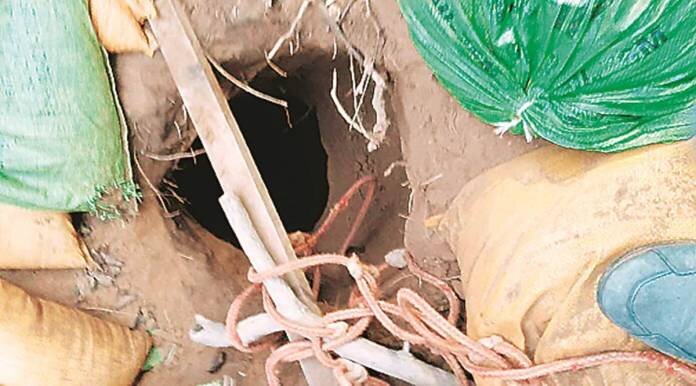
Entrance to tunnel discovered near BSF outpost in Samba sector last week
WHEN security forces tracked a GPS device recovered from the four Jaish Millitants who were shot dead in Jammu’s Nagrota on November 19, they reached a narrow opening that led to a 200m-long tunnel near a forward. BSF post in the Samba sector.
The discovery did not surprise them.
It was the sixth tunnel that the BSF had discovered in the past four years along the Jammu border. And since the first such construction was spotted in the Punjab in 1997, following the Khalistan movement and the start of activism in Kashmir, BSF records show the discovery of at least 12 key cross-border tunnels.
Officers say that with close border surveillance in place now, these tunnels have become a crucial route for militants carrying arms and ammunition to launch attacks in the valley. “Detecting tunnels on a 200 km border with considerable foliage and streams is not easy,” said former TSO IG Rakesh Sharma, who held command in the Jammu area.
The last tunnel was three feet wide and four feet high, with the small opening reinforced with sandbags. Security forces recovered 11 AK assault rifles, 24 magazines and 7.5 kg of RDX, as well as 20 m of IED wire and six detonators from the killed militants. They also found an under-barrel grenade launcher, 29 grenades, five rifle grenades, three pistols with six magazines, a cordless set – and GPS.
The previous discovery occurred in the Galar region, in the Samba sector, on August 27, when the ground around the spot began to sink. Days earlier, the National Investigation Agency (NIA) said in a report that the Pulwama assailants in February 2019 had used a tunnel at the Jammu border.
“Ground intrusion has become difficult since a strong anti-infiltration grid, involving a trained and alert workforce and cutting-edge technology, took shape over the past decade. This is why terrorists are now using underground methods, ”said former IG Sharma.
According to BSF officers, the first such road to be discovered dates back to March 12, 1997, in the Punjab, when the 70th Battalion discovered a tunnel 116 feet long and two and a half feet in diameter in the area of Amritsar.
The following year, a similar tunnel was spotted in the same area. And the following year, a more elaborate tunnel, 170 m long and three feet in diameter, was discovered at Gurdaspur. Another tunnel was discovered in 2001 near Chountra, also in Gurdaspur, which was 90m long and 3ft in diameter. The last Punjab tunnel was discovered in 2003 in Ferozpur, with a length of 50 m and a height of only two feet.
“Back then, the tunnels weren’t very deep and didn’t have enough space. Anything less than three feet tall will require you to crawl, which can become difficult over distances, ”said a senior officer.
According to intelligence sources, these tunnels were originally dug by a Pakistani gold and narcotics trafficker, Jacka Masih aka Jacka Isai. “But he was then roped up by Pakistani forces. Even now, we find his signature on some tunnels. But the modern tunnels, largely found in Jammu, have signs of engineering contributions by the Pakistan Rangers, ”the officer said.
On July 22, 2012, the BSF came across the first tunnel along the border from Jammu, at Chillayari to Samba. Agents said it remains the most “sophisticated” tunnel found to date – 255m long, 2.5ft wide and 5ft high, enough for infiltrators to pass through. It was dug to a depth of 25 feet and reinforced with wooden planks, with small pipes leading to the surface for air.
“It was clearly made by engineers from the Pakistan Rangers. Fortunately, we detected it when it was not yet finished. It seemed like an attempt to create a permanent tunnel, ”said an officer.
“The Punjab border was closed as a result of activism in the 1980s, but the Jammu border was not. So, through the peak of militancy in Kashmir, you might just cross if you managed to trick the patrol. But once the Jammu border was closed, the tunnels became an infiltration resource, ”said another officer.
The next tunnel, 50 feet long but only two feet high, was discovered in Jammu in 2016, followed by a similar discovery the same year. Two small tunnels were discovered in 2017 and, after a three-year gap, two more in 2020. “The last two were more sophisticated… Most of the tunnels are in the Samba area due to the bushy terrain. Due to the abundance of streams, the ground is soft and makes it easier to dig, ”said an officer.
Over the years, Jammu’s border has been reinforced with anti-infiltration controls, such as searchlights, thermal cameras, laser beams over streams, and high-resolution surveillance. “But there is no technology to detect the tunnels,” said a senior officer.
Following the 2012 discovery, the Home Office tested the technology to track the tunnels. “The ground sensors of an Israeli company have been tested. The company claimed it could detect seismic vibrations. But we found that it was only effective down to a depth of one to two meters, ”said an official.( News Tube )
