


Dr.Ratan Bhattacharjee
Nestled in the Himalayas, it has been a meeting ground of civilizations, philosophies, and spiritual traditions for centuries. This land has witnessed the confluence of Hinduism, Buddhism, and Islam, as well as smaller communities of Sikhs and Christians, all of which have contributed to its unique socio-cultural ethos. Despite political conflicts in recent decades, the core identity of Kashmir has historically been shaped by religious harmony—a way of life deeply rooted in mutual respect, coexistence, and a shared spiritual heritage.Kashmir has historical roots of Inclusive society and its Pluralism is reflected in the tradition of religious harmony in Kashmir which can be traced back more than two millennia.Pakistan sponsored Islamic terrorists identified victims by religion before executing them at close range in Pahalgam.But they could spur internal divisions which could threaten social cohesion. The unity of the Indian people is the most potent antidote to terror instigated from across the border. Amid the horror, a local Muslim man tried to shield the tourists but lost his own life in the process. Widespread protests across Kashmir following the incident also signalled a rejection of such violence by ordinary citizens. In recent years Kashmir re-emerged as a favoured tourist destination. The attack has disrupted not just lives, but also livelihoods in a region economically dependent on tourism.Kashmir, often described as “Paradise on Earth,”which is not only a region of breathtaking natural beauty but also a living mosaic of cultural and religious diversity.
During Emperor Ashoka’s reign, Buddhism spread across Kashmir, giving rise to a scholarly and tolerant environment. Buddhist monasteries became centers of learning where ideas from Central Asia, Tibet, and India were exchanged freely.By the early medieval period, Hinduism reasserted itself in Kashmir, particularly in the form of Shaivism. Kashmir Shaivism, a highly philosophical school, emphasized the unity of all existence. This worldview naturally encouraged an inclusive social environment where people of various faiths could interact peacefully.
In the 14th century, Islam entered Kashmir primarily through Sufi saints from Central and South Asia. Figures like Bulbul Shah, Mir Sayyid Ali Hamadani, and Sheikh Noor-ud-din Wali (Nund Rishi) promoted messages of love, equality, and spiritual unity. The Rishi-Sufi tradition became a defining feature of Kashmiri culture, blending Islamic teachings with local spiritual traditions. The Rishi- Sufi tradition is the soul of Kashmiri harmony. This movement is perhaps the most important reason why religious harmony became so deeply embedded in Kashmiri life.Sheikh Noor-ud-din Wali (Nund Rishi), revered by Muslims and Hindus alike, preached that “religion is not about ritual, but about humanity.” His verses encouraged tolerance, compassion, and respect for nature.Lal Ded (Lalleshwari), a 14th-century Hindu mystic poet, expressed spiritual truths that transcended religious boundaries. Her poems, rich with metaphors, criticized dogma and celebrated the divine presence in all beings.The friendship between Nund Rishi and Lal Ded symbolized a deeper truth: in Kashmir, spirituality was never seen as exclusive to one faith but as a shared human quest. If we analyse the shared cultural practices we will realize the reasons behind the colourful social fabric of the valley.
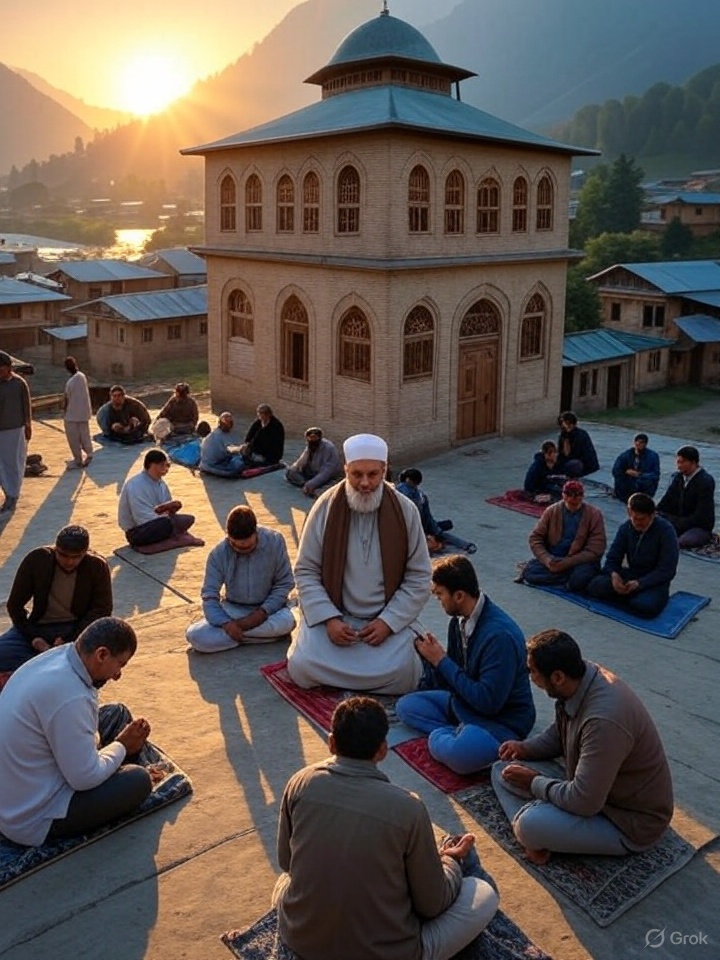
Over the centuries, Kashmiris developed cultural traditions that blurred religious lines.The Kashmiri language itself became a bridge, carrying the poetry of mystics from all communities. Folk songs, proverbs, and oral traditions incorporated both Sanskrit and Persian influences.Many festivals, though religious in origin, were celebrated across communities. Herath (Shivratri) was traditionally marked not only by Kashmiri Pandits but also respected by Muslim neighbors who offered greetings and even participated in festivities.Urs (death anniversaries) of Sufi saints attracted devotees from different faiths. Kashmiri cuisine, including dishes like wazwan, evolved through cultural exchange. Ingredients, cooking techniques, and dining etiquette carried influences from Hindu, Muslim, and Central Asian traditions.Architecture can be a symbol of unity and this one can understand if one visits Kashmir.Kashmir’s architecture reflects its pluralistic soul. Wooden mosques with pagoda-style roofs, such as the Jama Masjid in Srinagar display Buddhist and Hindu architectural elements. Hindu temples, Buddhist stupas, and Sufi shrines exist in proximity, testifying to a long history of coexistence.Under the Mughal and Afghan rulers, Kashmir retained its multi-religious character despite changing political powers. The Dogra period (1846–1947) saw an administrative structure where different communities participated in governance and trade. British colonial influence also brought Christian missionaries, who contributed to education and healthcare without disrupting local traditions.
There are tensions in the history of Kashmir but largely it is a story of co existence. The partition of India in 1947 introduced political divisions that strained relationships between communities.
Since the late 1980s, armed insurgency led to the tragic exodus of Kashmiri Pandits, fracturing centuries-old neighborhood bonds. Geopolitical interests often amplified divisions, overshadowing the cultural and spiritual unity of the region.Yet, even during times of turmoil, countless stories emerged of neighbors protecting each other, safeguarding homes, and preserving sacred sites. In recent years, there have been significant initiatives to revive Kashmir’s pluralistic ethos:Local NGOs, scholars, and cultural groups have organized discussions and heritage walks that emphasize shared histories.Efforts to restore temples, mosques, and shrines—sometimes with the support of people from different faiths—have created opportunities for reconciliation.Cultural festivals, poetry readings, and social media campaigns led by young Kashmiris are reclaiming the narrative of unity.The idea of religious harmony in Kashmir is not accidental—it is embedded in its philosophical traditions.Kashmir Shaivism teaches that the divine exists in every particle of the universe, eliminating the basis for discrimination. As discussed in the earlier part Sufism emphasizes love of God through love of humanity, transcending sectarian boundaries. Rishi Tradition encourages asceticism not as isolation but as service to others.These spiritual frameworks provided a common ethical ground for coexistence.
Most important is the harmony in every day life of the people of Kashmir. Historically, harmony was visible not just in grand events but in the smallest details of daily life: A Muslim carpenter would repair a temple door with the same devotion as a mosque pulpit. Hindu and Muslim women would gather at each other’s homes for childbirth rituals. Markets sold goods for Hindu festivals and Islamic feasts side by side. Even today, despite migration and political stress, many Muslim families maintain ties with displaced Pandit families, sending gifts during festivals or tending to ancestral homes. The role of Art and Music cannot be ignored in this process of harmonization. Kashmiri folk music, chakri and sufiana kalam, often contains verses from Hindu saints and Muslim poets in the same composition. Handicrafts like carpet weaving and papier-mâché incorporate motifs from multiple traditions, creating products that are both artistic and symbolic of harmony.In a world increasingly polarized by religious identities, Kashmir’s history offers lessons in: Syncretism over Exclusivism. Cultural and spiritual traditions can thrive when they borrow from each other without fear of losing identity.Then there comes the question of Community based harmony.True religious harmony is lived at the community level—through shared markets, kitchens, and festivals—rather than dictated solely by political frameworks. These are coupled with Resilience of Cultural Memory. Even when communities are physically separated, the shared memories of coexistence can remain a foundation for reconciliation.
Kashmir’s story of religious harmony is both inspiring and cautionary. It shows that centuries of peaceful coexistence are possible when a society is rooted in shared values of compassion, mutual respect, and spiritual openness. At the same time, it reminds us that harmony must be actively nurtured, for it can be strained by political, economic, or ideological forces.The Rishi-Sufi tradition, the syncretic cultural practices, and the architectural symbols of unity all point to a central truth: the strength of Kashmir lies not in the dominance of one faith over another, but in the ability of different traditions to coexist and enrich each other’s wisdom—a wisdom where Lal Ded’s verses and Nund Rishi’s teachings are not relics of the past, but living guides for the present and future. In doing so, the valley can continue to be, not just in name but in spirit, a paradise where the many paths to the Divine meet under the same sky.
Author of this article APJ Abdul Kalam Awardee Columnist and International Tagore Awardee Poet Dr.Ratan Bhattacharjee is a Former Affiliate Faculty of Virginia Commonwealth University Richmond USA. Email profratanbhattacharjee@gmail.com

