

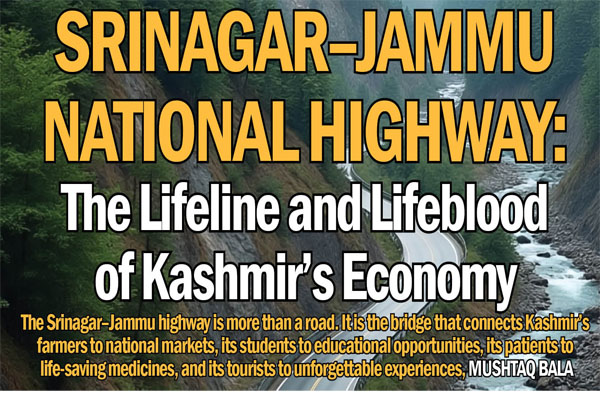
The Srinagar–Jammu highway is more than a road. It is the bridge that connects Kashmir’s farmers to national markets, its students to educational opportunities, its patients to life-saving medicines, and its tourists to unforgettable experiences, MUSHTAQ BALA
Mushtaq Bala
The Srinagar–Jammu National Highway is more than a stretch of asphalt winding through treacherous mountains. It is the artery that sustains Kashmir’s economy, culture, and day-to-day survival. Every truck carrying apples from the Valley’s orchards, every consignment of medicines entering hospitals, every family waiting for fuel and food supplies—relies on this road. Its importance cannot be overstated, for when the highway closes, life in Kashmir slows down, and the economy gasps for breath.
For decades, Kashmir’s prosperity has been tethered to the smooth functioning of this fragile link. The horticulture sector, particularly apple cultivation—the backbone of the Valley’s agrarian economy—depends almost entirely on this route to reach national and international markets. September and October, the critical harvesting season, see thousands of trucks plying the road, laden with apples destined for mandis across India. A day’s disruption means crores in losses, as perishable produce rots on the roadside and growers watch helplessly, their year-long labor wasted.
But the highway is not just about apples. It is the corridor for the inward movement of essential commodities: food grains, petroleum, LPG cylinders, construction material, medical supplies, and more. Kashmir has no sea or rail connectivity. Every item, from a loaf of bread in Srinagar to an IV fluid in a rural hospital, reaches the Valley through this road. Each blockade, whether caused by landslides, snowfall, or traffic mismanagement, triggers shortages. Petrol pumps run dry, hospital pharmacies issue distress calls, and ordinary citizens pay inflated prices for essentials.
The socio-economic impact of highway closures is immense. Shopkeepers complain of dwindling stocks, students traveling outside for education remain stranded, and tourism—the Valley’s most visible sector—suffers as visitors cancel their plans. The Srinagar–Jammu highway is not just a road—it is Kashmir’s lifeline.
The Highway’s Chronic Wounds
The vulnerability of the highway is not new. The Ramban–Banihal stretch, in particular, has been the site of chronic landslides and shooting stones. Despite years of promises and mega projects, the problem persists. The commissioning of tunnels like the Qazigund-Banihal and upgrades in certain sectors have brought partial relief, but frequent closures remind people of how precarious their connectivity remains.
Every year, officials issue reassurances of improvements, yet each season brings the same story of stranded vehicles and mounting losses. The lack of a dependable all-weather system remains a glaring gap. Until this is addressed, the Valley will continue to face economic shocks with every closure.
The Mughal Road: An Untapped Alternative
In this context, the Mughal Road presents itself as an underutilized but promising alternative. Historically, this route connected Kashmir with Poonch and Rajouri before proceeding towards Jammu. Revived in recent years as a motorable link, the road significantly reduces travel distance between Srinagar and Jammu. However, it has not been developed as a reliable all-weather corridor, largely due to neglect, lack of investment, and administrative indifference.
Experts and civil society voices have repeatedly urged the government to strengthen and operationalize the Mughal Road as a parallel highway. If properly widened, secured, and maintained, it could shoulder a significant portion of the traffic burden. More importantly, it could be earmarked for essential commodities and emergency supplies. In times of crisis—when the Srinagar–Jammu highway is blocked—fuel tankers, medicine trucks, and fruit-laden carriers could be diverted to the Mughal Road. This would prevent shortages, reduce economic losses, and ensure uninterrupted lifelines for the Valley’s residents.
Dedicating the Mughal Road for essentials would also ease congestion on the main highway. At present, long queues of passenger vehicles and heavy trucks clog the Srinagar–Jammu route, making traffic management a nightmare. With two dependable roads, the administration could streamline flows, separating emergency and commercial cargo from routine travel. The dual-route system would not only be more efficient but also safeguard Kashmir against the perennial vulnerability of depending on a single road.
The Call for Strategic Foresight
Repeated calls from trade bodies, fruit growers’ associations, and civil society groups highlight one simple fact: Kashmir cannot afford to depend on just one highway. The region’s economy is too fragile, its needs too immediate, and its aspirations too large to be tethered to a single, vulnerable artery.
Investments in strengthening the Mughal Road, completing pending tunnels, and constructing alternate alignments must be treated as strategic priorities, not routine projects. The government—both state and central—must understand that uninterrupted connectivity is not merely about convenience; it is about the survival of an entire people.
The argument that such projects require time and resources must be weighed against the colossal economic and social losses that occur with every closure. The costs of inaction far outweigh the costs of proactive investment. A resilient transport system is the bedrock of economic security, and for Kashmir, it is nothing short of existential.
Beyond Asphalt: A Road to Dignity
The Srinagar–Jammu highway is more than a road. It is the bridge that connects Kashmir’s farmers to national markets, its students to educational opportunities, its patients to life-saving medicines, and its tourists to unforgettable experiences. It is also the bridge that binds the Valley emotionally with the rest of the country.
Ensuring its uninterrupted functioning, while simultaneously developing the Mughal Road as a dependable alternative, must be at the heart of governance. The youth of Kashmir, already facing socio-economic pressures, should not be made to endure recurring shortages and crises caused by preventable infrastructure failures.
The road ahead is clear. To safeguard Kashmir’s economy, to secure its dignity, and to strengthen its resilience, the Srinagar–Jammu highway must be prioritized as a national asset. And alongside it, the Mughal Road must be developed into a fully functional, year-round alternative, dedicated especially for essential commodities and emergency relief.
For on these roads lies not only Kashmir’s survival but its journey toward progress and dignity
Mushtaq Bala is Editor-in-Chief of Kashmir Pen, an award-winning filmmaker, cultural commentator, and advocate for peace through narrative media.

