

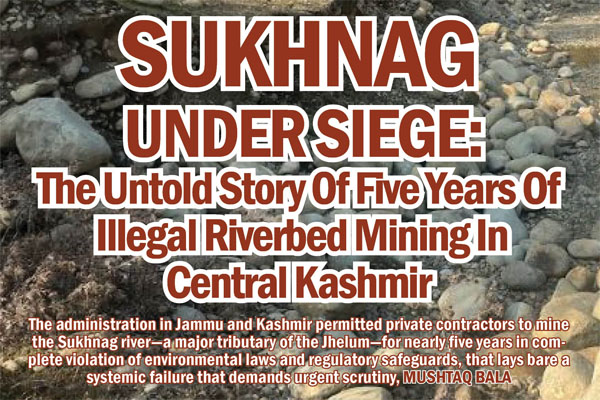
The administration in Jammu and Kashmir permitted private contractors to mine the Sukhnag river—a major tributary of the Jhelum—for nearly five years in complete violation of environmental laws and regulatory safeguards, that lays bare a systemic failure that demands urgent scrutiny, MUSHTAQ BALA
Mushtaq Bala
In a troubling revelation that exposes the widening gap between official claims of sustainable development and realities on the ground, official documents have confirmed that the administration in Jammu and Kashmir permitted private contractors to mine the Sukhnag river—a major tributary of the Jhelum—for nearly five years in complete violation of environmental laws and regulatory safeguards. The large-scale riverbed excavation not only defied legal norms but has also inflicted lasting damage on ecology, livelihoods, and local water systems, raising serious questions of accountability.
A River Exploited, Laws Ignored
The Sukhnag, fed by glacial currents from the Pir Panjal range, is among the most sensitive and ecologically important tributaries that feed the Jhelum. Despite this, authorities allowed continuous mechanical riverbed mining without mandatory environmental clearances, replenishment studies, or scientific impact assessments required under the law. Instead of applying the strict protocols outlined by the Ministry of Environment, Forest and Climate Change and the National Green Tribunal (NGT), permissions were granted that enabled full-scale commercial extraction.
It was only earlier this year—after local communities repeatedly raised alarm—that the NGT intervened and halted the activity, observing that unregulated mining was causing irreparable harm to the river’s structure and ecology. The Tribunal noted that unchecked excavation in a Himalayan river system could permanently alter its hydrology, flow patterns, and biodiversity.By then, however, the damage had already taken root.
The Human Cost: Livelihoods and Water Security Shattered
For hundreds of families living along the Sukhnag, the river is not merely a water body—it is the backbone of survival. Marginal farmers, fishermen, labourers, and daily-wage workers depend on its waters for irrigation, drinking needs, washing, livestock and small-scale fishing.
The years of mining unleashed a cascading crisis:
Water quality deteriorated sharply, with the glacial clarity giving way to muddy, unsafe, high-turbidity water unsuitable for household use.
The trout habitat was devastated, disrupting one of the region’s most prized freshwater ecosystems. Trout—both endemic and stocked—is central to the valley’s cultural and ecological identity, and the Sukhnag was once one of its healthiest breeding grounds.
Riverbanks eroded, threatening agricultural land and increasing the vulnerability of downstream communities to seasonal floods.
Informal livelihoods collapsed, as fishing became unviable and local labourers were denied access to traditional, small-scale extraction that once supported them.
Residents repeatedly approached district offices, engineers, and environmental authorities. Their protests, however, were overshadowed by the administration’s eagerness to fast-track major infrastructure projects that symbolised the post-2019 narrative of “transformational development” in Jammu & Kashmir.
A Flagship Project Built on a Fragile River
A majority of the illegally extracted riverbed material was transported to the construction site of the ₹3,000-crore Srinagar Ring Road project, being executed by NKC Projects Pvt. Ltd, a Haryana-based company. The Ring Road has been promoted as a crucial infrastructure milestone that showcases new developmental momentum in the Union Territory. But the revelations show a darker, unspoken layer—one in which environmental compliance was sacrificed to fuel speed and scale.
Instead of sourcing material from approved quarries located away from rivers, contractors repeatedly targeted the Sukhnag for easy and cheap extraction. Heavy machinery operated deep inside the riverbed, flattening pools, destroying spawning grounds, and altering the natural gradient of the tributary.
The irony is impossible to ignore: a project celebrated as a symbol of progress has simultaneously inflicted deep wounds on one of the valley’s most delicate ecosystems.
A Governance Failure Demanding Transparent Answers
The Sukhnag episode lays bare a systemic failure that demands urgent scrutiny. Key questions remain unanswered:
Who approved the mining despite clear legal prohibitions?
Were environmental clearance processes bypassed or manipulated?
Why did regulatory bodies fail to enforce NGT norms for years?
What measures are being taken to restore the river and rehabilitate affected families?
Governance in ecologically fragile regions like Kashmir cannot afford such complacency. The Himalayas are already experiencing rapid glacial loss, erratic precipitation, and climate stress. In such a context, unregulated mining is not merely a procedural lapse—it is a direct threat to long-term environmental stability and community resilience.
A Call for Accountability and Restoration
Stopping the mining is only the first step. The river now needs a long-term restoration plan involving scientific assessment, bank reinforcement, trout habitat reconstruction, and constant monitoring. Local communities must be part of the rehabilitation strategy, particularly those whose livelihoods were disrupted.
Equally important is the need for transparent accountability. The people of Kashmir deserve to know how such a large-scale violation continued for half a decade without administrative intervention. Development must follow the pathways of sustainability, legality, and community welfare—not shortcuts that leave behind environmental scars.
The story of the Sukhnag is not an isolated incident—it is a warning. As Jammu & Kashmir undergoes rapid infrastructural expansion, the balance between development and ecology must not be allowed to collapse. A tributary of the Jhelum has been pushed to the brink because regulatory vigilance faltered and commercial interests prevailed.
Kashmir cannot afford such costs. Sustainable development is not a slogan for reports—it is the only viable roadmap for a fragile Himalayan region. The administration owes the people not just explanations, but action.
The river must heal. The communities must be heard. And the system must learn. Only then can the idea of progress carry meaning.
Mushtaq Bala is Editor-in-Chief of Kashmir Pen, an award-winning filmmaker, cultural commentator, and advocate for peace through narrative media.

