

Date: June 29, 2025
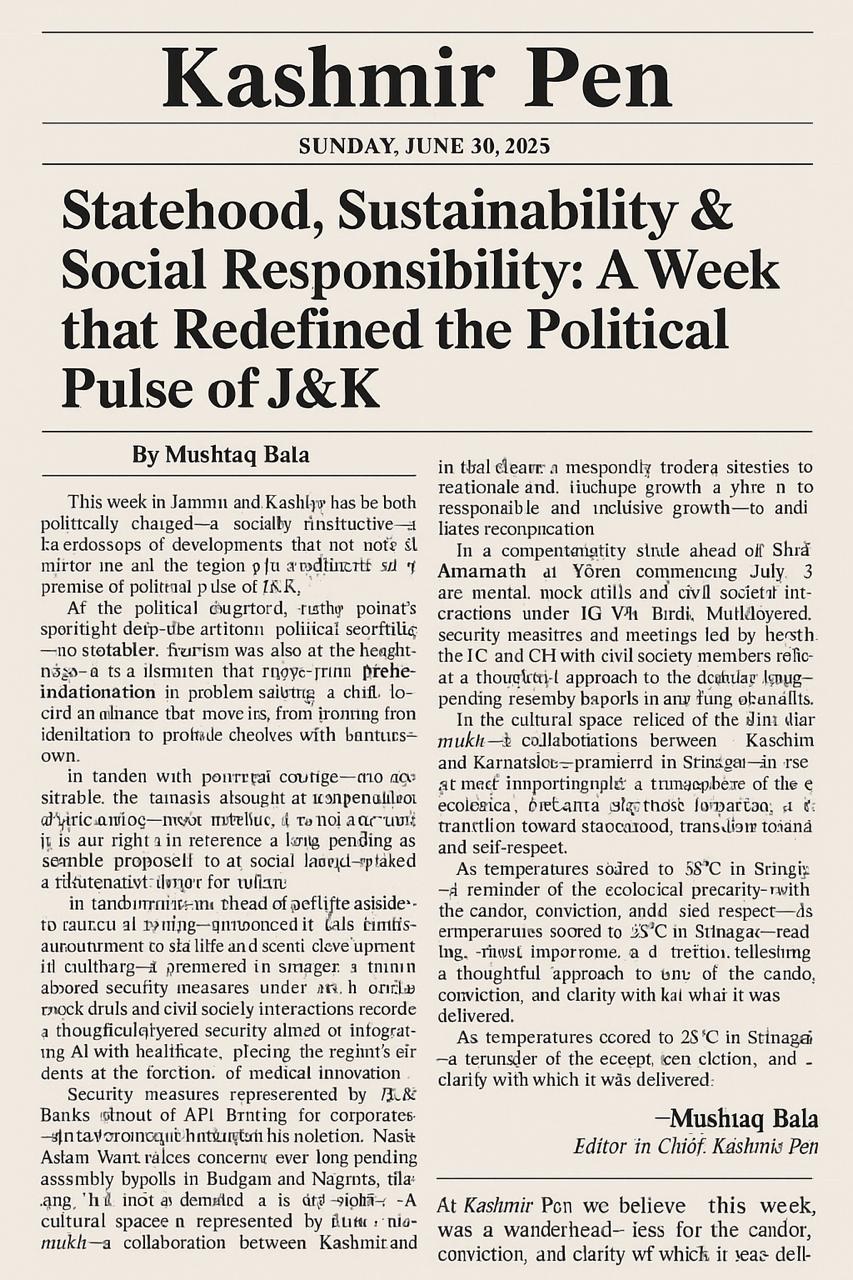
Statehood, Sustainability & Social Responsibility: A Week that Redefined the Political Pulse of J&K
This week in Jammu and Kashmir has been both politically charged and socially instructive—a kaleidoscope of developments that not only mirror the aspirations of the people but also underscore the challenges that lie ahead.
At the political forefront, Chief Minister Omar Abdullah’s bold assertion on statehood has ignited the public discourse once again. His unequivocal statement, “If restoration of statehood requires me to step aside, I am ready,” marks a decisive moment in the region’s political narrative. This is more than a symbolic gesture—it is a reminder that the soul of democracy lies in representation, and representation begins with self-governance. The promise of re-elections, if they are the means to that end, is not just a political step but a moral commitment to the people of J&K.
In tandem with political courage came tangible development. The Centre’s approval of 19 mega road and tunnel projects, amounting to over ₹10,600 crores, and the CM’s announcement to transform Gulmarg into a world-class golfing hub reaffirm that infrastructure and tourism remain twin pillars of progress. With Omar Abdullah laying foundation stones for ski lifts and scenic development in Gulmarg, the roadmap to economic rejuvenation through sustainable tourism is beginning to take clearer shape.
Tourism was also at the heart of the J&K Tourism Revival Dialogue at SKICC, where the launch of “Golfing in Paradise” echoed the renewed focus on eco-tourism. The Chief Minister, flanked by stakeholders, pledged support for responsible and inclusive growth—where development does not come at the cost of culture or climate.
And yet, amid these high-level policy announcements, the week also spotlighted deep societal wounds—most notably, the spiraling drug crisis. From SKIMS-GCC’s joint declaration of a public health emergency to LG Sinha’s emotionally resonant call on International Day Against Drug Abuse, the message was unanimous: drug abuse is not just a law-and-order issue; it is an existential threat to our social fabric. The damage, as reiterated by District Hospital Bandipora’s observance and police-led awareness campaigns, cuts across class and geography.
In a complementary stride, NIT Srinagar and SKIMS joined forces to launch an ambitious initiative aimed at integrating AI with healthcare—placing the region’s students at the forefront of medical innovation. These are the kinds of alliances that move us from problem identification to problem-solving, a shift J&K sorely needs.
On the security front, ahead of the Shri Amarnath Ji Yatra commencing July 3, mock drills and civil society interactions underscore the delicate balance between devotion and vigilance. Multilayered security measures under IG VK Birdi and meetings led by both the LG and CM with civil society members reflect a thoughtful approach to one of the largest spiritual congregations in the region.
Meanwhile, economic modernization saw a milestone with J&K Bank’s rollout of API Banking for corporates—a step that integrates local enterprise into the national digital economy. And in Budgam and Nagrota, the democratic deficit was raised again, with Nasir Aslam Wani rightly stating, “It is not a demand, it is our right,” in reference to long-pending assembly bypolls.
In the cultural space, the film Harmukh—a collaboration between Kashmir and Karnataka—premiered in Srinagar as a shining example of India’s pluralism. Graced by Dr. Farooq Abdullah and prominent filmmakers, the event stood as a cinematic ode to cross-cultural harmony and the creative power of Kashmir’s own.
As temperatures soared to 35°C in Srinagar—a reminder of the ecological precarity we live in—the week’s stories, whether rooted in politics, public health, technology, or art, reflected a region in transition. Transition toward statehood. Transition toward accountability. And perhaps, most importantly, a transition toward self-respect.
At Kashmir Pen, we believe this week was a watershed—less for what was promised, and more for the candor, conviction, and clarity with which it was delivered.
—Mushtaq Bala
Editor-in-Chief, Kashmir Pen

