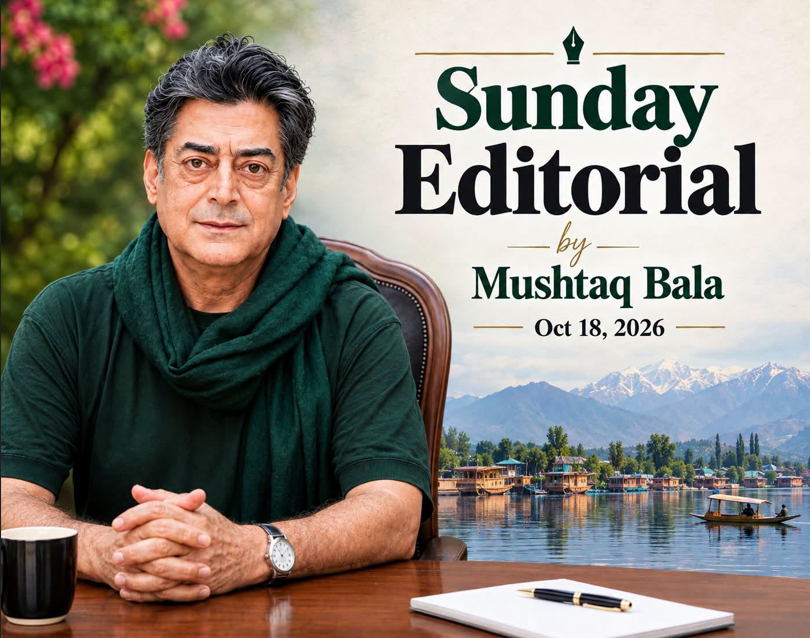
Sunday, October 18, 2026
The past week in Jammu and Kashmir has offered a revealing picture of the region’s continuing struggle to balance governance, accountability, development and public expectations. From a controversy involving senior civil servants to debates over religious autonomy, alongside fresh investments in skill development and initiatives for preserving Kashmir’s heritage, the headlines have raised a fundamental question: how effectively are our institutions responding to the aspirations of the people?
At the centre of public attention has been the alleged verbal misconduct by a senior IAS officer towards a junior woman JKAS officer during an official online meeting. The incident, captured in a video that circulated widely on social media, triggered widespread condemnation, a protest by JKAS officers and intervention by the National Commission for Women. The government has ordered an inquiry, placing the matter under formal scrutiny.
The significance of this episode extends beyond the individuals involved. It brings into focus the culture of administration itself. Public office is a position of responsibility, not a licence to intimidate. Seniority must command respect through professional conduct, fairness and leadership, rather than fear. Equally, allegations must be examined impartially, with due process respected and conclusions based on established facts.
The inquiry must therefore be credible, time-bound and transparent to the extent permitted by law. Equally important is the protection of the complainant against any form of retaliation. If public institutions expect ordinary citizens to respect the law, they must demonstrate that the same standards apply within their own corridors of power.
The controversy has also revived an important debate about the administrative structure of Jammu and Kashmir as a Union Territory, particularly the distribution of authority between the elected government and the Lieutenant Governor. Whatever the constitutional and administrative arrangements, accountability cannot become a casualty of divided responsibilities. The public is entitled to expect that every competent authority will act within its mandate and ensure that serious complaints receive an appropriate response.
Another issue that drew considerable attention during the week was the proposal by the J&K Waqf Board to introduce uniform Friday sermons across the region. The objections voiced by political leaders and religious representatives have brought questions of religious autonomy, institutional authority and community sensitivities into public discussion.
Religious institutions have an important role in the social and spiritual life of Kashmir. Any administrative initiative affecting their functioning must be approached through consultation, sensitivity and a clear understanding of the legal framework. Uniformity may appear administratively convenient, but matters of faith cannot be addressed solely through the logic of bureaucratic standardisation. Dialogue, rather than confrontation, offers the more constructive path.
Meanwhile, the government’s development agenda has continued to generate encouraging announcements. The Centre’s approval of ₹475.41 crore for upgrading Industrial Training Institute clusters in Jammu and Kashmir offers an opportunity to strengthen vocational education and improve employability. At a time when unemployment remains a major concern for young people, investment in skills must translate into practical training, industry partnerships and genuine employment opportunities.
The real test, however, will not be the size of the allocation or the prominence of the announcement. It will be the number of young people who acquire marketable skills, secure sustainable livelihoods and find opportunities to build their futures within the region. Jammu and Kashmir needs an employment strategy that connects education with industry, entrepreneurship and emerging economic sectors.
Recent initiatives concerning road infrastructure, college-level academic leadership, student grievance redressal and timely textbook distribution similarly underline the importance of effective implementation. Roads must improve connectivity, educational institutions must nurture critical thinking and employable skills, and administrative systems must respond promptly to students and citizens. Announcements create expectations; delivery earns public confidence.
The emphasis on research, mentorship and implementation of the National Education Policy 2020 is particularly relevant. Colleges cannot be judged merely by enrolment figures or examination results. They must also be assessed by the quality of teaching, opportunities for research, institutional discipline and their ability to prepare students for a rapidly changing world.
Equally significant is the effort to preserve Kashmir’s built heritage, including the initiative to restore the historic Vittal Bhairav Temple in Srinagar. Such projects remind us that Kashmir’s cultural identity is enriched by its layered history and diverse architectural and spiritual traditions. Heritage conservation should not be treated as a ceremonial exercise; it requires sustained investment, professional restoration and public participation.
Kashmir’s lakes, forests, traditional neighbourhoods, shrines, temples and historic structures are not merely remnants of the past. They are part of the region’s collective inheritance and deserve protection from neglect, encroachment and unplanned development.
Taken together, the week’s developments reveal both opportunities and unresolved concerns. Jammu and Kashmir has the potential to advance through improved infrastructure, stronger educational institutions, vocational training and cultural preservation. Yet progress will remain incomplete if citizens continue to feel that accountability is selective, public grievances are inadequately addressed or institutions operate without sufficient transparency.
The media, too, has a responsibility in this environment. It must scrutinise those in authority without prejudice, report allegations with due caution, distinguish facts from claims and provide space for reasoned public debate. Sensationalism may attract attention, but responsible journalism must ultimately help citizens understand the issues that shape their lives.
The coming days should be judged not merely by fresh announcements or statements of intent, but by measurable outcomes: a fair conclusion to the administrative inquiry, respect for institutional autonomy, meaningful employment opportunities, responsive public services and visible progress in education and heritage conservation.
Jammu and Kashmir does not lack talent, resources or public aspirations. What it needs consistently is a governance culture that places integrity above hierarchy, service above self-interest and public welfare above institutional convenience.
Ultimately, the strength of a democracy is measured not by the authority its institutions exercise, but by the trust they inspire. For Jammu and Kashmir, rebuilding and sustaining that trust remains one of the most important tasks before its institutions and leadership.
The message of this week is clear: development must be accompanied by accountability, authority by responsibility, and public policy by sensitivity to the people it is meant to serve.
The Road Ahead
As Jammu and Kashmir moves into another week, the challenge before its leadership is to convert public expectations into tangible outcomes. The controversy surrounding administrative conduct must culminate in a fair and credible process; educational reforms must create opportunities rather than remain confined to policy documents; development projects must reach the people they are intended to benefit; and cultural heritage must be protected as a shared legacy for future generations.
Above all, governance must become more responsive, transparent and humane. Citizens should not have to struggle for answers, young people should not have to abandon their homeland in search of opportunities, and public institutions should never lose sight of the dignity of the individuals they serve. These are not extraordinary demands; they are the basic expectations of a society that seeks progress with justice.
The coming week will undoubtedly bring new announcements, political statements and administrative decisions. But the people of Jammu and Kashmir need more than another cycle of headlines. They need assurance that their concerns are being heard, their rights respected, their resources used responsibly and their future treated as a priority.
For a region endowed with immense natural beauty, a rich cultural inheritance and a resilient population, the possibilities remain considerable. Real progress, however, will depend on the willingness of those in authority to listen, accept scrutiny, correct shortcomings and place public interest above personal or institutional considerations.
The ultimate measure of governance is not what those in power announce, but what ordinary people experience in their daily lives. When accountability becomes a practice rather than a promise, development reaches the last person, and institutions earn trust through their conduct, Jammu and Kashmir can move towards a future defined not by recurring controversies, but by confidence, opportunity and dignity.
That is the promise the people deserve—and the responsibility their leadership must fulfil.
— Mushtaq Bala
Editor-in-Chief, Kashmir Pen