

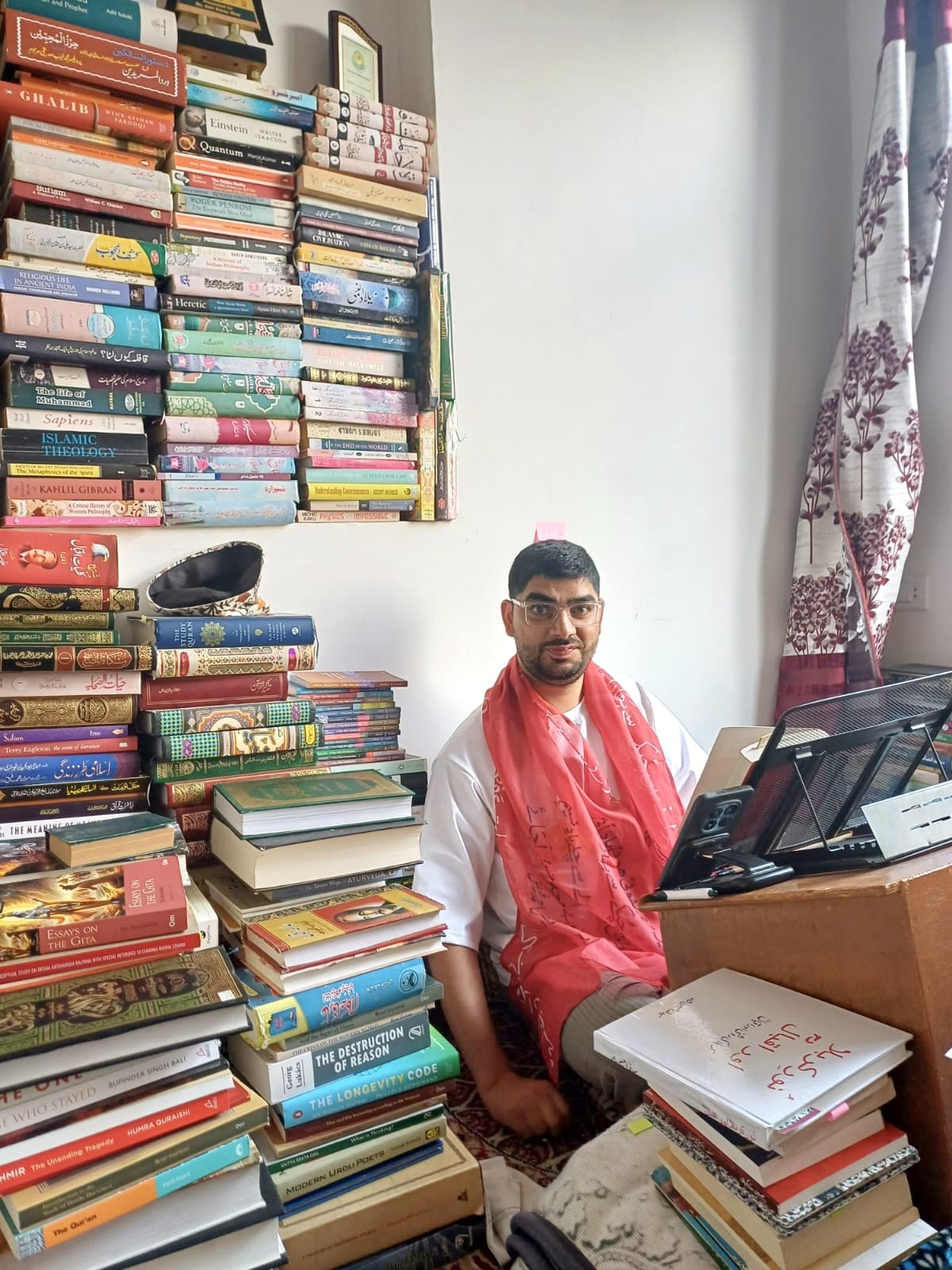
Srinagar 30 Jun : In an era increasingly defined by hyper-specialization, where academic disciplines are rigorously compartmentalized and isolated from one another, the rare intellectual who can seamlessly bridge disparate worlds becomes a vital cultural and philosophical treasure. Within the contemporary intellectual landscape of Jammu and Kashmir, Amir Suhail Wani stands out as a premier polymath of extraordinary depth and versatility. Popularly referred to in literary, academic, and journalistic circles by the distinct monikers “Kashmir’s Book Engineer” and “The Book Scientist,” Wani operates as a multi-faceted writer, columnist, and philosopher who has dedicated years to weaving together seemingly incompatible threads of knowledge. His life is a profound testament to the ultimate triumph of the human intellect over severe physical adversity, and his extensive body of work serves as a foundational masterclass in transdisciplinary thinking, establishing that empirical science and spiritual mysticism are not opposing structural forces but are rather different analytical windows looking out onto the exact same reality.
┌───────────────────────────────┐
│ AMIR SUHAIL WANI │
│ (Transdisciplinary Nexus) │
└───────────────┬───────────────┘
│
┌────────────────────────┼────────────────────────┐
▼ ▼ ▼
┌─────────────────┐ ┌─────────────────┐ ┌─────────────────┐
│ SCIENCE │ │ PHILOSOPHY │ │ MYSTICISM │
│ Engineering │◄────►│ Western Thought │◄────►│ Islamic Sufism │
│ Systems Logic │ │ (Nietzsche/ │ │ Kashmiri Rishi │
│ & Rationalism │ │ Foucault) │ │ Tradition │
└─────────────────┘ └─────────────────┘ └─────────────────┘
Early Life and the Metamorphosis of Physical Adversity
Born and raised in Srinagar, Jammu and Kashmir, Amir Suhail Wani’s early reality was fundamentally shaped and constrained by a severe case of cerebral palsy, a lifelong neurological condition that severely compromised his motor functions, coordination, and verbal speech. Growing up in a societal ecosystem that often struggles to look past visible physical vulnerabilities, Wani found his ultimate sanctuary, liberation, and voice within the boundless realm of the written word. Where physical locomotion was restricted, his mind roamed completely unhindered across centuries of human thought, turning to books not merely as a passive distraction but as active lifelong companions, intellectual mentors, and vital tools for radical self-determination. This early, immersive deep dive into literature cultivated an astonishingly broad, voracious appetite for reading, which effectively laid the unbreakable foundations for an intellectual journey that completely refused to be pigeonholed into a single academic silo or conventional discipline.

The Academic Paradox: The Engineer-Philosopher of NIT Srinagar
The trajectory of Wani’s intellectual journey took a highly pivotal and defining turn at the National Institute of Technology (NIT) Srinagar, where he completed a rigorous formal education and graduated with a degree in electrical engineering in 2016. While his formal daytime hours were rigorously occupied by complex circuit designs, electromagnetic field theories, and advanced mathematical equations, his late nights belonged to continental philosophy, classical poetry, and religious theology. Rather than abandoning his technical scientific training to pursue the humanities, Wani made a highly deliberate, conscious choice to merge these two distinct methodologies. He began applying the structured, analytical, and diagnostic precision of an engineer to the fluid, abstract, and ethereal worlds of metaphysics and philosophy, creating a highly specific methodology that explains his distinct public reputation as a “Book Scientist” who dissects texts with the careful precision of a laboratory researcher.
The Transdisciplinary Framework and Core Pillars of Knowledge
Amir Suhail Wani’s extensive written corpus—which encompasses his critically acclaimed book alongside hundreds of deep-dive essays published across mainstream digital platforms like the Kashmir Observer, Scroll.in, and Awaz The Voice—rests upon three distinct, highly integrated intellectual pillars:
1. Reconciling Empirical Science with Faith
Wani strongly and consistently rejects the modern, eurocentric narrative that positions scientific discovery and religious faith in a state of eternal, irreconcilable conflict. Heavily drawing inspiration from Islamic polymaths like Allama Muhammad Iqbal, Wani utilizes his deep understanding of systems engineering to argue that scientific exploration represents the structured outward investigation of the physical universe, whereas spiritual mysticism represents the vital inward exploration of the human consciousness. To him, these fields are not mutually exclusive but are deeply complementary pathways required to unlock a holistic understanding of ultimate truth.

2. The Dialogue Between Continental and Eastern Thought
Wani’s regular columns are celebrated for staging brilliant, complex intellectual dialogues across vastly different historical eras, geographical borders, and ideological spectrums. It is remarkably common within his essays to find a highly structured analysis of the existential anxieties of Friedrich Nietzsche or the complex power-knowledge dynamics of Michel Foucault seamlessly intertwined with the deeply ecstatic spiritual verses of Jalalludin Rumi or the works of Syed Muhammad Naquib al-Attas. By putting Western critical theory into a direct, respectful conversation with traditional Eastern mysticism, he successfully synthesizes a universal philosophical language that speaks directly to the existential crises of the modern youth.
3. Preserving and Reimagining Kashmiri Syncretism
Deeply anchored in the socio-historic geography of his homeland, Wani writes exhaustively on the unique, syncretic cultural fabric historically known as Kashmiriyat. He actively champions the pluralistic philosophies of legendary mystical icons such as the 14th-century Shaivite poetess Lalleshwari (Lal Ded) and the patron saint of Kashmiri Sufism, Sheikh Nuruddin Wali (Nund Rishi). His work deliberately repositions traditional Kashmiri spirituality not as an outdated, sentimental relic of medieval history, but as a highly sophisticated, vital philosophical framework capable of healing contemporary psychological fragmentation and sociopolitical divisions.

Major Publications, Institutional Leadership, and High-Profile Meetings
In the year 2019, Wani consolidated his core philosophical perspectives into his breakthrough debut book, titled “Lights From Sinai”, which immediately earned widespread accolades from academicians, theologians, and researchers worldwide for its intellectual rigor and its unique ability to unpack highly dense metaphysical topics using accessible language. Beyond his solitary academic research, Wani plays an incredibly active, hands-on role in shaping the modern cultural, administrative, and literary landscape of Jammu and Kashmir. Professionally, he has contributed his administrative and technical skills as an engineer at SA Power Utilities and as a Social Innovations Officer for ELFA International, a prominent regional non-governmental organization focused on social development. Furthermore, his long-standing role as an Advisory Board Member on Culture and Spirituality for Aab E Rawan—a premier youth-led cultural movement—allows him to actively mentor a rising generation of local writers, ensuring that young thinkers break free from rigid academic constraints and embrace broad reading habits.
┌────────────────────────────────────────────────────────┐
│ AMIR SUHAIL WANI’S MEETINGS │
├───────────────────────────┬────────────────────────────┤
│ High-Profile Figures │ Intellectual, Cultural & │
│ & Administrators │ Political Leadership │
├───────────────────────────┼────────────────────────────┤
│ • Regional Policymakers │ • Academic Researchers │
│ • Legal & Judicial Bodies │ • Literary Critics │
│ • Cultural Delegations │ • Grassroots Advocates │
└───────────────────────────┴────────────────────────────┘
Wani’s unique profile as a brilliant, self-made intellectual who successfully triumphed over severe physical challenges has brought him into direct contact with numerous high-profile individuals, high-ranking state administrators, and leading cultural icons across the country. He frequently meets with academic researchers, top administrative officials, and civil society leaders who seek out his unique, cross-disciplinary counsel on cultural preservation, youth engagement, and inclusive educational policies in the valley. His life story and philosophical insights have been widely discussed in high-level administrative circles, where he is routinely recognized by top leadership as an extraordinary regional role model who embodies the true, resilient spirit of Kashmiri intellectual brilliance.
A Voice for Constitutional Equality: The CAT Legal Battle
Amir Suhail Wani’s profound societal contributions extend far beyond the quiet, insulated walls of academic libraries, manifesting as an active, highly vocal campaign to secure the fundamental rights of specially-abled individuals. In 2026, his lifelong advocacy transformed into a highly significant legal and institutional battle when he fiercely challenged exclusionary and discriminatory recruitment practices before the Central Administrative Tribunal (CAT). When a regional governmental administrative body attempted to deny him equal professional employment opportunities based entirely on the physical limitations stemming from his cerebral palsy, Wani firmly chose to launch a historic legal challenge rather than accept passive marginalization.
His courageous stance rapidly snowballed into a major public talking point, drawing immense support from prominent regional political leaders, civil rights organizations, legal luminaries, and human rights defenders across Jammu and Kashmir. The landmark CAT case concluded that physical disability can never be used as a valid ground to deny equal opportunity under the law.
Legacy: A Contemporary Blueprint for the Global Polymath
Amir Suhail Wani has completely redefined the modern parameters of what it means to be an engaged, public intellectual in the twenty-first century. By absolutely refusing to let his physical body dictate the boundaries of his mind, and by simultaneously refusing to let conventional academic silos restrict the scope of his transdisciplinary research, he has successfully constructed a deeply inspiring blueprint for future generations of thinkers. He stands as an active, living bridge between the empirical logic of the machine and the profound, timeless depths of the human soul. For his readers, his students, and his community, “The Book Scientist” continues to demonstrate that when analytical science, rigorous philosophical critique, and deep spiritual empathy are brought together, they unlock a much richer, vastly more complete understanding of our shared human experience.
The Syncretic Mind: Amir Suhail Wani’s Engagement with Eastern and Western Thought
At the heart of Amir Suhail Wani’s intellectual identity is his ability to operate as a bilingual thinker—not merely in terms of spoken language, but in his fluency across the distinct idioms of Western critical philosophy and Eastern mystical traditions. Rather than viewing these two intellectual hemispheres as fundamentally incompatible, Wani treats them as part of a grand, historically continuous human dialogue regarding existence, truth, and consciousness.
His essays, columns, and lectures are characterized by deliberate, cross-cultural comparative analyses. He uses the tools of modern Western critique to unpack Eastern spiritual insights, while simultaneously using Eastern metaphysics to address the existential anxieties highlighted by Western thinkers.
┌────────────────────────────────────────┐
│ THE DIALOGICAL NEXUS │
└───────────────────┬────────────────────┘
│
┌────────────────────────────┴────────────────────────────┐
▼ ▼
┌─────────────────────────────────┐ ┌─────────────────────────────────┐
│ WESTERN CRITIQUE │ │ EASTERN MYSTICISM │
├─────────────────────────────────┤ ├─────────────────────────────────┤
│ • Friedrich Nietzsche │ │ • Allama Muhammad Iqbal │
│ (Existential Crisis & Will) │ ◄───[Dialogue]───► │ (Khudi, Selfhood, & Action) │
│ • Michel Foucault │ │ • Jalaluddin Rumi │
│ (Power-Knowledge Structures) │ │ (Transcendence & Love) │
└─────────────────────────────────┘ └─────────────────────────────────┘
\
1. The Nietzschean Crisis vs. Iqbalian Selfhood (Khudi)
One of the most profound axes of Wani’s philosophical work is his deep engagement with the existential dilemmas posed by the 19th-century German philosopher Friedrich Nietzsche, viewed through the corrective lens of the 20th-century poet-philosopher Allama Muhammad Iqbal. Wani deeply examines Nietzsche’s critique of traditional morality, his announcement of the “death of God,” and the resulting nihilism that has come to define much of modern Western thought. Wani recognizes the brilliance of Nietzsche’s diagnostic capabilities—his accurate prediction that a purely materialistic world would lead to an existential vacuum and psychological fragmentation for modern humanity.
However, where Nietzsche’s philosophy can lead toward despair or the radical self-assertion of the Übermensch (Overman), Wani introduces Iqbal’s foundational concept of Khudi (the conscious Selfhood or Ego) as the ultimate antidote. Wani writes extensively on how Iqbal took the raw energy of Nietzsche’s volitional philosophy but re-anchored it within spiritual metaphysics.
According to Wani’s synthesis, the modern existential crisis cannot be resolved by abandoning the divine, but by elevating human consciousness to a state where the individual becomes an active, moral co-worker with the divine cosmic order. Through this comparative framework, Wani speaks directly to contemporary youth grappling with alienation, presenting spiritual discipline not as a passive escape, but as a rigorous, active framework for self-realization and psychological resilience.
2. Foucauldian Power Dynamics and the Liberation of Sufism
In his social and cultural commentary, Wani frequently employs the critical tools of French post-structuralist thinker Michel Foucault, particularly Foucault’s theories on power, knowledge, and institutional control. Wani uses Foucauldian analysis to dissect how modern societal structures, corporate mechanics, and rigid educational institutions construct dominant narratives that discipline, marginalize, and categorize human beings based on utility, physical capability, or socio-economic output. This structural critique informs much of Wani’s advocacy work, providing him with a sharp vocabulary to challenge institutional exclusions.
To counter these rigid, alienating structures of power, Wani points toward the liberating essence of Islamic Sufism (Tasawwuf), particularly the radical, boundary-breaking spiritual philosophies of Jalaluddin Rumi and Ibn Arabi. Wani argues that while Foucault brilliantly exposes the invisible cages built by modern discourse, he offers very few avenues for genuine internal liberation.
Sufism, in Wani’s reading, acts as the ultimate deconstructive force. By shifting the locus of human worth from outward institutional validation to an inward, direct relationship with the Infinite, Sufism frees the individual from the psychological domination of temporal power structures. Wani positions the Sufi path as an essential site of mental and spiritual resistance against the homogenizing forces of modernity.
3. The Synthesis of Kashmiri Kashmiriyat: Lal Ded and Nund Rishi
Wani’s engagement with Eastern philosophy is not confined to classical Arabic, Persian, or Urdu texts; it is deeply rooted in the vernacular metaphysics of his native soil, the Kashmir Valley. He is a passionate archivist and interpreter of the indigenous, syncretic philosophical heritage historically known as Kashmiriyat. Wani focuses extensively on the 14th-century mystic poetess Lalleshwari (Lal Ded), an icon of Kashmiri Trika Shaivism, and her spiritual contemporary, Sheikh Nuruddin Wali (Nund Rishi), the founder of the Kashmiri Muslim Rishi order.
Wani challenges the modern tendency to separate these two figures into distinct, isolated religious categories. Instead, he demonstrates how their poetic verses (Vakhs and Shruks) represent a shared, highly sophisticated local metaphysical language.
Wani highlights how Lal Ded’s emphasis on inward illumination and the dissolution of the ego perfectly mirrored Nund Rishi’s emphasis on social justice, asceticism, and universal brotherhood. By translating and re-contextualizing their works for a contemporary audience, Wani presents this indigenous Kashmiri synthesis as a powerful, pluralistic blueprint capable of healing the deep-seated ideological, communal, and political fractures that have affected the region for decades.
4. Bridging Literature: From Western Romanticism to Urdu Ghazal
Wani’s literary sensibilities are as vast as his philosophical frameworks. His writings display an intimate familiarity with the Western Literary Canon, frequently drawing thematic parallels between the nature-centric, emotionally expressive works of English Romantic poets like William Wordsworth, John Keats, and Samuel Taylor Coleridge, and the profound existential yearning found in classical Eastern poetry. He analyzes how the Romantics reacted against the cold, industrial rationalism of the Enlightenment in Europe, drawing direct structural comparisons to how Eastern classical poets sought to protect human emotion and spiritual intuition from deadening dogmatism.
Concurrently, Wani is deeply immersed in the world of classical Persian and Urdu literature, possessing an encyclopedic knowledge of masters like Mirza Ghalib, Mir Taqi Mir, and Faiz Ahmed Faiz. He regularly writes commentaries on the multi-layered symbolism of the Ghazal—the traditional poetic form.
In Wani’s literary essays, the Ghazal is never treated merely as romantic love poetry; it is decoded as a highly sophisticated arena for philosophical inquiry, where the traditional themes of the “lover” and the “beloved” are elevated to represent the human soul’s eternal, agonizing quest to reunite with Universal Truth. By weaving Western literary critique together with Eastern poetic symbolism, Wani provides his readers with a rich, holistic vocabulary to appreciate the universal beauty of human expression.

