

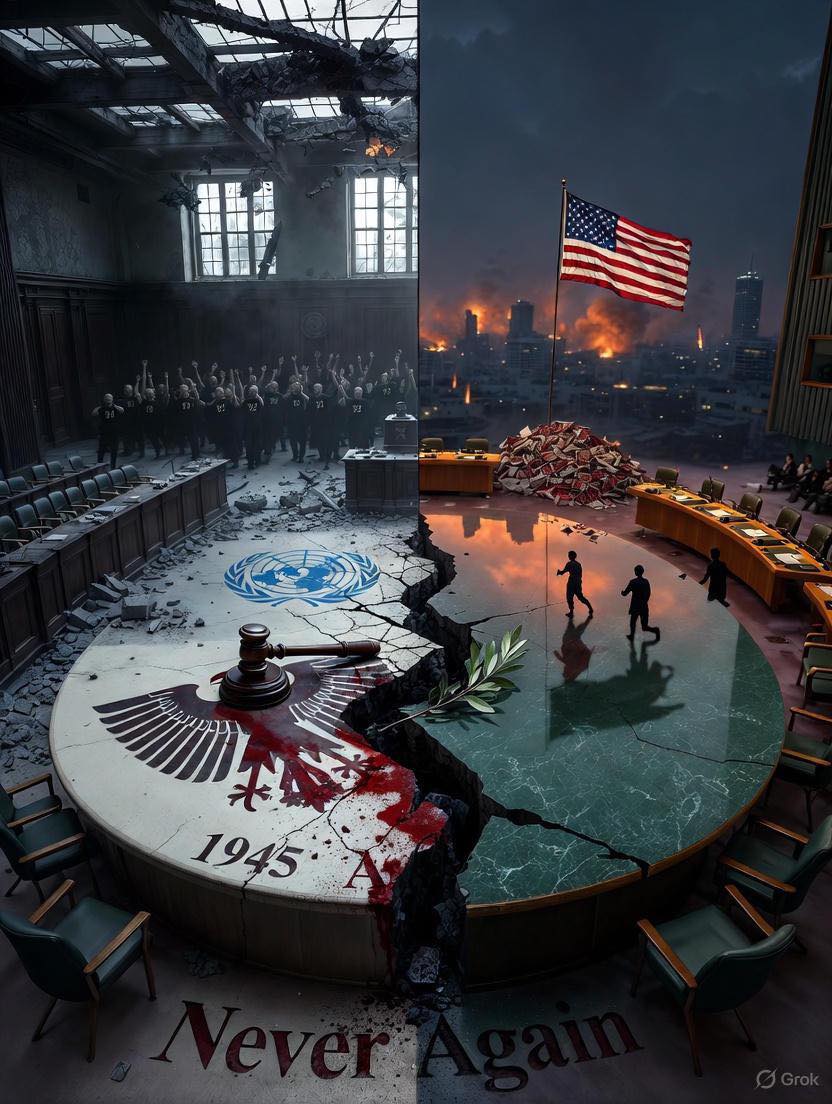
Eighty years after the Nuremberg Trials shaped a global order grounded in accountability, the UN’s paralysis over Gaza exposes a system slipping back into the habits that once allowed disasters…
FAULTLINES & FRONTIERS
NOV 29, 2025
Born from the ashes of 1945 and defined by the Nuremberg spirit, the United Nations was meant to restrain power and protect civilians. In Gaza, it cannot even secure a ceasefire. As Washington shields Israel and global institutions fracture, India quietly recalibrates its place in a world where the old order no longer holds.
If someone rewinds global history to the ruins of 1945, they find a world clawing its way out of catastrophe. Cities flattened. Millions displaced. Survivors carrying numbers on their arms. The victors, shaken by the kind of brutality even they could barely process, gathered in courtrooms in Nuremberg to try the men who designed that violence. Those trials were not only about punishment. They were a declaration. The world had crossed a line so unforgivable that it needed new rules. And out of that conviction, a new structure was imagined: the United Nations.
The idea was simple. Never again. Those two words carried the moral weight of the previous decade. Never again children buried in ditches. Never again cities bombed without pause. Never again a leader shielded by power while civilians paid the price. The UN was the institutional expression of that promise.
Now listen carefully to the debates in New York today. The same building, the same tall chamber, the same motions and resolutions. But the spirit that created the UN is nowhere to be found.
THE PARALYSIS OF TODAY
Gaza has become the clearest example of the UN’s failure. A war that has killed thousands of Palestinians and flattened entire neighbourhoods moves forward without any meaningful restraint. And every time the Security Council tries to stop the bloodshed, the United States blocks it. The resolutions do not even demand political solutions. They often ask for something much smaller: a pause in bombing, safe passage for aid, protection of civilians. But each attempt collapses against the same veto.
The irony is almost too heavy to describe. The country that helped craft the UN Charter, the country that once held Nuremberg forward as a model for the world, now prevents even a symbolic ceasefire for people trapped in a war zone.
Israel, protected by that shield, behaves like a state unbound. UN resolutions pile up like discarded paper. Investigations are rejected. Civilian sites are struck. The ICC issues warrants for Netanyahu and Gallant. The response is to dismiss the entire court as illegitimate. It is a pattern the world has watched before in different places. When powerful states reject accountability, the institutions built to enforce it turn useless.
The General Assembly can vote until its hands hurt. Those votes have no real power. The Security Council is the gatekeeper, and that gate is locked.
The result is a world where the promise of “never again” sounds less like a moral line and more like a historical slogan fading on a museum wall.
A LONG HISTORY OF SELECTIVE JUSTICE
Gaza is not an isolated case. The UN has struggled to uphold its own ideals for decades. Rwanda was one of the early betrayals. UN forces watched a genocide unfold in the spring of 1994 with orders to do almost nothing. Srebrenica followed. Eight thousand Bosniaks massacred while Dutch peacekeepers stood on the sidelines. Iraq in 2003 showed another failure. The invasion bypassed the UN entirely, constructed on faulty intelligence, and left behind a region shattered for years.
Every time the system fell short, diplomats promised reforms. Every crisis was followed by a blue-ribbon committee, a new protocol, a fresh set of speeches. Yet nothing changed at its core. The veto survived. Power shaped outcomes, not principle.
For all its flaws, people still believed in the idea of the UN because the alternative felt too bleak. Now that belief is eroding faster than ever. And the Gaza war, broadcast in real time on millions of screens, has made the gulf between the founding ideals and the present reality impossible to ignore.
THE WORLD THAT CREATED THE UN IS GONE
In 1945, there were clear victors and clear villains. A world ready to accept new rules. A moral consensus formed out of horror. Today’s world does not resemble that year at all. Power is diffused. Rivalries are layered. Technology shapes narratives faster than diplomats can react. And global politics has no central authority capable of preventing war or even slowing it.
The Security Council reflects a world order that expired somewhere in the 1990s but never received its funeral. Five permanent members guard their privileges. Four of them are nuclear-armed rivals. Three of them are locked in geopolitical contests. One uses its veto reflexively. Under those conditions, expecting unified action is almost delusional.
The UN is a mid-twentieth century machine dropped into a twenty-first century storm. It was built for an era of empires, superpowers, and structured diplomacy. It now faces decentralized conflicts, non-state actors, drone wars, cyber sabotage, militias operating across borders, artificial intelligence shaping public sentiment, and real-time footage that outruns official narratives.
The machinery is old. The world is not.
THE UNITED STATES AND ITS DOUBLE ROLE
It is too simple to say the UN is failing because the United States blocks Gaza resolutions. The deeper issue is the contradiction built into the system. The US has always played a double role. It is both its strongest architect and its most persistent obstacle. It champions human rights in speeches but shields allies when accountability approaches. It talks about international law but bypasses it when convenient. This inconsistency is not new. The difference today is that people can see it instantly.
During the Gaza war, images travelled across TikTok, Instagram, WhatsApp, and regional outlets without any filter. Traditional media did not have a monopoly on the narrative. That left Washington exposed. When people across the world watched hospitals burning, the diplomatic arguments sounded hollow.
In 1945, world opinion was shaped by newspapers, radios, and speeches. In 2025, world opinion emerges from an unfiltered river of real-time footage. And great powers find themselves on the defensive, scrambling to control a story that refuses to be controlled.
ISRAEL, ACCOUNTABILITY, AND THE ARCHITECTURE OF EXCEPTION
Israel’s disregard for UN resolutions is not new. What is new is the scale of documentation. Every strike appears on camera. Every civilian death leaves a digital trace. Yet even with all this evidence, the state behaves as if the UN is an advisory committee, not a global authority. It has learned that as long as one powerful ally stands behind it, accountability is theoretical.
The ICC warrant was a symbolic attempt to restore some balance, but symbols do not stop bombs. Israel knows that the court cannot enforce its order. It knows the Security Council will never act against it. And it knows that when human rights groups raise alarms, governments will respond with carefully crafted statements and nothing more.
This creates a dangerous precedent. If one country can simply dismiss the UN, others will follow. And once the idea of international law becomes optional, the world moves toward a darker place where might replaces rules.
THE INDIA CONNECTION
India sits in an unusual place within this crisis. Traditionally, it supported Palestinian statehood. Historically, it aligned itself with anti-colonial struggles and post-war global institutions. But the geopolitical reality around Delhi is different now. The country’s relationship with Israel has strengthened quietly through security cooperation, intelligence exchange, and technology partnerships. India needs Israeli defense systems for its borders. Israel needs India as a stable regional ally.
In recent years, Indian statements on Gaza have balanced sympathy for civilians with caution, avoiding direct confrontation with Israel or the United States. Delhi is calculating. It sees the collapse of post-war global structures. It sees China pushing its own version of world order. It sees the United States drifting in and out of global leadership. And it knows the UN cannot protect India’s interests in moments of crisis.
So India has adapted. It now builds parallel diplomatic tracks. One with the US and the Quad. One with Israel. One with the Arab world through energy and diaspora ties. One with Europe. And a wary, watchful track with Russia. This balancing act is less about ideology and more about survival in a world where the UN cannot guarantee stability.
Delhi does not fully trust the UN to handle Kashmir-related debates fairly. It does not trust the Security Council to act when cross-border terrorism spikes. It has watched repeated failures in Afghanistan, Iran, and the South China Sea. That experience taught Indian policymakers something important. Institutions matter only as long as great powers allow them to matter.
LOOKING BACK TO LOOK AHEAD
If you compare the world of 1945 with today, the contrast is startling. In 1945, great powers were willing to restrain themselves for fear of repeating a global catastrophe. In 2025, restraint is scarce. Every major power is pursuing its own version of order. Russia pushes into eastern Europe. China redraws maritime borders. The US alternates between intervention and retreat. Israel follows its security doctrine without regard for international bodies. Iran advances regional influence through proxies. The Gulf states pursue transactional diplomacy.
The web of global cooperation built after the Second World War is thinning. And the UN stands like an old monument that people still visit but rarely trust.
If the founders of the UN walked into the chamber today, they would struggle to recognise it. Not because the architecture changed, but because the conviction behind it has evaporated.
THE QUESTION NO ONE WANTS TO ASK
If the system designed to stop the horrors of the past cannot even produce a ceasefire vote, then what exactly remains of its promise? If “never again” becomes a phrase we repeat without believing, what fills the space it leaves behind?
No one wants to answer these questions because the answers force a uncomfortable realisation. The world is drifting back toward an era where global authority collapses and power blocs take its place.
India sees this. China sees this. The US senses it but resists admitting it. Europe hopes it is not true. The Middle East lives the consequences every day.
THE COST OF A HYPOCRITICAL STRUCTURE
The paralysis of the UN does more than weaken diplomacy. It erodes trust in the very idea of rules. Once people believe that the world is governed by selective justice, they stop expecting justice at all. That is how cynicism turns into instability.
In Gaza, children grow up believing the world has abandoned them. In Israel, leaders believe they can continue without consequence. In the West, political classes believe their voters will not notice contradictions. In the Global South, countries see the UN as a theatre where the powerful perform the language of morality while doing as they please behind the curtain.
India has responded to this landscape by stepping out of the traditional frames. Its diplomacy is more assertive. Its partnerships more diversified. Its public posture more independent. Whether this marks the beginning of a larger shift in the global balance is still unclear. But it reflects a simple truth: stable nations cannot rely on unstable institutions.
THE FINAL PARALLEL
There is one last historical parallel that often gets ignored. The UN was created by men who had seen devastation firsthand. Every decision, every rule, every speech came from a place of lived trauma. They knew what could happen when institutions fail. They knew the price of ignoring small fires until they turned into infernos.
Today’s leaders do not carry that memory. They operate in a world of televised wars, digital outrage, and geopolitical bargains. The distance between action and consequence has widened. The suffering is real, but the accountability is abstract.
That is why the UN looks empty. Not physically. Emotionally. Morally.
WHERE THIS LEAVES US
The UN’s paralysis is not just an institutional problem. It is a moral crisis. Gaza exposed it brutally. But the cracks have been there for decades. What we are witnessing is not a sudden collapse. It is the end of a long, slow decline.
For India, for the region, and for the world, the question is simple but uncomfortable.
If the system built to prevent the darkest moments of human history can no longer function, what replaces it?
The answer is still unfolding. And like most turning points in history, it will be shaped not by ideals, but by the choices countries make when the old order finally loses its hold.
Copyright  2025 Yassir Ahmed Mir. All rights reserved.
No part of this article may be reproduced or distributed without written permission from the author. For permissions or syndication, contact yassirahmed001@gmail.com.
Disclaimer:
This article draws on verified public sources and research available at the time of writing. The views expressed are solely those of the author and do not represent any government or institution. While accuracy has been prioritized, some details may rely on incomplete or evolving information.
Author Note: Yassir Ahmed is an Indian journalist covering national security, defense, and Asian–Middle Eastern affairs.
Contact: yassirahmed001@gmail.com
First published by Kashmir Pen, Srinagar, Jammu & Kashmir (www.kashmirpen.com)
2025 Yassir Ahmed Mir. All rights reserved. Published with permission.

