

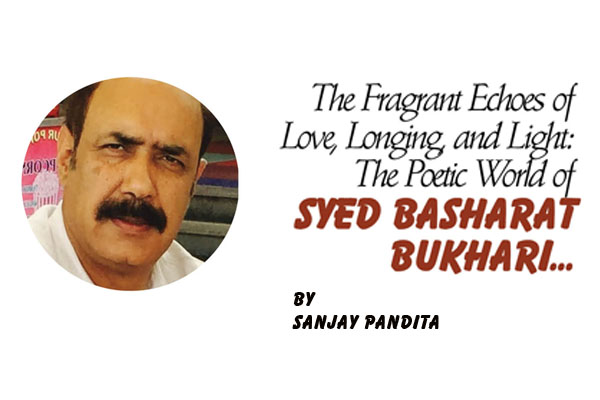
SANJAY PANDITA
In an age when poetry often drifts into performative spectacle, where lines are crafted for applause rather than insight, Basharat Bukhari’s voice emerges as a quiet rebellion—a flame burning inward, illuminating the depths rather than glimmering outward. His verses are not crafted to amuse or to dazzle; they are forged to lead the reader into silent chambers of the heart, to unsettle complacency, and perhaps to cleanse, if not fully then at least partially. He is at once mystic, lover, philosopher, observer—a seeker across multiple streams of thought, bringing them together in a lyrical tapestry rich in humility, hunger, and intelligent restraint.
His poetry is not ornamented with flamboyant gestures—it is molten in its simplicity. In such restraint, it glows. Take for instance this supplication:

“You alone are the Supreme One, You alone are the Master, You are the sustainer, O Lord
We all are dependent on Your mercy, O Lord”
This couplet could very well be the whispered prayer of a mystic in solitude, or the loud chorus of a seeker in spiritual ecstasy—both recognizing one truth: God alone suffices.
“You alone are the most exalted, You alone are the Master, You alone are the Sustainer, O Lord!
We are all in need of Your mercy here, O Lord!”
This is not just religious praise; it is a cry of the heart—an admission that without the Divine’s kindness and care, humanity is lost. It’s a reminder of spiritual poverty in contrast to Divine richness, a theme central to many Urdu spiritual and Sufi verses.
(“I am the sinner—by the Prophet (PBUH), do not cast me out; from the folds of Your mercy, O Lord, do not expel me.”)
This is no mere confession—it is an immersion in tawba, a drowning in divine mercy. The poet’s voice trembles here—not with defeat but with the hope that mercy follows brokenness. It evokes the Sufi notion of repentance, a path of ashes toward transformation.
He does not flinch from naming the self’s illusions. In a couplet of rare admission:
(“Sometimes I considered myself great, sometimes I was proud.”)
Here, pride is not a literary device—it is confessed sin, a veil removed in the presence of God. In this instant, Bukhari is not a poet—he is a dervish before the Beloved, stripped bare in acknowledgment of his own nothingness. This is the voice of fana—self-annihilation—rendered without ritual, without grandiosity.
Yet, Bukhari is not confined to the sacred. His romantic poetry is no sweet indulgence—it is disciplined devotion. Consider these lines:
(“With joy, I turn my gaze into the very path you tread, and on that road beneath your steps I spread my eyelashes.”)
These metaphors dissolve boundaries—they are devotional acts disguised as romance. The beloved is the mirror of the Divine, and the poet’s gaze, a channel of worship. In Bukhari’s world, love and devotion fuse until they seem indistinguishable.
In another verse:
(“Though your absence brings me no peace, at every turn I shall call your name—I shall call your name.”)
Repetition becomes ritual. A litany echoing within, where the lover’s longing slides into metaphysical ache. The beloved here is both a person and a presence—distance becomes an existential condition, longing an act of faith.
Bukhari’s skill lies in the subtlety of his tools—every line feels like a prayer. His diction is accessible, yet its impact is potent. He does not adorn; he reveals.
Even his social commentary avoids bombast. He wields satire lightly, like a surgeon:
(“With the tongue one can guess character—where is the scale here? Tell me of the sleeves.”)

This is not mockery—it is inquiry. The “sleeves” become symbols of hidden intent; the poet’s sharpness becomes their mirror.
His rhythm isn’t thrusting—it breathes. Lines carry internal rhyme and pause. They are meant to be whispered, imagined in candlelight. Silence is active, not empty.
Bukhari’s pen moves like a scalpel in the hands of a surgeon—precise, painful, necessary. He unmasks the superficialities of modern living and exposes the hollowness of words without meaning, rituals without heart, and authority without compassion. Yet even as he critiques, he hopes. Even as he mocks, he mourns. His satire is soaked in a mystic’s sorrow.
And always, behind every word, there is that overwhelming humility, that insistence that all is dust without the mercy of the One. In a moment of devotional climax, he writes:
“Those who are higher than the highest—He (ﷺ) is the intercessor for sinners,
Let me be counted among his lovers, O Lord!”
This couplet bears the fragrance of a centuries-old tradition of praise poetry (na’at) but carries the trembling urgency of a modern seeker. The poet places himself not among the saints or the righteous, but among the sinners who dare to love. This theme of being simultaneously unworthy and yet hopeful defines much of Bukhari’s mystical landscape.
His later poems continue this journey, but with even greater luminosity. There, he writes:
“The whole universe is lit by Your resplendent manifestations,
All creation, by Allah, is but a pearl from Your ocean.”
The metaphysical imagination on display here is staggering. To see creation as a single pearl in the ocean of Divine being is to place oneself in awe, to see life not as a possession but as a gift. Bukhari’s poetry does not seek control—it seeks communion. It does not seek answers—it offers wonder.
(“When love’s intoxication falls, then its test is fierce— sometimes a moment can stretch like months.”)
Time becomes elastic; poems become journeys through states of heart and self. Love is philosopher, chronicle, trial, rapture.
Bukhari’s theology is not systematic or scholastic; it is lived, trembling, experiential:
(“My heart is dull, my soul weary and broken; my being is full of fault, defeated by the ego.”)
This theology is sculpted by wounding. The poet’s confession is a vessel for all those who bear the scars of weakness, fear, pride.
And still, within the melancholy, there glimmers paradox:
(“My day is like night; every prelude to dawn of mine is false.”)
This is the language of Koans—riddles designed to wake the soul. Bukhari is playing the paradoxes of existence; he invites the reader to taste their edges.
He is modest in his imagery, yet universal in ambition. The moon isn’t just beauty—it’s guide. Stars are divine signs. A sigh is sacred scripture.
His couplet on disparity:
(“Those who always have everything can never estimate the sweat of the poor.”)
This isn’t populism; it is spiritual empathy. He contrasts ease with effort, blessing with burden, privilege with labor. Without harsh criticism, he raises awareness; through poetic telling, he fosters compassion.
Throughout, Bukhari refuses the hero’s mask. He writes not for fame, but for fidelity—to heart, to breath, to breathless moments. He dissolves the barrier between speaker and witness. His art is hospice for a weary soul, architecture for a fragile spirit.
One finds in him a mirror—of weakness, of hope, of the dust from which we emerge and to which we may return. His is not a voice that shouts; it is one that listens. Its echo is internal before it travels outward. His pen doesn’t write to be seen; it writes so that the unseen may be seen within.
He doesn’t seek applause—he seeks alignment. With God, with self, with you who dare to listen. His poems are not ends—they are beginnings: beginnings of introspection, of confession, of compassion.
In a world frenzied with noise, Basharat Bukhari’s poetry is quiet. But it is deep. Not shallow. It is slow but sure. Not flashy. It is intended to awaken, not entertain. To cleanse more than to clarify. To create urgency in stillness. To build communion in silence.
Here, finally, in the elemental lines:
(“How astonished and troubled I am—though human, have you forgotten the fruit of Adam’s hand? Unfamiliar with God’s majesty, I was also foolish enough to forget that not every morning brought the promise of the Sustainer’s re-creation.”)
These lines circle back to origin—dust, dawn, dependence, humility. The cosmos is not backdrop—it is companion. The poet is not agent—he is dependent.
In Basharat Bukhari the poet, we encounter something rare: a voice unshakeable in its vulnerability. A truth made of flaw, not façade. A flame that burns quietly, yet clearly—illuminating not to blind, but to show the way inward.
He does not conclude his poetry with flourish; he leaves us with a door ajar, a wind stirring possibilities, a breath held in anticipation. That is his legacy—the echo that persists, the hush that heals, the piece of you that turns toward dawn because he dared to whisper.
In contemporary Kashmiri literature,(urdu and kashmiri), where many voices rise only to echo one another, Syed Basharat Bukhari stands singular. He does not follow the fashion; he follows the flame. A flame that lights without consuming, that warms without branding. His poems do not demand your attention; they earn your trust. They invite you into a space where the personal becomes prophetic, where sorrow becomes song, and where silence becomes sacred.
To read Basharat Bukhari is not merely to encounter a poet, but to meet a witness—someone who has seen the many faces of love, divinity, hypocrisy, and loss, and who has returned not with bitterness but with wisdom. His poetry teaches us to see with compassion, to critique with care, and to love with responsibility. He is a poet for our times precisely because he refuses to be consumed by them. In his verses, we find not only beauty, but belonging.
In the final reckoning, Syed Basharat Bukhari is not merely a contemporary poet. He is a contemporary necessity. In his words, we are reminded that poetry is not about performance but presence; not about decoration but depth. He does not give us answers. He gives us the courage to ask the right questions—and to sit, patiently, with the silence that follows.
He does not conclude his poetry with flourish; he leaves us with a door ajar, the wind whispering through its unseen crack. One does not finish reading Basharat Bukhari; one pauses, returns, and listens again. His words are not destinations—they are thresholds. And what lies beyond them is not certainty, but the quiet invitation to deepen, to descend, and to dwell—in longing, in light, in love.
The writer can be reached at sanjaypanditasp@gmail.com

