

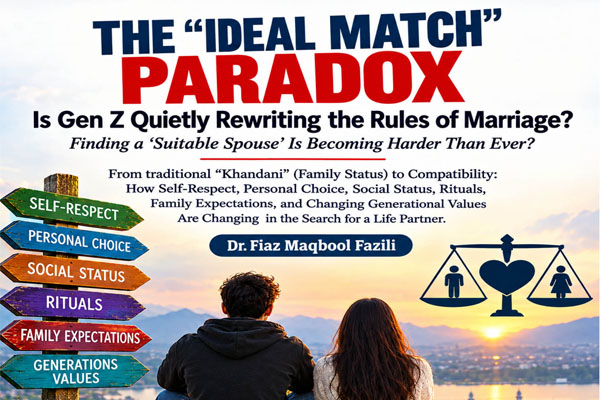
Dr. Fiaz Maqbool Fazili
Marriage in Kashmir is no longer merely a search for a husband or wife. It has become a search for an entire package: a good family, good looks, higher education, a secure government or corporate job, a respectable salary, an independent house, strong religious values, a modern outlook, traditional roots, and increasingly, a willingness to live separately from parents. The checklist grows longer. The willingness to compromise seems to grow smaller.
The irony is striking. Kashmir today has more educated young men and women than any previous generation. Women are more financially independent. Social exposure has widened. Matrimonial websites, social media, and professional networks have multiplied opportunities for connection. Yet finding a compatible spouse often feels more difficult than ever. Why? The answer lies in a society caught between inherited expectations and individual choice, between status and compatibility, between tradition and autonomy. The idea of choosing partners from “khandani” families remains influential in marriage decisions in some Kashmiri families. It generally refers to family lineage, reputation, values, social standing, and established ancestry, rather than wealth alone. Families may see a khandani background as a sign of good upbringing, education, religious or social standing, and family compatibility. However, the meaning is subjective and varies between families, so being “khandani” does not objectively determine a person’s character or suitability, or financial standing as a spouse. At its best, the term refers to respectability, good upbringing, and family values. At its worst, it creates a hierarchy: established versus ordinary, “our people” versus “others.”
The uncomfortable question is whether we sometimes examine a surname before we examine character. Many respectable proposals are quietly rejected because the family background is not deemed an appropriate “match.” Others are welcomed because family prestige, lineage, or social standing creates an impression of suitability. This contradiction is especially striking in a society whose religious and moral foundations emphasize equality and human dignity. Sometimes what passes as tradition is simply status anxiety wearing traditional clothes. Yet the counterargument deserves respect. Families inquire about background not merely to display social superiority but because culture, values, and upbringing matter. Parents want to know what environment their son or daughter is entering. That concern is legitimate. The problem begins when family pedigree becomes more important than the individual standing before us, when a Job, the salary, title of position becomes a marriage certificate. If there is one universally accepted currency in Kashmir’s matrimonial market, it is employment. Look at the middleman’s diary—a brief bio that can be quite revealing. What stands out is not merely the individual’s qualifications, but the height of prospective spouse along with highlighted names of relatives who hold, or have held, social, professional, or societal prominence.
Government service, once considered the gold standard, is no longer the only preferred choice. Yet a permanent and stable job, promising career prospects, a lucrative salary, steady income, home ownership, current residential (NRI/PR )status, even nature of visa is mentioned and financial security often determine a person’s matrimonial value—sometimes before personality, temperament, akhlaq (conduct), religiosity, nobility, or character are even discussed.Economic caution is understandable. Marriage brings responsibility, and financial insecurity can strain even healthy relationships. Yet somewhere along the way, economic security has become a matrimonial obsession.
An educated, responsible, emotionally mature person may struggle to receive consideration because employment is not considered secure enough. Meanwhile, prestigious designations often make personal shortcomings easier to overlook. In some circles, the conversation becomes even more troubling. Whispers of additional earnings, regardless of how they are acquired, are sometimes treated as hidden matrimonial assets rather than ethical concerns. When money- financial position, affluence becomes the defining criterion, we should ask what exactly is being evaluated: compatibility between two human beings or the market value of a résumé. A job is not a personality. A salary cannot teach kindness. A government designation cannot guarantee loyalty, loving and caring. A luxurious home cannot ensure emotional safety. Yet many families investigate credentials more carefully than character.
The rise of the independent Kashmiri woman has added another dimension to spouse selection.Perhaps no change has transformed Kashmir’s marriage landscape more dramatically than the rise of the educated, financially independent woman. Many young women no longer view marriage as financial security. They possess degrees, careers, earnings, professional identities, and ambitions of their own. Consequently, the central question has shifted. Earlier generations often asked: Can he provide for her? As women become more independent—professionally, financially, and personally—they are increasingly exercising the freedom to choose whom they marry. Their choices are no longer shaped solely by family status, wealth, physical appearance or social expectations; many now seek a partner who respects their autonomy, shares responsibilities, supports their aspirations, and is willing to build a life together as equals. A financially independent woman is not necessarily looking for a provider. She is often looking for an equal partner. She may wish to continue working. She may want control over her finances. She may want to preserve a career built through years of effort. She may seek companionship rather than guardianship.For some men, this evolution is welcome. For others, it challenges traditional expectations. The result is an understandable collision between changing realities and established gender roles. Yet independence also requires balance. If both individuals insist that careers, locations, lifestyles, finances, and family arrangements remain entirely untouched, marriage becomes difficult. Every successful marriage requires negotiation. Independence should never mean I will adjust to nothing. But adjustment should not mean I will surrender everything. The future of marriage lies somewhere between those extremes.The satellite family revolution, nothing highlights changing expectations more clearly than the growing preference for nuclear or “satellite” families. For many older Kashmiris, the joint family remains a source of strength, continuity, belonging, and support. It offers practical advantages during childcare, illness, old age, and financial hardship. For many younger couples, however, separate living signifies privacy, autonomy, and fewer domestic conflicts. A young bride may wonder why marriage should automatically require entering a household where every decision is collectively supervised.A young husband may struggle to balance the expectations of ageing parents with his spouse’s need for independence. Neither side is entirely wrong. Joint families can provide emotional security but may generate tensions regarding privacy, finances, domestic responsibilities, and decision-making.
Nuclear families offer independence but may create loneliness, higher costs, and heavier caregiving burdens. The real question is not whether joint or nuclear families are superior.The question is: What arrangement allows a particular couple and their families to live with dignity, respect, and emotional well-being?
Another powerful matrimonial trend is the attraction toward spouses settled outside Kashmir or abroad – non-resident dreams, local realities. The appeal is obvious. Better opportunities, stronger economies, enhanced lifestyles, and international exposure often make such proposals highly desirable. Yet geography can conceal difficult questions. What happens to ageing parents? How are family bonds maintained? What if one spouse eventually wishes to return home while the other does not? How will future children navigate identity, culture, and belonging? A foreign address can enhance a proposal on paper. It cannot guarantee compatibility. The passport, visa status, PR may be impressive. The marriage still has to work.Social media has transformed not only communication but expectations themselves into the myth of perfection. People constantly see on Facebook or Instagram, reels, photographs of extravagant weddings, luxurious homes, foreign vacations, and apparently flawless couples. The result is that compatibility is increasingly confused with perfection. The desired spouse must be educated, attractive, successful, caring, religious, modern, traditional, ambitious, independent, financially secure, emotionally available, and somehow free of complications. What emerges is not a human being.It is a customized matrimonial product. The pursuit of perfection often blinds people to qualities that actually sustain marriages: honesty, patience, empathy, resilience, emotional maturity, and commitment. Perfect spouses do not exist. Compatible, Cooperative, Obedient. Resilient, adjusting spouses do. Families worry about delayed marriages and a shortage of suitable matches, yet the very same proposals are often rejected because of family, profession, location, age, lifestyle, or social background. Not enough money. Too much family involvement. Too little family involvement. And then comes the striking new-age verdict, replacing generations of concern over lineage, status and family standing: “The vibes just weren’t right.”
Certainly, nobody should marry merely because society is impatient. Choosing carefully is wise. But endless rejection based on unrealistic expectations creates its own crisis. The perfect human being does not exist. Neither does the perfect marriage. While marrying quickly can be unwise, endlessly waiting for perfection may be equally costly. Perhaps the most revealing aspect of modern matchmaking is the information we prioritize, what we record and what we ignore.Marriage profiles frequently contain detailed data about degrees, employment, wealth, social connections, property, and family influence.Yet some of the most important questions frequently receive little attention. Is this person kind? Are they honest? Do they respect others? Are they emotionally mature? Are they spiritually grounded? Have they been raised with integrity and empathy?We have become remarkably efficient at documenting what people possess and strangely careless about documenting who they are. Character enters a marriage every single day. Qualifications, Position titles and salaries do not.The real crisis, I noticed is a shortage of flexibility
Kashmir’s matrimonial challenge is not a shortage of eligible men or women. It is often a shortage of flexibility. Parents seek tradition. Children seek autonomy. Women seek independence. Men seek acceptance without relentless financial scrutiny. Families want closeness; couples want privacy. Everyone wants respect, security, and compatibility—yet somehow, everyone expects the other side to compromise first. Too often, we negotiate status before values, property before partnership, and salaries before character. Then, after marriage, we tell the couple to “adjust. “Perhaps the order should be reversed. First ask whether two individuals are genuinely compatible.Then discuss careers, finances, living arrangements, parental responsibilities, and future expectations.These conversations may be uncomfortable before marriage.They become far more difficult afterward.
Gen Z Is not rejecting institution of marriage. It Is renegotiating. A common complaint is that Gen Z is undermining family values. The reality is more nuanced. Many young people are not rejecting marriage; they are reimagining what it should look like. They are asking whether respect for parents can coexist with individual choice, whether families can remain close without insisting on a shared household, and whether tradition can preserve its values without perpetuating outdated hierarchies. Can weddings remain meaningful without becoming financially burdensome? And can an educated, financially independent woman be recognised as an equal partner rather than a dependent? These are not anti-family questions. They are questions about the future of the family itself.
Kashmir does not need to choose between tradition and modernity as though they are enemies. It needs to distinguish between traditions that preserve values and practices that merely preserve privilege or control. The matrimonial revolution is already underway. The question is whether families will participate in it thoughtfully or continue searching for perfection while compatible matches quietly pass them by. Because the greatest matrimonial mistake is not necessarily marrying late. It is mistaking perfection for compatibility. Marriage has never depended primarily on surnames, salaries, passports, or social status. It survives on character, mutual respect, flexibility, communication, and courage. The ghost of “Khandani” may still be sitting at the table. Gen Z has simply stopped pretending not to see it. And perhaps that is not the beginning of a crisis.
Perhaps it is the beginning of an honest conversation.
The Author is a Surgeon at Mubarak hospital, Healthcare policy analyst, Certified Professional in Quality improvement in Hospitals can be reached at drfiazfazili@gmail.com

