

By Mishal Riaz
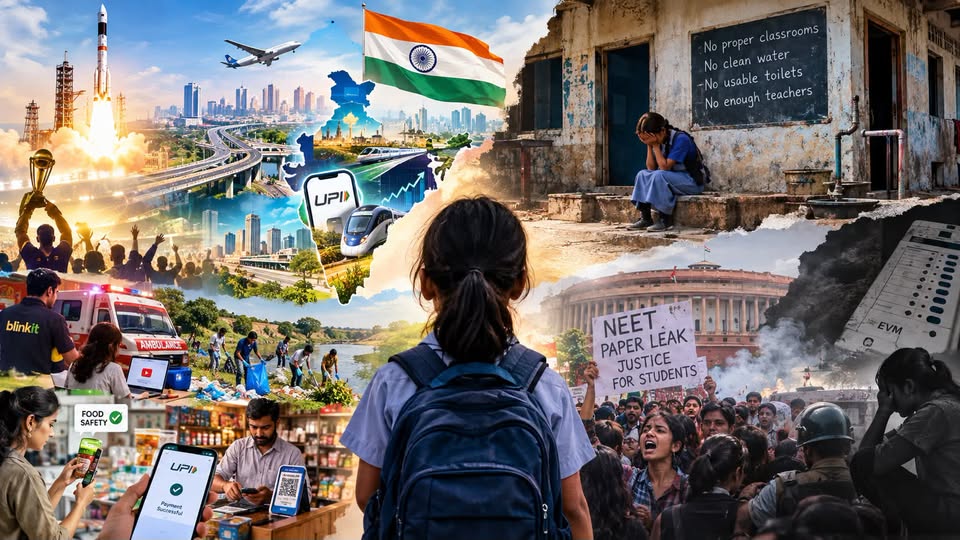
India is changing rapidly. Every other day, our eyes are blessed by some new achievement of our holy nation. Another headline, another celebration and a new reminder of how far India has come. And in all this noise of achievements, there is still something important being ignored. We are constantly reminded of the India that is rising, the India sending missions to space, growing its economy, building highways and airports, proudly showcasing its achievements and earning a name for itself around the world. These achievements are undoubtedly worth celebrating. But the question remains, are these achievements actually improving the lives of the common people of our nation? Somewhere between these headlines of progress, there is another India. One that doesn’t make it onto the celebration posts. If a country is progressing, but millions of its people are still struggling to access quality education, find secure opportunities or simply have their voices heard, what exactly are we measuring when we call it progress? Maybe the answer lies in looking at the things we have somehow learnt to accept as normal. Things that don’t necessarily make it onto some political leader’s Instagram post, but affect millions of Indians every single day.
One of the biggest among them is education. We love telling our children that education is the great equaliser, the magical little ticket that apparently takes you from a village classroom straight into your dream life. It sounds very inspiring. Except the system handing out those tickets seems to occasionally lose the question paper. Paper leaks aren’t exactly a new plot twist in Indian education. Students spend months preparing for an exam, families spend money on coaching, everyone collectively loses sleep, and then, sometimes, the integrity of the examination itself becomes the thing nobody can guarantee. An Indian Express investigation identified 45 major paper-leak cases between 2002 and 2025. And suddenly, “just study harder” sounds like questionable career advice. While we’re busy debating cut-offs and competitive exams, there is another India where the problem isn’t whether you got 97% or 98%.
The problem is whether your school has the resources to give you a fair chance in the first place. Because apparently, in one of the world’s largest economies, your postcode can still have a surprisingly large say in the quality of education you receive. While one child is worrying about which coaching institute will get them into the country’s top colleges, for another, it can mean studying in an environment where clean water, usable washrooms or even a proper classroom can feel like a luxury. And this isn’t some exaggerated picture of rural India. ASER’s 2024 data shows that even today, the basics are not provided everywhere. In the rural schools it surveyed, drinking water was available in 77.7% of schools, while just 79% had a usable toilet. For girls, the figure was even lower: only 72% had a usable girls’ toilet. And the problem doesn’t stop at the walls of the classroom. Between 2014–15 and 2024–25, the number of government schools in India fell from 11.07 lakh to 10.13 lakh, nearly 94,000 fewer schools.
At the same time, more than 1 lakh schools now operate with just one teacher, meaning one person can be left teaching multiple grades while also handling the work that comes with running the school. Imagine trying to give an entire school an education when there is barely an entire staff to educate it. We keep talking about giving every child an equal opportunity to succeed. But how equal can that opportunity really be when one child begins with private coaching, well-equipped classrooms and teachers for every subject, while another begins with a school where even the basics, and sometimes even the number of teachers, are stretched thin? We’re talking about education here. The bare minimum, not some luxury service. A child shouldn’t have to wonder whether the place they’re spending half their day in will even provide them with clean water or a usable toilet. Yet somehow, we’re comfortable calling this the same “right to education” we proudly talk about on paper.
India is also very well known as the “world’s largest democracy”. But democracy isn’t supposed to end the moment the votes are counted. And even before we get to know who gets elected, we have to ask a more basic question, can citizens trust the process that decided it? The 2024 Lok Sabha election saw genuine incidents that should not simply be brushed aside. In parts of Manipur, polling stations witnessed violence and EVMs were damaged, leading the Election Commission to order re-polling at 11 polling stations. Votes are supposed to be the foundation of that democracy. So what happens when even the process of voting starts raising questions? The very fact that the transparency of the process has become such a major public issue tells us something, trust in an election isn’t just about declaring a winner. It’s about convincing people that the process itself deserves their trust. And that’s where the phrase “vote chori” has entered the political conversation. So perhaps the question isn’t simply, “Who won?” It’s: can the people trust how the winner was chosen?
Democracy isn’t simply about votes. It’s also about what happens when people say, “You got this wrong. Now answer us.” And Jantar Mantar gave us a pretty uncomfortable example. The NEET paper-leak crisis did not just disrupt an examination. According to reporting on the aftermath of the controversy, 21 students died by suicide, leaving behind families who were not just grieving, but demanding answers. Citizens came to Jantar Mantar asking for justice. They wanted accountability for what had happened to an exam that millions had trusted with their futures. They protested peacefully, and yet when protesters marched towards Parliament, police used tear gas and lathi charges. And that is where this stops being just an exam controversy. These were students who had spent years preparing for one of the most competitive exams in the country. Their parents had invested years, money and hope into the same dream. When that system failed them, they did what citizens in a democracy are supposed to be able to do, they asked for answers. So why did demanding those answers have to become a confrontation? We proudly call India the world’s largest democracy. But democracy cannot simply mean having the right to vote. It has to mean having the right to question, to protest and to demand accountability when the system fails you. Because if the people asking questions are met with tear gas before they are met with answers, then what exactly are we calling democracy?
And, instead of simply answering young people’s questions about an examination system they were being asked to trust with their futures, the national conversation also turned towards the language some protesters had used. In a video posted on social media, Prime Minister Narendra Modi referred to abusive language used against him and his late mother at the protest and said it was a “cultural shock” to hear such language from girls. Of course, abusing anyone isn’t suddenly acceptable because they are protesting. But why did the fact that some of those protesters were girls become part of the outrage? Would the same behaviour from boys have carried the same cultural meaning? That’s where this stops being only about a protest. It’s also about the way we respond when young people become inconvenient. And eventually, the government did respond. On July 25, after 36 days of protest, Education Minister Dharmendra Pradhan resigned, and the protesters called off their agitation after saying the government had accepted their demands. So yes, accountability eventually happened. But why did it take 36 days of protest, hunger strikes and a national uproar to get there. These students weren’t asking for some impossible revolution. They were asking for an education system they could trust. They were asking their leaders to simply answer them. If citizens have to shout this loudly just to be heard, how much of our democracy is actually listening?
We are also constantly reminded that India is one of the largest economies in the world. And yes, the growth is real, with India’s rapid expansion in infrastructure, digital payments and businesses. Even the IMF has described India’s economic rise as significant.But sometimes I wonder what this growth looks like from the other side of the screen. Because we have reached a point where Blinkit is sending ambulances to emergency situations. Kids are learning from YouTube because the internet can sometimes offer them what their school cannot. Influencers are organising clean-up drives for rivers and streets. People like FoodPharmer and Trustified are testing food products and bringing food-safety concerns to millions of people online. None of that is bad. In fact, thank God people are doing it. But it does raise an uncomfortable question.
Why are citizens, creators and private companies increasingly stepping in to fill gaps in systems that are supposed to serve the public? If a government school doesn’t provide the quality of education a child needs, the family looks elsewhere. If a public hospital isn’t accessible or reliable enough, people turn to private hospitals. If a street is drowning in garbage, someone starts a clean-up drive. If people don’t know what’s actually in the food they’re buying, an influencer buys the product, sends it for testing and explains the results online. And then there’s UPI. For years, UPI has been presented as one of India’s great digital success stories. And it genuinely is. It has made everyday payments ridiculously convenient and has become a major part of India’s digital economy. The government says UPI will remain free for consumers, while a 0.4% Merchant Discount Rate will apply to specified merchant transactions above ₹2,000, with exemptions for many small merchants and other categories.
So technically, no, you aren’t being charged 0.4% for buying your ₹3,000 headphones. But the person selling them still has to account for that cost if their transaction falls under the new MDR. And that is where the conversation becomes bigger than UPI. The government says merchants must not pass the MDR on to customers. But businesses still have costs. A large company might be able to absorb a small additional expense. A small shop operating on thin margins has a very different calculation. Whether the cost gets absorbed, reflected elsewhere in pricing, or changes how merchants use digital payments is something that will become clearer with time. And that is the part people should be allowed to question. Because we already pay taxes.
We pay them through our incomes, our purchases and the things we consume every day. That money is meant to help fund the public systems around us: schools, hospitals, roads, sanitation, transport, safety and countless other services that aren’t nearly as glamorous as announcing another giant project. So when we see citizens filling gaps themselves, and then see new costs appearing somewhere else in the system, it is fair to ask: What exactly are we paying for, and how much of what we pay actually comes back to us as a functioning public service? India’s economic growth deserves recognition. So does UPI. So do the people creating businesses, cleaning streets, testing food and helping communities. But a country’s success cannot be measured only by how impressive its economy looks from above. It has to mean something on the ground too.
Because what does it matter that we are becoming an economic giant if an ordinary person still has to wonder whether the government hospital will have what they need, whether their child’s school will actually teach them, whether the road outside their house will be maintained, or whether the public systems they pay for will actually be there when they need them? Progress isn’t just about how much a country can produce. It is also about how much of that progress an ordinary person can actually feel. Yes, India is growing. The economy, infrastructure, the digital economy is growing and every few days there is another achievement for us to celebrate. But growth on a national chart does not automatically mean a better life inside every household. If the school still lacks basics, the hospital still cannot provide what people need, public money does not always translate into public services, and citizens have to fight to be heard, then somewhere between the headlines, something big is being lost. India does not need to stop acknowledging its achievements. It just needs to start being honest about everything those achievements haven’t fixed yet. And perhaps the most important change is already happening, people are asking questions. The old distraction of turning every issue into Hindu versus Muslim cannot answer questions about schools, jobs, hospitals, corruption or accountability.
I hope that very soon, the people of India are looking past the noise and demanding answers from whoever asks for their vote. Because we deserve more than a country that looks successful from the outside. We deserve a country where that success can actually be felt at home. And after everything we have seen, questioned and demanded, I hope 2029 provides us with justice.
About the author:
Mishal Riaz is a student from Srinagar, Jammu & Kashmir, with a growing interest in writing about politics, society and the issues that affect young people.. “The India They Don’t Post About” is her first article and her first step into exploring these subjects through writing. She hopes to continue developing her voice and understanding of the world around her through her work.
