HAROON RASHID BHAT
The recently telecast interview of Dr. Ghulam Qadir Allaqband, conducted by a local channel, was highly informative, engaging and, above all, deeply moving.

What made this interview particularly special was the liberal and relaxed manner in which it was conducted. The interviewer gave ample time and space to the guest to share his life experiences, memories and reflections without unnecessary interruption. There was no apparent language barrier. Dr. Alaqband used language with remarkable skill, expressing some experiences in his native tongue with great lucidity and warmth. Perhaps he understood that certain memories carry an emotional attachment that can be expressed most naturally in one’s own language.
Another remarkable aspect of the interview was Dr. Alaqband’s honesty. While narrating the ups and downs of his life, he did not hesitate to speak about the hardships he faced in meeting even his basic needs and pursuing his education. He spoke about a time when life was difficult and resources were scarce, yet determination and hope kept him moving forward.
His story was not merely the story of an individual. In many ways, it was the story of Kashmir itself—a land and society that has passed through profound social, economic and political changes over the decades. The experiences of one person reflected the experiences of an entire generation that grew up with limited resources but abundant resilience.
One particular incident narrated during the interview has stayed with me. Dr. Sahib recalled how, on the occasion of Eid, his family was unable to arrange a new dress for him. At a time when even fulfilling basic needs was a challenge, a local tailor showed an extraordinary gesture of kindness. The tailor arranged a dress for the young Dr. Sahib so that he could celebrate Eid like other children.
The incident may appear small in today’s materialistic world, but its emotional significance is enormous. The tailor perhaps did not possess great wealth himself, yet he possessed something far more valuable—the sensitivity to understand another person’s difficulty and the generosity to help without expecting anything in return.
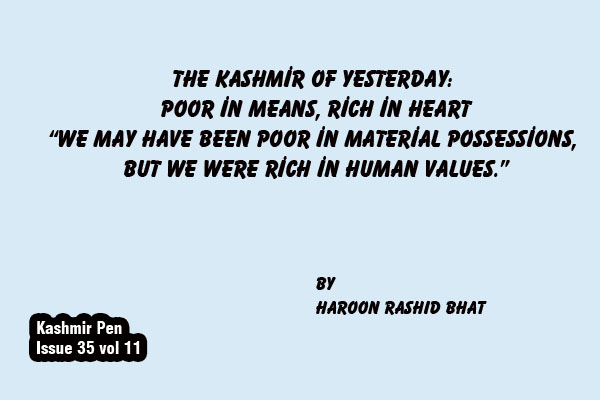
This simple incident tells us something profound about the Kashmir of that time. People might have been poor in material terms, but they were often rich in compassion. A neighbour’s difficulty was not always considered someone else’s problem. People cared for one another and tried to share whatever little they had. Such acts of kindness were not necessarily publicised; they were part of everyday life.
The story also made me think about the meaning of Eid. Beyond new clothes, delicious food and celebrations, Eid has always carried a message of sharing, compassion and remembering those who may not be in a position to celebrate. The tailor’s gesture embodied that spirit in its simplest and purest form.
As the conversation progressed, it became increasingly emotional. With his eyes filled with tears, Dr. Alaqband spoke about the health condition of his better half, who, as he acknowledged, played a pivotal role in his journey and success. His words reflected not only gratitude but also the deep bond, sacrifice and companionship that often remain hidden behind a person’s achievements.
There was something deeply human in the way he spoke about his past. He did not try to hide his struggles or present his life as a smooth journey. Instead, he allowed the audience to see the difficult phases as well as the moments of achievement. Perhaps that is what made the interview so relatable. Behind every successful person there is often a story of sacrifice, uncertainty, struggle and the support of people who stood beside them.
As I watched the interview, new windows seemed to open into our past. A past that was undoubtedly marked by financial difficulties and political uncertainties, but which was also rich in social values, morality, compassion and mutual care. People had fewer material resources, yet they often stood by one another in times of need. There was a stronger sense of community and responsibility towards neighbours and fellow beings.
The episode narrated by Dr. Shab during the interview was particularly revealing. His account of the tailor’s gesture brought before us a picture of a society in which kindness could emerge from the most ordinary corners of life. It reminded us that greatness does not always belong to those who occupy important positions. Sometimes, an ordinary person performing an ordinary act of kindness can leave an extraordinary mark on another person’s life.
Such stories are becoming increasingly important in our times. We live in an age of rapid technological advancement and unprecedented material choices. Yet, in the midst of this abundance, we sometimes find ourselves longing for the simplicity, trust and human warmth that characterised earlier generations.
Interviews such as this are, therefore, more than conversations with accomplished individuals. They are living archives of our collective memory. They preserve experiences, struggles, values and stories that might otherwise disappear with time. When an elderly or accomplished person speaks about his childhood, education, family and hardships, he is also giving us a glimpse into the social history of the place to which he belongs.
The interview also demonstrates the importance of allowing people to speak freely and at length. Masood Hussain’s conversational approach enabled Dr. Alaqband to move naturally from one memory to another. There was no sense of haste. The pauses, emotions and personal recollections were allowed to become part of the conversation. That made the interview feel less like a formal question-and-answer session and more like a sincere conversation between two people about life.
My appreciation goes to Masood Sahib for conducting such meaningful interview sessions with distinguished personalities. By bringing their life journeys before the public, he is not merely interviewing individuals; he is helping us understand our own society and reconnect with the Kashmir of our memories.
Dr. Ghulam Qadir Alaqband’s interview will remain memorable not simply because of the personality he is, but because through his life story, we were given an opportunity to look back at a Kashmir that was economically poor and politically troubled, yet socially, morally and emotionally rich.
Perhaps the greatest lesson from the interview is that a person’s journey is never entirely his own. Behind every achievement there are people, known and unknown, who contribute through their sacrifices, prayers, encouragement and acts of kindness. The tailor who arranged an Eid dress for a struggling child may never have imagined that his small act would become a cherished memory decades later.
That is the Kashmir we must remember—not merely for its hardships, but also for its humanity. And that is why such interviews matter. They do not simply tell us where we came from; they quietly ask us what kind of society we wish to become.
Haroon Rashid Bhat is a teacher and columnist and can be reached at minamharoon123@gmail.com.