

DR Fiaz Maqbool Fazili
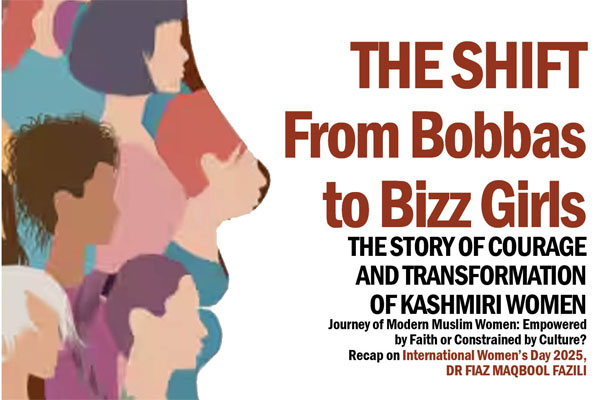
The 21st century has witnessed a significant transformation in the lives of Muslim women across the globe, including those in Kashmir. Traditionally, Kashmiri women, particularly young girls, were often branded with stereotypes such as “Bobbas,” a term used to describe a timid, bubbly, and submissive girl. However, in the modern era, Kashmiri women have broken free from these limiting labels, emerging as confident, educated, and empowered individuals. The journey of Kashmiri women from being confined by traditional stereotypes to excelling as “Bizz girls” in modernity is a testament to their resilience, determination, and adaptability. For centuries, Kashmiri women were bound by societal norms that confined them to domestic roles, limiting their opportunities for education, employment, and self-expression. Patriarchal structures and cultural expectations often overshadowed their potential, leaving little room for them to explore their aspirations beyond the household. However, the winds of change began to blow as globalization, education, and technological advancements reached the valleys of Kashmir. Women started challenging these age-old stereotypes, seeking education and venturing into fields previously dominated by men. The rise of entrepreneurship and digital platforms provided them with opportunities to break free from traditional constraints and carve out their own identities. Today, Kashmiri women are redefining their roles as “Bizz girls,” excelling in diverse fields such as technology, entrepreneurship, arts, and social activism. They are founding startups, leading businesses, and contributing to the economy while balancing their cultural heritage with modern aspirations. Social media and e-commerce have become powerful tools for these women to showcase their talents, whether in handicrafts, fashion,food or tech innovations. This transformation has not been without challenges. Many women face resistance from conservative sections of society, yet their determination to succeed has inspired a new generation. Organizations and initiatives supporting women’s empowerment have also played a crucial role in this journey, providing mentorship, resources, and platforms for growth. The story of Kashmiri women is one of courage and transformation. From being confined by traditional roles to emerging as leaders and innovators, they are rewriting their narrative, proving that tradition and modernity can coexist. Their journey is a beacon of hope, not just for Kashmir but for women everywhere striving to break barriers and achieve their dreams. This essay explores the journey of Kashmiri women from being confined by traditional stereotypes to excelling as “Bizz girls” in modernity, examining whether their empowerment stems from faith, modernity, or a combination of both.
The Traditional Stereotype: Bobbas of Kashmir in traditional Kashmiri society, women were often confined to domestic roles, with their identities tied to familial and cultural expectations. The term “Bobbas” is used to describe young girls who were perceived as timid, obedient, and carefree. This stereotype was deeply rooted in patriarchal norms that emphasized modesty, submission, and the prioritization of family honor over individual aspirations. Education and career opportunities for women were limited, and their voices were often silenced in public and private spheres. The Bobbas stereotype was not just a reflection of individual behavior but a cultural construct that reinforced gender roles. Women were expected to be soft-spoken, nurturing, and compliant, while men were seen as the decision-makers and breadwinners. This dichotomy created a rigid framework that left little room for women to explore their potential beyond the confines of their homes.
The Shift: From Bobbas to Bizz Girls: The advent of modernity, globalization, and education has played a pivotal role in reshaping the lives of Kashmiri women. Over the past few decades, there has been a noticeable shift in the way women perceive themselves and are perceived by society. The term “Bizz girl” symbolizes this transformation—a confident, ambitious, and independent woman who excels in various fields, including business, education, politics, and the arts. One of the key drivers of this change has been access to education. Kashmiri women have increasingly pursued higher education, both within and outside the region, equipping themselves with the skills and knowledge needed to compete in a globalized world. Universities and colleges in Kashmir have seen a surge in female enrollment, with women outperforming men in many academic disciplines. This educational empowerment has enabled them to challenge traditional norms and carve out spaces for themselves in previously male-dominated fields. Another factor contributing to this shift is the influence of technology and social media. Platforms like Instagram, Facebook, and LinkedIn have provided Kashmiri women with a voice and a platform to showcase their talents, share their stories, and connect with like-minded individuals. Social media has also played a crucial role in challenging stereotypes and promoting positive representations of Muslim women. For instance, Kashmiri women entrepreneurs, artists, and activists have used these platforms to build brands, advocate for social change, and inspire others.
Faith and Feminism: A Complex Intersection: The empowerment of Kashmiri women cannot be understood without examining the role of faith. Islam, often misrepresented as a religion that oppresses women, has been a source of strength and guidance for many Kashmiri women. The Quran emphasizes the equality of men and women in the eyes of God and grants women rights to education, property, and participation in public life. For many Kashmiri women, their faith has been a source of empowerment, providing them with a moral framework to navigate the challenges of modernity. However, the intersection of faith and feminism is complex. While some women find liberation through their interpretation of Islamic teachings, others face resistance from conservative cultural practices that are often conflated with religion. For example, the hijab, a symbol of modesty in Islam, has been both a source of empowerment and contention. Some women choose to wear it as an expression of their faith and identity, while others feel pressured to conform to societal expectations. In Kashmir, where religion and culture are deeply intertwined, women often navigate a delicate balance between faith and modernity. Many have found ways to reconcile their religious beliefs with their aspirations, using Islamic principles to advocate for gender equality and social justice. For instance, women’s rights activists in Kashmir have drawn on Islamic teachings to challenge discriminatory practices such as gender-based violence and unequal inheritance laws.
Challenges and Resilience: Despite the progress made, Kashmiri women continue to face significant challenges. The region’s protracted conflict has had a profound impact on women’s lives, exposing them to domestic violence, displacement, workplace harassment and economic hardship. The disruption of the peace in the region in the past had further restricted their mobility and access to resources, making it difficult for them to fully realize their potential. Moreover, the persistence of patriarchal attitudes and cultural norms at times continues to hinder women’s progress. While many women have broken free from the Bobbas stereotype, others still grapple with societal expectations that prioritize marriage and domesticity over education and career. The pressure to conform to traditional gender roles can be overwhelming, particularly for women who aspire to pursue non-traditional paths. Despite these challenges, Kashmiri women have demonstrated remarkable resilience and determination. They have formed support networks, created safe spaces, and advocated for their rights in the face of adversity. Women-led initiatives in fields such as Education, Healthcare, Politics ,Aviation, Mass Communication and entrepreneurship have made a significant impact on their communities, challenging stereotypes and inspiring future generations.
Empowerment Through Faith and Modernity ;The journey of Kashmiri women from being branded as Bobbas to excelling as Bizz girls is a testament to their strength, resilience, and adaptability. While modernity has provided them with the tools and opportunities to challenge traditional norms, their faith has served as a source of guidance and empowerment. The intersection of faith and feminism has enabled them to navigate the complexities of their identities, balancing cultural expectations with their aspirations. Kashmiri women have not only broken free from limiting stereotypes but have also redefined what it means to be a Muslim woman in the 21st century. They have shown that empowerment is not a zero-sum game—it is possible to be rooted in faith while embracing modernity. As they continue to excel in various fields, Kashmiri women are not just breaking chains but also paving the way for a more inclusive and equitable society. Their journey is a powerful reminder that liberation is not about rejecting one’s identity but about reclaiming it on one’s own terms.
Author besides being a medical doctor at Mubarak hospital , is very active in positive perception management of various moral, social and religious issues. He can be reached at drfiazfazili@gmail.com & twitter

