

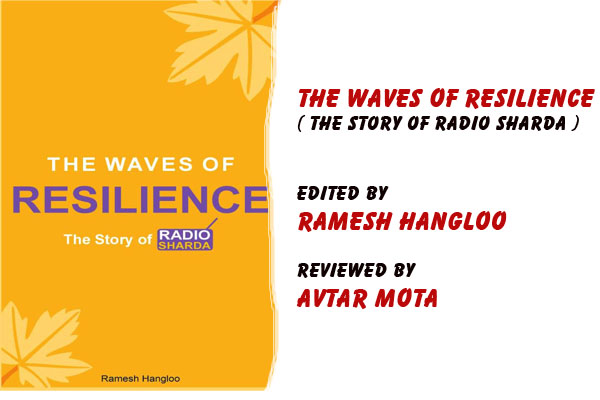
The Waves of Resilience: (The Story of Radio Sharda), edited by Ramesh Hangloo and published by Pir Panchal (CESES) Organisation, is a deeply evocative and intellectually grounded contribution to the discourse on cultural survival, memory, and identity in exile. Priced at Rs 499/-, the volume (190 pages ) brings together 29 essays that collectively document the history, creation, and far-reaching contribution of Radio Sharda, a pioneering initiative dedicated to the preservation of the Kashmiri language and culture in the aftermath of the forced displacement of the Kashmiri Pandit community from Kashmir. This volume must be read not merely as an institutional chronicle but as a layered cultural text that captures the anxieties, aspirations, and resilience of a community negotiating its identity under conditions of prolonged exile. It stands at the intersection of historiography, cultural studies, and memory discourse, offering insights that are both academically significant and emotionally compelling.
Editorial Vision and Structure.

As editor, Ramesh Hangloo demonstrates a clear and purposeful vision. The decision to compile 29 essays from a wide spectrum of contributors ensures that the narrative is neither singular nor reductive. Instead, it unfolds as a polyphonic account, enriched by the diversity of voices and experiences represented within its pages. The contributors include distinguished figures from the Kashmiri Pandit community, such as Dr K L Chowdhary, Vijay Bakaya, Prof. B.L. Zutshi, Pran Kishore Kaul, Arvind Gigoo, Prof. A.N. Sadhu, Prof. R.L. Shant, Ashok Ogra, and Dr R L Bhat, among many others. Their collective engagement lends the work both intellectual depth and cultural authenticity.
The essays are thoughtfully curated to trace the evolution of Radio Sharda, from its conceptual genesis to its emergence as a vital cultural institution. At the same time, they situate this journey within the broader historical context of displacement, thereby linking the story of the radio station to the larger narrative of the Kashmiri Pandit experience.
Radio Sharda: A Living Archive of Culture
At the centre of the book lies the remarkable story of Radio Sharda. Established as a community radio initiative, it has grown into a powerful medium for cultural preservation and dissemination. The essays collectively underscore its role as a living archive, one that not only records but actively produces culture.
Radio Sharda’s programming, which spans music, literature, oral traditions, religious discourse, and contemporary issues, serves as a vital conduit for the transmission of cultural knowledge. In exile, where traditional modes of cultural transmission are disrupted, such a platform becomes indispensable. It recreates, in an auditory form, the shared spaces that once existed within the homeland. The emphasis on the Kashmiri language is particularly noteworthy. Language, as the contributors repeatedly highlight, is not merely a tool of communication but a repository of collective memory. By prioritising Kashmiri in its broadcasts, Radio Sharda performs a crucial function: it ensures that the language remains alive, relevant, and accessible to future generations.
Ramesh Hangloo and His Team: An Extraordinary Contribution
The book foregrounds the extraordinary efforts of Ramesh Hangloo and his team. Their work on the ground represents a rare and commendable example of community-driven cultural preservation. In an era where displacement often leads to cultural dilution, their initiative stands as a powerful counterpoint.
As per the essays, Hangloo’s vision has been both pragmatic and deeply rooted in cultural consciousness. He recognises that the survival of a community’s identity depends not only on remembering the past but on actively engaging with it in the present. Through Radio Sharda, he has created a platform that enables such engagement, fostering a sense of continuity despite the rupture of exile. Equally significant is the collective effort of his team. Their contributions, spanning programming, content creation, technical management, and outreach, are integral to the success of the initiative. Theirs is a labour of commitment, sustained over years, and marked by a profound sense of purpose. Their efforts remain praiseworthy on all fronts for promoting, preserving, and ensuring the continuity of the language and culture of a community under severe stress following their forced exile from Kashmir.
Themes of Memory, Identity, and Resilience
The book’s thematic core centres on memory, identity, and resilience. The essays engage with memory not as a passive recollection but as an active process of reconstruction. In exile, memory becomes a site of resistance, a means of asserting identity in the face of displacement. The contributors also explore the challenges of intergenerational transmission. The younger generation, growing up outside Kashmir, often finds itself distanced from its cultural roots. The book addresses this concern with sensitivity, emphasising the need for deliberate efforts to bridge this gap. In this context, Radio Sharda emerges as a crucial mediator, facilitating the transmission of cultural knowledge across generations.
Resilience, as the title suggests, is the overarching theme. The story of Radio Sharda is, in essence, a story of the resilience of a community that refuses to relinquish its cultural identity despite the adversities it has faced. The essays collectively celebrate this resilience, while also acknowledging the challenges that accompany it. The essays collectively examine the pivotal role of Radio Sharda as a cultural and emotional lifeline for a displaced community grappling with the trauma of exile. Rather than being merely a broadcasting platform, Radio Sharda is portrayed as a unifying force that responds to the aspirations, anxieties, and identity needs of a community under severe stress.
A dominant theme across the essays is the preservation of cultural identity through various programmes like Vangij-Vor, Aaradhana, Safar Zindagi Hund, Meiyan Kasheer, Aash Pagahitch ( a programme for children ), Orzuv /Health Programme and many more programmes. Through programmes in the mother tongue, the radio station sustains linguistic continuity and safeguards traditions that risk fading in displacement. Contributors emphasise how hearing familiar voices, idioms, and music recreates a sense of home, even in exile. The essays also highlight Radio Sharda’s role in psychological healing. For a community marked by loss and dislocation, the station provides comfort, solidarity, and a shared emotional space. It allows individuals to express grief, resilience, and hope, thereby reducing isolation and reinforcing collective belonging. Radio Sharda, located at Lower Buta Nagar, TRT Migrant Camp, Jammu (181121; Tel: +91 191-2597806), broadcasts on the FM band at 90.4 MHz, covering Jammu city and its surrounding regions. Beyond its terrestrial reach, the station is readily accessible worldwide via online streaming on TuneIn (Radio Sharda 90.4 FM). Over the years, Radio Sharda has cultivated a dedicated listenership among the Kashmiri diaspora, extending its cultural and community presence not only within Jammu but across different parts of the world.
Conclusion
The Waves of Resilience: The Story of Radio Sharda ultimately stands as an important contribution to the documentation of cultural perseverance in exile. By bringing together diverse voices across its essays, it not only chronicles the journey of a community radio initiative but also situates it within the broader context of identity, memory, and displacement. While the volume foregrounds the efforts of Ramesh Hangloo and his colleagues at Radio Sharda, it does so in a manner that underscores the larger significance of collective cultural action. The book demonstrates how sustained, community-driven initiatives can play a vital role in safeguarding linguistic and cultural heritage under conditions of rupture.
Overall, the collection portrays Radio Sharda as far more than a medium of entertainment or information. It emerges as a symbol of resilience and continuity; a community-driven institution that nurtures identity, fosters cohesion, and helps displaced people articulate and sustain their aspirations in the face of enduring adversity. In this sense, the work extends beyond a commemorative account; it serves as a reflective record of resilience, illustrating how media, memory, and community engagement intersect to sustain a living cultural legacy.
ABOUT THE REVIEWER
Avtar Mota is a bloger and writes for local and national papers and magazines

