

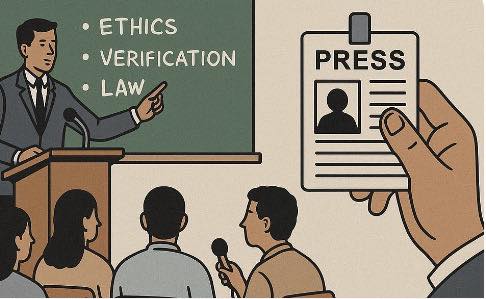
In the age of digital voices, journalism can’t be fenced by degrees or licenses. The answer isn’t censorship—it’s education and accountability. Train the storytellers, don’t silence them.
YASSIR AHMED
NOV 10, 2025
The office of the lieutenant governor of Jammu and Kashmir recently announced a plan that at first seemed like prolonged cleaning: “surveying real journalists” to weed out fake journalists and restore credibility.
The move comes after repeated complaints about self-appointed journalists using smartphones and social media handles to extort money, harass officials or spread unverified information. The government’s frustration is understandable – misinformation can create panic and tarnish its reputation overnight.
We are told that the scheme aims to restore the dignity of a profession which has suffered both financial and moral decay. But beneath the formal language lies a deeper question: What happens when the state decides what is considered “real” media?
In theory, it seems reasonable to clear the system. In practice, this risks creating a gatekeeper state – a state that grants the right to speak.
Journalism’s fragile home in Kashmir:
Journalism in Jammu and Kashmir has always been in a storm. In the 1990s, when curfews and shootings defined daily life, local journalists risked everything to tell the world what happened. Most had no formal training, no security tools, no digital security. Avoiding this, he learned to report.
These journalists laid the foundation of Kashmir’s press. But today they have been mixed with a flood of “pseudo-journalists”—some motivated by opportunism, others driven by desperation—who see journalism as a shortcut to influence.
Social media has multiplied that problem: anyone with a camera and a Facebook page can call themselves “media”. Some people use that freedom responsibly; Others abuse it. The government now says it will separate the two. The goal seems clear. There is no method.
Numbers that highlight paradoxes
If the authorities actually conducted a degree-based audit of Jammu and Kashmir’s media landscape, the results would be explosive. Of the hundreds of newspapers registered in the Union Territory, perhaps 2 percent are run by trained journalists with formal degrees. The rest are owned or edited by people who have learned by doing – and in many cases hardly learning at all.
If “professional qualification” becomes the new eligibility test, more than 95 percent of J&K publications will disappear overnight. Many of their owners will fail even a basic literacy test; Some people may not know whether the letter “A” is standing or sleeping.
And yet, among these untrained journalists are also those who have covered floods, human rights abuses, societal wrongs and corruption with courage and accuracy. If we delete them from the bureaucratic rule book, we will not end fake journalism – we will end local journalism.
The media pond will appear clear, yes, but it will be empty.
Political irony: no degree for power
There is another irony. If we start examining degrees and experience as eligibility criteria, we can apply this to politics as well. How many political leaders in India have degrees in political science, law or governance? How many have studied economics before creating a budget? Democracy never required a degree. It requires responsibility, empathy and courage. So why should journalism—the very art that has the power to be accountable—suddenly be subject to academic policing?
If politics doesn’t need a degree, there’s no need to speak the truth.
The real problem: We can’t stop anyone from speaking
Let’s face the modern truth: you can’t stop someone from reporting in the digital age.
Technology has made everyone a potential witness and broadcaster. With a smartphone and the Internet, anyone can document, analyze and share information in real time. It is not reversible. Trying to license journalism in 2025 is like trying to license breathing. The platforms are too big, the borders too porous. What governments can do – and should do – is to train citizens to use this freedom responsibly.
If the state really wants to protect credibility, it needs to move from policing to teaching.
First published by Kashmir Pen, Srinagar, Jammu & Kashmir (www.kashmirpen.com)
© 2025 Yassir Ahmed Mir. All rights reserved. Published with permission.

