

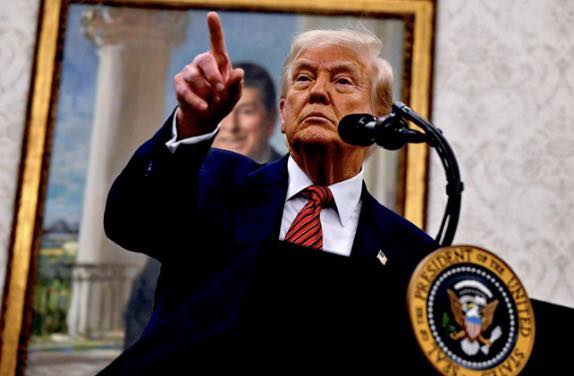
Washington, April 7: U.S. President Donald Trump’s recent threats to target Iran’s critical infrastructure—including power plants and bridges—have triggered widespread international concern, with legal experts and humanitarian bodies warning of potential violations of the laws of war.
The escalation comes amid the ongoing U.S.-Iran conflict, where Trump has reportedly issued ultimatums linking military restraint to Iran reopening the Strait of Hormuz. His statements suggesting large-scale destruction of civilian infrastructure have drawn sharp criticism globally. 
Legal scholars and military experts have cautioned that deliberate attacks on civilian infrastructure—if not justified by clear military necessity—could amount to war crimes under international humanitarian law, particularly the Geneva Conventions. 
The International Committee of the Red Cross (ICRC) has also issued a rare warning, stressing that both rhetoric and action must adhere to the rules of war, and cautioning against normalizing threats against essential civilian systems. 
Criticism has intensified within the United States as well, with former military lawyers and policy experts arguing that orders to strike purely civilian targets would be “manifestly unlawful,” placing military personnel in a difficult legal and ethical position. 
While some voices have attempted to justify such strikes by citing the “dual-use” nature of infrastructure, a broad consensus among international law experts remains that any attack must meet strict criteria of proportionality and direct military advantage. 
The developments have further heightened fears of escalation in an already volatile region, with growing calls from global leaders and institutions for restraint and adherence to international law.

