
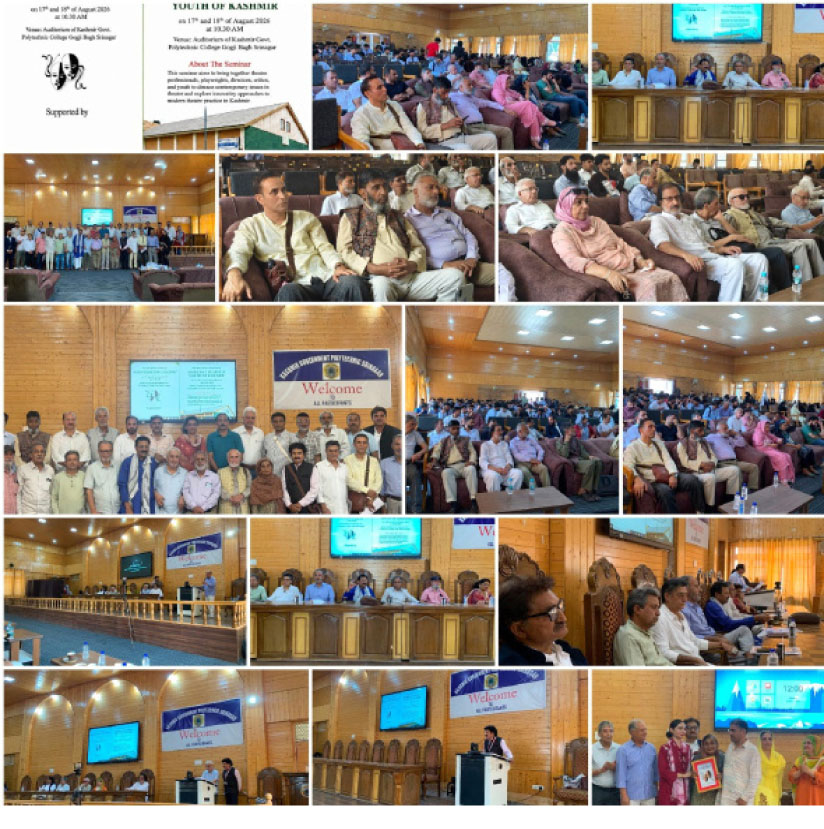
Srinagar, August 18, 2026: A two-day theatre seminar on “Modern Theatre and Youth of Kashmir” concluded successfully at Kashmir Government Polytechnic College, Gogji Bagh, Srinagar, bringing together prominent theatre experts, artists, scholars, critics and young theatre enthusiasts.
The seminar was organised with the objective of creating meaningful dialogue on the present state of modern theatre in Kashmir and exploring the role of youth in strengthening and carrying forward the region’s rich theatrical tradition.
The two-day programme was divided into three major sessions—an inaugural session, paper-reading session and lecture session. The sessions provided a platform for theatre practitioners, scholars and critics to share their experiences, research and perspectives on contemporary theatre.
During the paper-reading sessions, prominent theatre personalities and scholars including Majeed Majazi, Shakir Shafi, Sheikh Fatima, Hakeem Javed, Shahzad Shabir, Mantasha Shuja, Shahid Malik and Shabeer Hakak presented their papers on various aspects of modern theatre, its development, challenges and relevance to young people.
The lecture sessions featured eminent theatre personalities and experts including Bashir Bhawani, Mohammad Amin Bhat, Nisar Naseem, Hamayun Qaisar, Shafiq Qureshi, Dr. Nishtar, Shakeel Rehman, Shabir Mujahid, Bashir Qadri and Dr. Sohan Lal Koul. The speakers discussed different dimensions of theatre, including contemporary theatrical practices, acting, direction, writing, theatre criticism, experimentation and the changing relationship between theatre and society.
The experts emphasised that theatre is not merely a form of entertainment but an important medium of social communication, cultural expression, education and preservation of identity. They highlighted the need to encourage young people to participate in theatre and create more opportunities for their training, experimentation and professional development.
The speakers also discussed the challenges faced by theatre practitioners in Kashmir and stressed the importance of institutional support, collaboration among theatre groups and greater engagement of educational institutions with theatre and performing arts.
The seminar witnessed active participation and interaction among theatre practitioners, scholars, students and young artists. The discussions provided an opportunity for participants to exchange ideas and reflect on the future direction of modern theatre in Kashmir.
The organisers expressed gratitude to all the distinguished speakers, paper readers, artists, students and participants for making the two-day seminar a meaningful platform for dialogue on modern theatre and the aspirations and creative potential of the youth of Kashmir.
The seminar concluded with a call for continued efforts to promote theatre among the younger generation and to create a vibrant, inclusive and sustainable theatre movement in Kashmir.
ADVERTISEMENT
Two-Day Theatre Seminar on “Modern Theatre and Youth of Kashmir” Concludes at Kashmir Government Polytechnic College
ADVERTISEMENT


Leave Comment

ADVERTISEMENT