

Online Web Editor : Haamid Bala
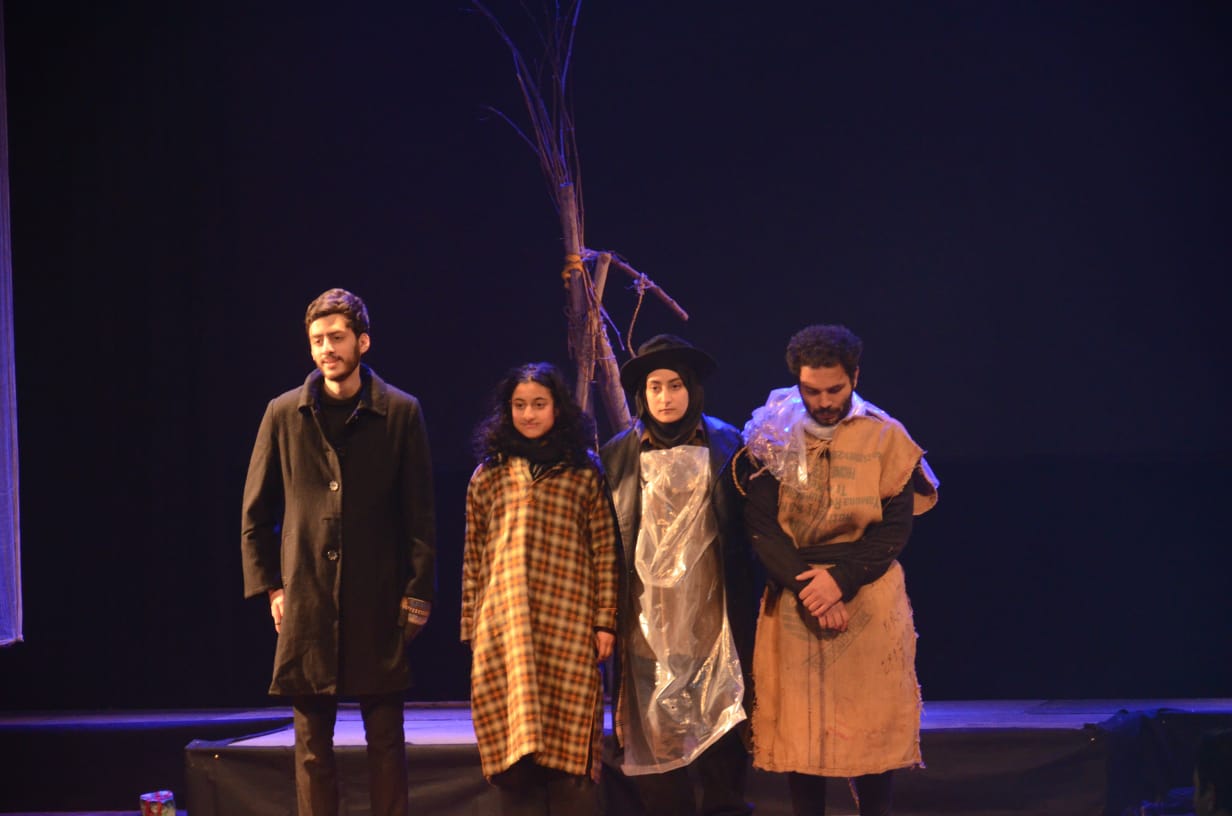
On a winter afternoon in Srinagar last week , as temperatures slid toward –3°C and Chilai Kalan knocked, Tagore Hall stood unexpectedly full. The late-afternoon performance of The Travellers of Barzakh did more than defy the cold; it reaffirmed a faith long considered fragile in Kashmir—that there remains a committed audience for rigorous, idea-driven, and formally disciplined theatre.

Written and directed by acclaimed Kashmiri theatre director Arshad Mushtaq, The Travellers of Barzakh unfolded not as an event to be consumed, but as a condition to be entered. Originally written in Urdu and later reformed in English, the play resists the notion of translation as linguistic transfer. Instead, it carries forward the philosophical cadence, silences, and inward rhythms of the original text, allowing the work to speak across registers while remaining deeply rooted in Kashmiri intellectual and spiritual thought.
Barzakh, in Mushtaq’s staging, is neither allegory nor abstraction alone. It is a lived state—between life and afterlife, memory and erasure, speech and silence. Rejecting linear narrative and psychological realism, the production draws from Neo-Absurd theatre, employing fragmented dialogue, ritualised movement, repetition, and extended stillness. Meaning is not delivered but deferred; waiting itself becomes action. The play interrogates obedience, surveillance, systems of control, and the quiet erosion of inner life—concerns that resonate far beyond local context, addressing contemporary global anxieties without spectacle or didacticism.

The production was the culmination of an intensive 12-day workshop conducted by Theatre for Kashmir Repertory (TfK) over six weekends, from early November to mid-December, with space generously provided by AbiGuzar Art Space. The process began with individual explorations—presence, breath, voice, stillness—before being carefully woven into a collective structure. What emerged on stage was not a patchwork of exercises, but a unified work that retained the integrity of each performer’s inner journey.
The performers—students aged between 18 and 23—appeared on a professional stage for the first time, yet their work carried striking restraint and control. Zoya Qazi’s Bokut, visibly choked by an unnamed weight, transmitted a bodily unease that travelled across the auditorium; a teenage audience member later remarked that she “felt it in her bones.” When Faizaan, as Qismat, erupted with the anguished cry, “Are you listening?”, the question seemed to rupture the fourth wall—everyone was. Sania Mukhtar’s Nayib argued her case with such conviction that a practicing lawyer in the audience reportedly suggested she consider the profession in real life. Saqlain Syed’s Potcs, brushing aside urgent questions with weary indifference, became an unsettling mirror—an image of collective fatigue in the face of endless discourse.
These were not performances driven by display, but by discipline. Silence was trusted. Stillness was allowed to speak. For first-time actors, this refusal to overperform emotion marked a rare maturity—one often absent even in seasoned stages.

Behind the scenes, a committed TfK backstage and technical team—Reyaz Mir, Bilal Baghat, Tahir Najar, Faizan Bhat, Junaid A, and Daamin Arsh Saqlain Sauleh & Wajahat Ahmad —formed the unseen spine of the production, ensuring precision in transitions, spatial control, and technical restraint. They were supported by Dr. Zamir Ahmad and Shahjehan Baghat, whose guidance strengthened both conceptual clarity and execution. In keeping with TfK’s ethos, technical work functioned not as ornament, but as an integral element of meaning-making.
The audience comprised intellectuals, artists, writers, academicians, scholars, and students, with a notable presence of young viewers. Despite the cold, the hall remained full—an affirmation that serious theatre in Kashmir still finds takers, including those willing to pay for it.

The Travellers of Barzakh does not offer answers, catharsis, or comfort. It demands attention, patience, and thought. In a theatrical landscape increasingly crowded with hurried skits and purposeless narratives, this production took its first confident steps in another direction—toward theatre as inquiry, ethics, and philosophical engagement. It is a beginning that signals not revival by nostalgia, but renewal by rigor.
The production is scheduled to return soon, with future performances planned in both English and Urdu.

