

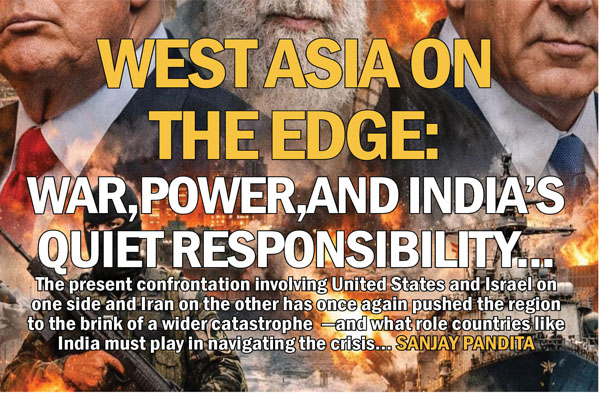
The present confrontation involving United States and Israel on one side and Iran on the other has once again pushed the region to the brink of a wider catastrophe —and what role countries like India must play in navigating the crisis… SANJAY PANDITA
SANJAY PANDITA
War in West Asia has rarely remained confined to the battlefield where it begins. The region has long been a theatre where history, religion, power politics and strategic rivalries collide with devastating consequences. The present confrontation involving United States and Israel on one side and Iran on the other has once again pushed the region to the brink of a wider catastrophe. What initially appeared to be a calculated military operation aimed at crippling Iranian strategic capabilities has rapidly evolved into a conflict whose consequences are reverberating far beyond the Middle East. The question now confronting the world is not merely how this war will proceed but what kind of geopolitical order it will produce—and what role countries like India must play in navigating the crisis.
The confrontation marks a dramatic escalation in the long-standing hostility between Israel and Iran, a rivalry that has simmered for decades through proxy wars, covert operations, cyber attacks and shadow diplomacy. Israel has consistently viewed Iran’s military ambitions and nuclear programme as an existential threat. Iran, in turn, has positioned itself as a leading force of resistance against Israeli and Western dominance in the region. The United States, Israel’s closest strategic ally, has historically been drawn into this rivalry as both a protector of Israeli security and a guardian of its own geopolitical interests in the Middle East. The present war is therefore not merely an isolated military campaign but the culmination of decades of mistrust, ideological confrontation and strategic competition.
The scale and intensity of the ongoing conflict indicate that it has already crossed the threshold of a limited engagement. Air strikes, missile attacks and drone warfare have become routine features of the battlefield. Military installations, communication centres and strategic infrastructure inside Iran have reportedly been targeted by coordinated operations. Iran has responded with retaliatory missile strikes and the deployment of long-range drones, signalling that it is prepared to resist rather than capitulate. Unlike earlier confrontations that remained confined to covert operations or proxy battles, this conflict carries the unmistakable character of an open war.
Yet the most alarming aspect of the crisis is the possibility that it may not remain confined to these principal actors. West Asia is a region where alliances are layered, loyalties are complex and conflicts rarely remain bilateral. Groups allied with Iran in countries such as Lebanon, Iraq and Syria possess the capacity to transform the war into a wider regional confrontation. Should these forces become fully engaged, Israel could find itself fighting on multiple fronts, while American military bases across the Gulf region could also become targets. In such a scenario the war would cease to be a strategic contest between states and evolve into a regional upheaval with unpredictable consequences.
Another dimension that amplifies the global anxiety surrounding this conflict is the vulnerability of the world’s energy supply routes. The narrow maritime corridor known as the Strait of Hormuz remains one of the most critical arteries of global oil transportation. Nearly one-fifth of the world’s oil passes through this waterway each day. Iran has often hinted that in the event of an existential threat it could disrupt shipping through this strategic passage. Even the perception of such a possibility has historically been enough to send oil prices soaring. If the war intensifies and maritime traffic in the Gulf is threatened, the consequences would ripple through the global economy, affecting everything from transportation costs to food prices across continents.
For countries heavily dependent on imported energy, the crisis carries immediate economic implications. India, which imports the majority of its crude oil from the Middle East, finds itself particularly vulnerable to fluctuations in energy supply and pricing. Rising oil prices could exert pressure on India’s economy, weaken its currency and intensify inflationary trends. In a globalised world where energy remains the lifeblood of economic activity, wars fought thousands of kilometres away can quickly become domestic concerns.
Yet the significance of this conflict extends beyond economic calculations. It raises profound questions about the evolving nature of warfare itself. Modern conflicts are no longer confined to tanks and aircraft. They are fought through cyber operations, artificial intelligence, satellite surveillance and drone technology. The war in West Asia is increasingly becoming an example of how technological innovation is reshaping the battlefield. Artificial intelligence systems are being used to analyse surveillance data, identify targets and coordinate military responses with unprecedented speed. Autonomous drones capable of navigating complex environments have emerged as powerful tools capable of altering the balance between conventional armies and smaller forces.
The integration of such technologies has transformed warfare into a domain where algorithms and data often determine strategic outcomes. Artificial intelligence can process vast volumes of information in seconds, identifying patterns that human analysts might miss. This technological shift has not only increased the efficiency of military operations but also intensified ethical debates about the future of warfare. When machines begin to influence decisions that determine life and death, the line between human judgement and automated warfare becomes dangerously blurred.
Amid this turbulent geopolitical landscape, India finds itself in a uniquely delicate position. Unlike many countries that are aligned firmly with one side of the conflict, India maintains significant relationships with almost all major actors involved in the crisis. Its defence and technological cooperation with Israel has grown substantially over the past two decades. At the same time, India has historically maintained cordial ties with Iran, particularly in areas such as energy trade and regional connectivity projects. Its strategic partnership with the United States further complicates the diplomatic equation, while its economic and diaspora ties with the Gulf countries add another layer of responsibility.
This complex network of relationships places India in a position where neutrality must be balanced with strategic prudence. India cannot afford to alienate any of these partners, yet it must also safeguard its own national interests. The presence of millions of Indian citizens working in the Gulf region adds a humanitarian dimension to the crisis. Any escalation of conflict could necessitate large-scale evacuation operations similar to those undertaken during previous international crises. Ensuring the safety of its diaspora remains one of India’s most immediate concerns.
Beyond these practical considerations lies the broader question of whether India can contribute to diplomatic efforts aimed at reducing tensions. Historically, India has often projected itself as a voice of moderation in global affairs, advocating dialogue over confrontation. Its foreign policy tradition emphasises strategic autonomy rather than rigid alignment. In moments of international crisis, this balanced approach can sometimes allow India to serve as an informal bridge between competing powers.
Diplomatic mediation in a conflict of this magnitude is neither simple nor guaranteed to succeed. The ideological hostility between Israel and Iran runs deep, and the strategic calculations of the United States are influenced by global power dynamics that extend far beyond the Middle East. Nevertheless, diplomacy often progresses through quiet conversations rather than dramatic public interventions. Countries like India can facilitate communication channels, encourage dialogue and support international initiatives aimed at preventing escalation.
The unfolding war also forces the international community to confront a fundamental truth about modern geopolitics: military power alone rarely resolves the underlying causes of conflict. History offers numerous examples where wars intended to create stability instead produced prolonged instability. From the invasion of Iraq in 2003 to the protracted conflict in Syria, military victories have often been followed by political chaos and humanitarian suffering. The Middle East has witnessed countless cycles where the destruction of one power vacuum simply creates another.
The present war risks repeating this pattern. Even if one side achieves temporary strategic advantages, the deeper tensions that define the region will remain unresolved. The ideological divide between revolutionary Iran and the security-driven state of Israel cannot be erased through bombardment alone. Nor can external military intervention permanently reshape the political landscape of the region. Stability in West Asia ultimately requires political accommodation, economic development and the gradual building of trust among societies that have long been divided by history and ideology.
For India, the crisis serves as a reminder that its rise as a global power carries responsibilities that extend beyond its borders. Economic growth, technological progress and diplomatic influence have positioned India as an important voice in international affairs. With that influence comes the expectation that India will contribute to global stability rather than merely observe unfolding crises from the sidelines.
The war in West Asia is therefore not merely a distant conflict but a test of how emerging powers respond to global challenges. India’s response must combine strategic caution with moral clarity. It must protect its economic interests and citizens while simultaneously advocating for restraint and dialogue among the warring parties.
In the final analysis, the conflict unfolding across West Asia represents more than a geopolitical struggle between states. It is a reminder of how fragile international stability remains in an age where technological warfare, ideological rivalry and strategic competition intersect with devastating force. The flames of war may illuminate the night sky above distant deserts and cities, but their consequences travel across oceans and continents.
In such times the world must remember a lesson that history has repeatedly taught yet humanity repeatedly forgets: wars may begin with the promise of security, but they often end with deeper insecurity. If wisdom prevails over ambition, diplomacy over destruction and dialogue over vengeance, the present crisis may yet find a path toward de-escalation. Nations like India, positioned at the crossroads of competing alliances, may quietly help guide that journey—reminding the world that the pursuit of peace is often the most powerful act of leadership.
The writer can be reached at sanjaypanditasp@gmail.com

