

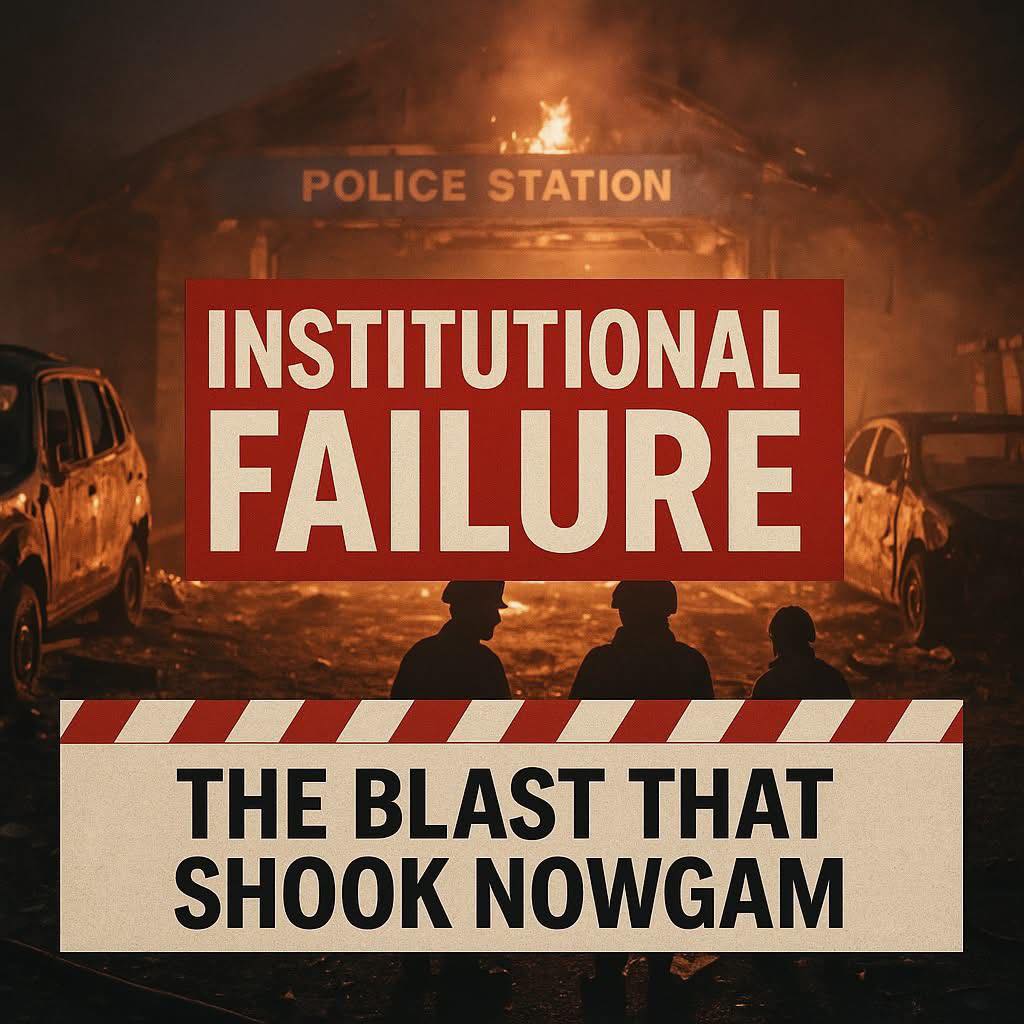
A late-night sampling of seized ammonium nitrate at Nowgam Police Station exposed a chain of procedural lapses, absent oversight, and scientific negligence that turned routine evidence handling into one of India’s deadliest institutional failures in years.
Yassir Ahmad New Delhi, India
November 2025
There are tragedies that stun a nation, and then there are tragedies that indict its systems. The explosion at Nowgam Police Station in Srinagar on November 15 belongs to the second category. Nine people died and twenty-nine were injured when 350 kilograms of seized ammonium nitrate detonated during what should have been a routine evidence-sampling exercise. These were not casualties of a militant strike. They were casualties of a system that continues to treat hazardous material like stationary files and scientific discipline like a technicality.
The substance that erupted inside the police station was not obscure or unpredictable. It was ammonium nitrate, one of the most studied oxidizers in the world. Its behavior is documented across decades of research and hundreds of incidents. Its hazards are neither secret nor new. And yet, in Police Station Nowgam The material was kept outdoors, in the open area of the police station compound, exposed to routine environmental fluctuations—winter air at night, patches of sunlight earlier in the day, ambient dust, and open humidity cycles that Kashmiri weather naturally creates. It sat there without a chemical barrier, without controlled overhead covering, and without the atmospheric monitoring demanded for reactive oxidizers. While this reduces the risk of gas accumulation that occurs in sealed rooms, it introduces an entirely different set of risks: destabilization from temperature cycling, crystal fracturing, moisture crystallization layers, and accidental ignition during manual handling. And when forensic teams arrived late at night to collect samples and without blast shielding, the tragedy unfolded. This was not fate. It was a failure—technical, institutional, administrative and supervisory. The conditions would violate even the most basic global safety norms. When the containers were opened at night, indoors, by officers without senior scientific supervision, the outcome felt less like an accident and more like an inevitability.
A Major Terror Case Mishandled from the Start:
The ammonium nitrate belonged to an alleged white-collar Jaish-e-Mohammed module operating out of Faridabad. The arrests of professionals in the medical field—people with access, credibility, and mobility—should have triggered high-level oversight. The material they handled allegedly linked back to the car bomb near Delhi’s Red Fort just days earlier. This was not simply a seizure. It was part of a live, multi-state terror investigation.
Yet the chain of custody was handled with a kind of bureaucratic casualness that defies belief. The material was transported across states in ordinary trucks, exposed to vibration, temperature swings, and humidity changes—each of them capable of altering the stability of ammonium nitrate. By the time the convoy reached Srinagar, the prills had lived through environmental stressors that demanded scientific assessment before anyone even touched the containers.
Instead, when the trucks pulled into Nowgam Police Station, the entire consignment was unloaded like routine evidence and the entire consignment was offloaded not into a controlled storage facility, but directly into the open courtyard of the station compound. The sacks and canisters were left exposed to the valley’s moisture-rich air, nighttime cold, daytime warmth, and particulate contamination from the surroundings. The courtyard had no overhead cover, no humidity regulation, no temperature buffering, and no physical segregation from other materials. In effect, a sensitive oxidizer linked to an ongoing terror case was left sitting outdoors as though it were a stack of routine contraband.
This was not a storage decision guided by safety. It was one driven purely by administrative convenience: Nowgam was the station where the FIR originated, so Nowgam became the place where everything was dumped—regardless of suitability, expertise, or infrastructure.
India has witnessed catastrophic chemical failures before. Yet the outdoor storage of industrial-scale ammonium nitrate, in winter conditions, inside a police station courtyard, during an active terror investigation, reflects an institutional blind spot that cannot be described as anything but bewildering.
The Most Dangerous Error:
Night Sampling Without Senior Oversight:
The worst decision of all came hours before the blast, when evidence-sampling was scheduled for 11:20 p.m. in winter temperatures, under artificial lighting, and without specialized supervision. No one has explained why this was necessary, or who authorized the timing. Globally, high-risk material is handled:
• in daylight, under controlled ambient conditions
• inside designated explosive-handling bays
• with senior explosives chemists directing procedure
• with full environmental monitoring
• and with emergency response teams positioned nearby
In Nowgam, the team consisted of a single forensic scientist, a magistrate, two junior police officers, and a constable. None of them had extensive field experience with oxidizers in degraded condition. The Director of FSL Srinagar was not present. No central-level chemist was consulted. No blast-resistant enclosure was used.
Friction on caked AN, combined with moisture buildup, temperature stress, and confinement, created a pressure surge. When the lid of one container was pried open, the mixture of oxygen, heat, and crystalline instability crossed the threshold. A decomposition burst became an explosion.
This was not sabotage.
This was not an “unforeseen” event.
It was the direct result of ignoring the basic rules of chemistry.
A System That Treats Science as an Afterthought:
The Nowgam blast reveals an uncomfortable truth: India’s law-enforcement institutions still view hazardous evidence through bureaucratic, not scientific, lenses. Chain-of-custody procedures often overshadow material-specific safety. Officers rely on improvisation because the infrastructure around them is outdated, inconsistent, or simply nonexistent.
Police stations across India store fuels, acids, fireworks, explosive precursors, narcotics, and electronics alongside paper files and broken furniture. They are built to investigate crime, not house industrial chemicals. The gap between what police stations are expected to hold and what they are equipped to hold grows wider each year.
Nowgam was a disaster waiting to happen. It just happened to erupt on November 15.
A Global Pattern: When Nations Ignored Chemistry and Paid the Price:
What unfolded in Srinagar is part of a long global history of ammonium-nitrate negligence. In 2013, a fertilizer depot in West, Texas, burned for twenty minutes before erupting in a blast that killed 15 people and injured over 260. Investigators found AN sacks stored near fuel and wood. In 2020, Beirut’s port was turned to rubble when 2,750 tons of abandoned AN detonated—one of the largest non-nuclear explosions in history—after years of warnings were ignored. France witnessed its own tragedy in 2001 when the Toulouse factory explosion, caused by damp and poorly segregated chemicals, killed 31.
Every subsequent inquiry reached the same conclusion: the explosions were preventable. And in each case, the aftermath reshaped national policy. The United States amended storage regulations. Lebanon rewrote port safety guidelines. France overhauled chemical industry oversight.
India must decide whether the Nowgam tragedy becomes another data point in global negligence or a turning point for national reform.
Where Leadership Failed:
The Nowgam blast was not the fault of one team or one officer. It was a multi-layered breakdown:
The J&K Home Department: did not impose safety conditions on storage.
The Forensic Science Laboratory leadership: did not deploy senior chemists or ensure proper facilities.
Senior Official leadership : did not question the timing, environment, or safety protocols.
Central agencies: did not provide hazard-handling directions despite the interstate nature of the case.
Everyone trusted someone else to act.
No one did.
Leadership failure, in this case, was not passive. It was active negligence.
A Central-Level Inquiry Is Essential:
A state-level inquiry cannot credibly examine its own leadership. If any lesson emerges from Nowgam, it is that institutional self-examination is insufficient. A central scientific commission with experts from CFSL Delhi, NDMA, DRDO, and independent explosives scientists must lead the probe.
They must study:
• who approved outdoor storage,
• why night sampling was ordered,
• why senior chemists were absent,
• whether transport compromised the compound,
• and how standard operating procedures collapsed.
Only an inquiry with scientific expertise and independence can assign responsibility.
The Way Forward: Reform or Repeat:
India has thousands of police stations storing hazardous evidence. Without structural reforms, another Nowgam is inevitable.
The country must prioritize:
• dedicated hazardous-evidence vaults,
• strict classification of seized material,
• senior-only handling rules for oxidizers,
• mandatory chemical-safety training for police and FSL teams,
• and enforceable accountability mechanisms for violations.
This is not simply about fixing a system. It is about protecting those who protect the country.
A Final Reckoning:
The officers who died in Nowgam were not killed by terrorists. They were killed by the absence of scientific discipline, the absence of leadership, and the absence of safety culture within the very institutions meant to keep them safe.
Their deaths demand more than condolences. They demand reform grounded in science, enforced by leadership, and protected by accountability.
If India refuses to learn from Nowgam, then the next explosion will not be a surprise. It will be the result of risks the country already understands but has chosen to ignore.
What happened at Nowgam was not fate, misfortune, or chemistry’s betrayal. It was the direct consequence of storing ammonium nitrate outdoors in uncontrolled conditions and conducting sensitive procedures at night without senior supervision.
A tragedy created not by malice, but by systemic failure.
Nine people died because the system underestimated science. Justice for them requires more than condolences. It requires change—real, structural, enduring change.
Copyright  2025 Yassir Ahmed Mir. All rights reserved.
No part of this article may be reproduced or distributed without written permission from the author. For permissions or syndication, contact yassirahmed001@gmail.com.
Disclaimer:
This article draws on verified public sources and research available at the time of writing. The views expressed are solely those of the author and do not represent any government or institution. While accuracy has been prioritized, some details may rely on incomplete or evolving information.
Author Note:
Yassir Ahmed is an Indian journalist covering national security, defense, and Asian–Middle Eastern affairs.
Contact: yassirahmed001@gmail.com
First published by Kashmir Pen, Srinagar, Jammu & Kashmir (www.kashmirpen.com)
© 2025 Yassir Ahmed Mir. All rights reserved. Published with permission.

