

SANJAY PANDITA
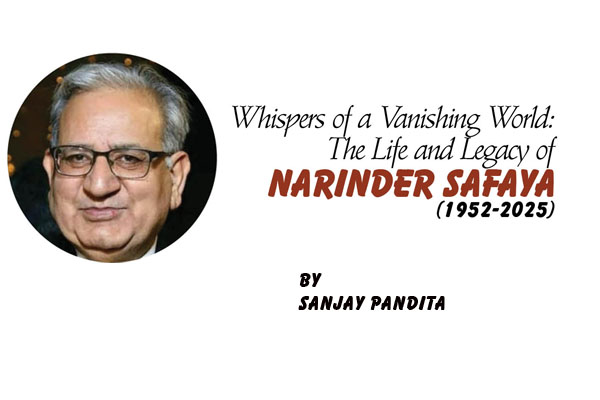
In an era increasingly defined by amnesia and fragmentation, when identities are commodified and cultures flattened by homogenized narratives, few lives shine as incandescently and as silently as that of Narinder Safaya. A poet whose silences spoke as much as his verses, a jurist whose judgments carried the pulse of poetry, and a soul whose very presence was an ode to a vanishing world — Safaya was, in every sense, an inheritor and protector of an endangered legacy. His life was not simply lived; it was curated like a sacred manuscript — each moment infused with integrity, reflection, and deep spiritual luminosity.
Born in 1952 in the poetic womb of Kashmir — Srinagar — Safaya entered a world still resounding with the musical footfalls of saints, the rustling of chinar leaves, and the quiet dignity of a civilization grounded in harmony. His early years were spent in a milieu where poetry and prayer were not separate, where one’s tongue was both a cultural instrument and a vessel of transcendence. The scent of freshly ground saffron, the echoes of river hymns, and the whispered parables of Lal Ded and Nund Rishi shaped his earliest sensibilities. He was raised in a household where tradition did not weigh heavy as dogma but danced lightly as wisdom, and it was here that the seeds of his poetic and philosophical temperament were sown.

Safaya’s academic brilliance led him to pursue law — a discipline that sharpened his mind even as poetry continued to soften his soul. As a jurist, he rose with quiet distinction, never seeking the limelight but always commanding respect through his intellectual depth and unshakeable moral clarity. In courtrooms often thick with rhetoric and procedural rigidity, his voice emerged as a gentle yet firm call to justice that was both legal and humane. His judgments were not just legal pronouncements; they were compassionate insights into the human condition.
What set him apart in the legal community was his ability to merge jurisprudence with a sense of ethical poise rarely seen in black-letter law. He approached law not merely as a tool of regulation but as a living, breathing framework for human dignity. Many of his legal writings — now being compiled posthumously — reveal a mind deeply influenced by literature, philosophy, and spiritual thought. Whether deliberating on matters of civil liberties, custodial rights, or refugee status, Safaya read between the lines of statutes to find the soul behind the sentence.
Yet, for all his achievements in the legal sphere, it was in the sacred realm of poetry and cultural preservation that his spirit found its fullest expression. Language, for Safaya, was not just a medium — it was memory, identity, resistance, and redemption all at once. After relocating to Delhi during the turbulent 1990s — part of the larger exodus that wounded the soul of Kashmir — he could have chosen to retreat into silence. But Safaya believed in the redemptive power of articulation. He responded to exile not with despair, but with devotion — to his mother tongue, to his people, and to the disappearing ethos of Kashmir.
From the heart of urban Delhi, amidst the anonymity of apartment blocks and the hurried pace of modern life, he carved out a space so unique, so deeply rooted in Kashmiri tradition, that it became a lifeline for a culture in peril. His home became the hearth of a movement — a quiet but powerful assertion of identity and continuity. Thus were born the now-legendary Kashmiri Baithaks — intimate, soulful gatherings of poets, musicians, scholars, and seekers. They were not events. They were ceremonies of remembrance.
Each Baithak was an invocation. The air thick with the scent of kahwa, the soft strumming of the santoor providing an ambient heartbeat, the conversations flowing like the Jhelum. Language was not merely spoken but revered — uttered with a tenderness one reserves for the sacred. Kashmiri, often dismissed as a regional tongue, here assumed the status of scripture. Children who had only heard it in the broken fragments of lullabies now spoke it haltingly, lovingly. Elders wept hearing their mother tongue echo once again in voices untouched by the Valley’s soil.

Source : Chinar Shade
The gatherings were astonishing in their pluralism and depth. Safaya was never prescriptive about who could participate. His Baithaks were attended by Muslims, Pandits, Sikhs, agnostics, even foreigners who had fallen in love with Kashmir through its literature. “Sincerity is the only invitation,” he would say. The sessions were unstructured yet profound — a verse by Rehman Rahi would lead to a discussion on exile, which in turn would meander into an impromptu ghazal, a memory, a song. It was improvisation elevated to ritual.
What made Safaya remarkable was that he never placed himself at the center. He was not the performer but the platform. He had an uncanny ability to make others feel seen, heard, validated. Young poets, unsure of their metaphors, would read tentatively, and he would listen with rapt attention, sometimes closing his eyes, sometimes nodding gently. He would offer a single comment — precise, nourishing, unforgettable. “Add one more line to let the pain breathe,” he once told a nervous teenager whose poem on loss needed room to mourn. That young poet is now a published author in Toronto.
Despite this growing reverence, Safaya remained strikingly humble. He believed poetry was a living thing — it must be heard, shared, carried on the breath, not locked in spines. But even then, with persuasion from close friends and admirers, he eventually agreed to publish some of his own work — quiet volumes that are now considered lyrical landmarks in modern Kashmiri poetry.
His published collections — slender, deliberate, and profound — are not mere books. They are lanterns in a fog of cultural erasure. Each poem reveals facets of his linguistic brilliance and philosophical depth. What sets Safaya’s poetry apart is the immediacy of its imagery and the intimate metaphorical language drawn from the everyday life of Kashmir. The scent of noon chai, the creak of a wooden balcony, the hush of snowfall — all become metaphors for loss, memory, longing, and home.
His poetic style leans heavily toward lyrical expression, weaving Kashmiri linguistic nuances with vivid sensory imagery and emotional resonance. A deeper analysis of the themes, style, and tone suggests that Safaya is both a nostalgic chronicler and a romantic mystic, whose pen carries the weight of seasons, love, and loss.
- The Mystical Romanticist – “Bal Yaar Sæl Annan”
This Kashmiri poem brims with longing and spiritual yearning. The recurring refrain “maal Karhas koshman” (“what would I do without my beloved”) serves as a haunting echo that reverberates through every line like a ritual chant. This refrain binds the poem thematically and musically, reinforcing the poet’s state of existential yearning. Whether the beloved is a divine entity, a lost lover, or a metaphysical longing, the ambiguity allows the reader to interpret the poem on multiple planes—Sufi, Bhakti, or romantic.
Phrases like “Su myon hosh mann” (He is my soul’s wisdom) and “Shiv tchu aasaan chai chaya” (Shiva is both the being and the shadow) reflect a transcendental sensibility, merging the earthly with the divine. The poem has a musical cadence that echoes Kashmiri oral poetic traditions, particularly reminiscent of Sufi poetry and Kashmiri mystic verse, where the boundaries between divine love and human longing blur.
Safaya, here, aligns with the tradition of poets like Lal Ded and Rupa Bhawani, blending devotion with metaphors of intimacy. He uses the poetic form as a means of spiritual expression, making him a mystic-romantic poet who does not shy away from the sensual even when seeking the sacred. - The Nostalgic Chronicler of Kashmir – “Memories – 1 (Winter)”
In this poem, Safaya reveals another facet of his poetic self—the custodian of seasonal memory and childhood innocence. The tone here is tender, observant, and steeped in personal nostalgia. The snow, the icicles, the frozen taps—all become symbols of an untouched past, rendered sacred by the act of remembering. The poem paints a vivid landscape of Kashmir in winter, not just as a geographical location but as a repository of memories and cultural identity.
Lines like “trees dressed in white like the waiting brides / For that summer touch” are metaphors loaded with pathos, encapsulating both the static beauty of winter and the anticipation of change. Safaya’s skill lies in his ability to turn simple childhood recollections into universal experiences. The transformation of icicles into swords for play, or the description of numb toes, frostbitten ears, resonates with anyone who has known winter not just as weather, but as emotion.
This poem reveals Safaya as a memory-keeper, whose pen preserves the emotional textures of Kashmir’s seasons. His style in this piece is imagistic, narrative, and delicate, with a naturalistic grace that borders on the poetic documentary. - The Emotional Minimalist – “Che Malala Kota tchuy dilus”
This poem represents Safaya at his most emotionally raw and stylistically minimal. The repetition of the line “Dil havtam” (I want the heart) gives the poem a pulsating rhythm, almost like a heartbeat echoing through a vacuum of loss or emotional confusion.
Lines like “Malal DiluK kith tchales / Aagur ye looluk kith khules” (Where shall the grief of the heart go / If the flower of love does not bloom) reflect a sense of personal anguish and romantic despondency. The poet here abandons metaphorical complexity for direct emotional appeal, making the poem feel like a whispered confession.
Safaya’s Kashmiri verses, however, remain the most potent. They are drenched in the cadence of the Valley, in the idioms of its alleys and attics, in the gentle teasing of grandmothers and the sighs of rivers. They remind one of what is possible when a mother tongue is not merely used, but worshipped.
He passed away quietly in May, 2025.
Remembering Narinder Safaya is more than an act of tribute. It is an act of resistance against forgetfulness. In his life, we find a model of how to hold fast to beauty, even in exile. How to preserve culture, not by shouting from rooftops, but by whispering into the hearts of others. How to keep a language alive, not in documents, but in dialogues. How to make poetry not a profession but a prayer.
He was not merely the soul of a vanishing world. He was its refuge. In every young poet who dares to write in Kashmiri, in every reader who weeps over a remembered verse, in every gathering where words are loved — Narinder Safaya lives.
The writer can be reached at sanjaypanditasp@gmail.com

