

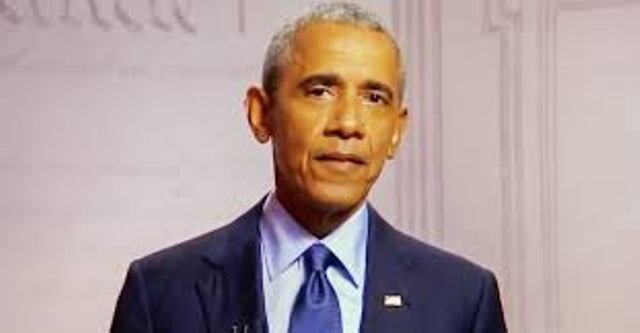
Barack Obama was describing to me the manner in which the Mongol emperor and war-crimes innovator Genghis Khan would besiege a town. “They gave you two choices,” he said. “‘If you open the gates, we’ll just kill you quickly and take your women and enslave your children, but we won’t slaughter them. But if you hold out, then we’ll slowly boil you in oil and peel off your skin.’”
This was not meant to be commentary on the Trump presidency—not directly, at least. In any case, Obama has more respect for Genghis Khan than he has for Donald Trump. He raised the subject of Genghis Khan in order to make a specific, extremely Obama-like point: If you think today’s world is grim, simply cast your mind back 800 years to the steppes of Central Asia. “Compare the degree of brutality and venality and corruption and just sheer folly that you see across human history with how things are now,” he said. “It’s not even close.”
We were sitting at opposite ends of a long table in his office suite in the West End district of Washington. The offices were empty, except for a couple of aides and a discreet Secret Service detail. Obama was in a good mood, happy to discuss the work that has consumed him for more than three years: the writing of A Promised Land, his presidential memoir—or what turns out to be (because he has much to say about many things) the first of two volumes of his presidential memoir. The first volume’s 768 pages carry him from childhood to the bin Laden raid of 2011. A publication date for the next installment, which will presumably cover such issues as the Syrian civil war, Russia’s invasion of Ukraine, and the Iran nuclear deal, has not yet been announced.
A Promised Land is an unusual presidential memoir in many ways: unusually interior, unusually self-critical, unusually modern (this is the first presidential memoir, I believe, to use the term ethereal bisexual to describe an unrequited love interest), and unusually well written. The book does suffer at times from a general too-muchness, and it has its arid stretches, although to be fair, no one has yet invented a way to inject poetry into extended explanations of cap-and-trade, or Mitch McConnell’s motivations.
We covered a lot of ground in our face-to-face discussion, which took place on Wednesday, and in a follow-up call on Friday. The broadest subject of our conversation was the arc of the moral universe: Does it still bend toward justice? Does it even exist? When Obama was elected 12 years ago, the arc seemed more readily visible, at least to that swath of the country interested in seeing someone other than a white male become president. But he now recognizes that the change he represented triggered an almost instantaneous backlash, one that culminated in the “birther” conspiracy that catapulted its prime propagandist, Donald Trump, to the White House.
“What I think is indisputable is that I signified a shift in power. Just my mere presence worried folks, in some cases explicitly, in some cases subconsciously,” Obama said. “And then there were folks around to exploit that and tap into that. If a Fox News talking head asks, when Michelle and I dap, give each other a fist bump, ‘Is that a terrorist fist bump?,’ that’s not a particularly subtle reference. If there’s a sign in opposition to the ACA in which I’m dressed as an African witch doctor with a bone through my nose, that’s not a hard thing to interpret.”https://df87120dd46a813d8e9152af5f34993b.safeframe.googlesyndication.com/safeframe/1-0-37/html/container.html
For Obama, though, the overarching story of America, and all humanity, is one of fitful progress—and nothing about the past four years has seemed to change his mind. Joe Biden’s election is proof that America moves forward; the persistence of racial animus and resentment-driven populism represents the difficulty of maintaining momentum.
Obama’s you-think-you-have-it-so-bad invocation of Genghis Khan was prompted by a passage I read aloud to him. It is a brief peak-Obama, “Ozymandias”-inflected passage about a visit to Egypt. Obama recalls brooding over a face of a forgotten figure etched into an ancient wall, a face that resembled his. “All of it was forgotten now, none of it mattered, the pharaoh, the slave, and the vandal all long turned to dust. Just as every speech I’d delivered, every law I passed and decision I made, would be forgotten. Just as I and all those I loved would someday turn to dust.”
I noted the presence in this passage of a kind of paralyzing self-awareness (“True,” he said), but he told me he included this rumination to make a point about the long view. “That scene of me going through the pyramids—it’s not an empty exercise; there’s a purpose to it. So much of whether you’re optimistic or pessimistic depends on the time frame,” he said, invoking the specter of Genghis Khan. He went on: “What I’ve always believed is that humanity has the capacity to be kinder, more just, more fair, more rational, more reasonable, more tolerant. It is not inevitable. History does not move in a straight line. But if you have enough people of goodwill who are willing to work on behalf of those values, then things can get better.”
Which brought him to his main point: “America as an experiment is genuinely important to the world not because of the accidents of history that made us the most powerful nation on Earth, but because America is the first real experiment in building a large, multiethnic, multicultural democracy. And we don’t know yet if that can hold. There haven’t been enough of them around for long enough to say for certain that it’s going to work,” he said.
Trump, Obama noted, is not exactly an exemplar of traditional American manhood. “I think about the classic male hero in American culture when you and I were growing up: the John Waynes, the Gary Coopers, the Jimmy Stewarts, the Clint Eastwoods, for that matter. There was a code … the code of masculinity that I grew up with that harkens back to the ’30s and ’40s and before that. There’s a notion that a man is true to his word, that he takes responsibility, that he doesn’t complain, that he isn’t a bully—in fact he defends the vulnerable against bullies. And so even if you are someone who is annoyed by wokeness and political correctness and wants men to be men again and is tired about everyone complaining about the patriarchy, I thought that the model wouldn’t be Richie Rich—the complaining, lying, doesn’t-take-responsibility-for-anything type of figure.”https://df87120dd46a813d8e9152af5f34993b.safeframe.googlesyndication.com/safeframe/1-0-37/html/container.html
Two issues that run deeper for Obama than Trump’s personal deficiencies concern the changes he sees in the Republican Party and the broader conservative movement. “I did not believe how easily the Republican establishment, people who had been in Washington for a long time and had professed a belief in certain institutional values and norms, would just cave” to Trumpian populism, he said.
He traces the populist shift inside the Republican Party to the election that made him president. It was Sarah Palin, John McCain’s 2008 running mate, he said, who helped unleash the populist wave: “The power of Palin’s rallies compared with McCain’s rallies—just contrast the excitement you would see in the Republican base. I think this hinted at the degree to which appeals around identity politics, around nativism, conspiracies, were gaining traction.”
The populist wave was abetted by Fox News and other right-wing media outlets, he said, and encouraged to spread by social-media companies uninterested in exploring their impact on democracy. “I don’t hold the tech companies entirely responsible,” he said, “because this predates social media. It was already there. But social media has turbocharged it. I know most of these folks. I’ve talked to them about it. The degree to which these companies are insisting that they are more like a phone company than they are like The Atlantic, I do not think is tenable. They are making editorial choices, whether they’ve buried them in algorithms or not. The First Amendment doesn’t require private companies to provide a platform for any view that is out there.”
He went on to say, “If we do not have the capacity to distinguish what’s true from what’s false, then by definition the marketplace of ideas doesn’t work. And by definition our democracy doesn’t work. We are entering into an epistemological crisis.”
We talked about much more: the Iowa caucus; Ta-Nehisi Coates; climate change; the art and science of presidential memoir-writing; Michelle’s views on race and optimism. It’s all below. The Q-and-A is long but, I think, useful, if only as a reminder of what a thoughtful president sounds like. Our conversation has been edited for clarity and concision.
1. The Cost of Donald Trump’s Petulance
Jeffrey Goldberg: How much of the death and destruction we’ve seen—over the past five or six months especially, after the beginning of the pandemic—do you blame on President Trump?
Barack Obama: This would have been a really hard thing to deal with for any president, and we’ve seen countries that have acted responsibly and taken the right steps and they’re still seeing an uptick, because we haven’t seen this disease before. This is a really well-designed virus to maximize damage. This is not as deadly as Ebola, it doesn’t transmit as rapidly, but it is just deadly enough that it takes a huge toll.
What I think is fair is to take a look at what’s happened in Canada, where they still have had big problems but their death rate per capita is about 61 percent lower than ours. There are a whole set of explanations around that—universal health care in Canada, and in some areas they may not have the same population densities. But it is a comparable country on the same continent.https://df87120dd46a813d8e9152af5f34993b.safeframe.googlesyndication.com/safeframe/1-0-37/html/container.html
There is little doubt that if we had had a White House that from the start had said, “Let’s follow the science, let’s take this seriously”—if they had reinforced the message coming from people like [National Institute of Allergy and Infectious Diseases Director] Dr. Fauci and not politicized basic preventive measures like wearing masks, if they had not been intent on rushing the reopening and downplaying the severity of the pandemic across the primary channels that a big chunk of the country gets its news from—some lives could have been saved and we would have had better control of this.
It’s also fair to say that had we taken better steps to contact-trace and set up testing protocols earlier, it is likely that we would not have seen severe outbreaks everywhere and we might have been able to reduce the severity of the pandemic in certain portions of the country.
The good news is that Joe Biden’s chief of staff, Ron Klain, was my point person on Ebola. He knows how to work on these big public-health issues, and they’ve already surrounded themselves with the right people who are going to be applying the very best science and technology and organizational measures to this problem. The vaccine It’s going to be a challenge both distributing it and also overcoming some of the mistrust that has developed from misinformation and bad messaging early on. We’ll get through this. But we’re making it harder than it should be. It would have been hard no matter what, but we’ve made it harder. ( The Atlantic )
