

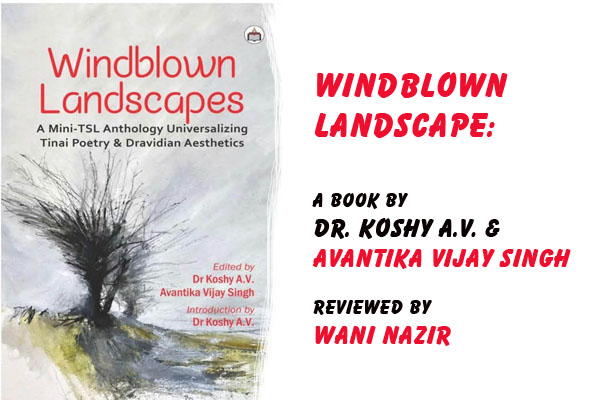
Ever stand outside and the wind feels like it is trying to tell you something? I mean, like, not any old gust, but, like, a whole “he said.” That’s the vibe here. Poetry doesn’t begin as lines on a page — it is the ground beneath your feet humming a tune you almost recognize. So Windblown Landscapes — this crazy little anthology edited by Dr. Koshy A.V. and Avantika Vijay Singh — is not just another book. No way. It is a secret map inscribed into red dirt where feelings get etched into the ground, and memories bloom blue, like the Neelakurinji that reveals itself once in a lifetime. The whole thing is a kind of love letter to Tinai, that old-school way the Tamils had of mapping emotions and rituals onto literal earth and sky.
Forget being a passive reader. You’re something of a barefoot rambler here, traipsing through five mythical lands — Kurinji, Mullai, Marutham, Neythal, Palai. Every spot’s got its own vibe, its own plant life, its own legends. Reading this book is like time-travel, except you have mud between your toes and poetry affixed to your skin. The language? Not just with your eyes, because, you got to have feel this in your bones, even your lungs. The coolest part? These are not merely pretty backdrops for people to pose in. They are alive, almost stubborn aching, breathing and telling you their own stories when you least expect it. It’s wild. You have birdsong, footsteps intertwining in some long-forgotten language, pollen settling like similes and earth that feels to beat with desire.
Tamil Sangam poets back in the day got straight to the point. For that to have meaning, that was their home. For them, a fast mountain or a lick of desert wasn’t scenery; it was the script and the stage and in some cases the entire show. Tinai is not only a poetic device. It is a perspective where your heartbreak, your giggles, even your waiting-for-a-text-back agony, all get plotted using jungles, rivers, or dry plains. Every Tinai — the mountains (Kurinji), forest (Mullai), farmland (Marutham), coast (Neythal), and desert (Palai) — is not just a locatable space. It is a mood, an emotion, a whole state of mind. The Neelakurunji’s blue isn’t only for Instagram; it is the flush of a secret, perhaps forbidden, love. And that dry hush in Palai? Not only dry but with the sound of someone missing so hard it echoes. These are not metaphors affixed to the surface afterward. They are baked right in — like, the outside world and your inner mess are practically twins.
The old Tinai mood isn’t museum-dusty, at least not in Windblown Landscapes. It is alive and well, as if the hills and rivers themselves simply picked up a pen and started scribbling. The book is not a gathering, it is a sewing, land and language, root and breath, wrought together until you can’t say poem from place. This whole Tinai thing? It is not just a theme — it is the heartbeat. Every poem, every tiny turn of phrase, every bizarre metaphor, it all grows from this primordial, earthy logic. You begin to understand: these are not poems about some landscape — these are poems from the landscape. As if the land itself had at last found the strength to empty its guts. Really, that is the magic trick of Windblown Landscapes. That is something pretty specific Dravidian tradition and manages to somehow feel universal without dilution. Reminds you —every patch of earth has its own language and every emotion has got a home somewhere. And the means by which this book interlaces it all? It sort of sucks you into a rhythm in a way that is a little old and a little weirdly new.
The Tinai, in this book, feels like a vessel carrying the old Dravidian vibe to today. You feel the forest breathing, the coastline moaning, the desert simply being stubborn. It is a good reminder: poetry is not just playing with words. It is syncing up with the heartbeat of the planet. Out of this earthy, emotional grammar, the anthology rolls into lived moments — poems that not only reverberate the old ways but spin them anew. These aren’t detours. They are only one step on the journey. Let us be honest — Windblown Landscapes isn’t just fooling around with pretty words. The whole feel is pretty thick in Dravidian aesthetics and I don’t mean some artsy style-guide. We are talking about a way of being, a philosophy that’s all up in temples and festivals and songs your grandma hummed and even the dirt under your nails. These poems not only nod politely to tradition — they throw the door open and allow the ancestors to come inside.
So: language and land? You can’t separate them. Metaphor in this world is not merely a neat trick; it’s like meaning standing up and walking across decades, changing coats with each new season. Every poem in this collection? It’s basically an altar. Every patch of land? Scripture. And now, when you mix Dravidian aesthetics and Tinai poetry, it goes from interesting to just plain sacred. There is that wild, almost spiritual intimacy with the natural world. You get kind of a defiant, “screw you” approach to colonial poetry. The vibe is deep ecology — nature isn’t a backdrop, it is breathing right along with you.
This is where the book ceases to be just something on your shelf and starts to sound like a fever dream of decolonization. This is not solely an effort to reanimate some poetic meters that have grown wooden and ceremonial; it is an effort to imagine the world as your great-great-grandparents imagined it. Art isn’t a thing you sell or buy here — it is how you get here for life. You crack open this anthology and you put on a new pair of eyes. All of a sudden, the flower isn’t only pretty — it is spewing fire. The desert aches. The coast sings you home. It is not just Dravidian, either. It has got echoes of Native American river songs, or those Japanese waka poems where blossoms mutter secrets in 5-7-5. Yes, this book is deep in its own soil, but it hums along with anyone, anywhere, who ever tried to write the earth into a poem.
Now, let’s hear it for Dr. Koshy A.V and Avantika Vijay Singh, the masterminds behind the whole operation. They aren’t the sort to be a dictator-editor. Instead, they simply let the poets be themselves — dialects, accents, long pauses and all. Instead of one voice burbling up, you get a chorus, everyone singing to the land in their own strange, lovely ways. The thing, too, is you don’t simply read Windblown Landscapes. You kind of stumble into it. The floor keeps moving — Kurinjis and deserts and waves, centuries like overstuffed suitcases. It is more “fall headfirst into a blue-stained mountain” and less “turn the page.” You don’t pick apart these poems; you let Mullai soothe you when you feel bone-tired. You don’t memorize lines; you carry the dust of Palai in your chest and the salt of Neythal in your breath.
Read this collection and for a hot minute, you are Dravidian. You speak from the roots. You feel the sap. You are up in the overhead branches chowing down on sunlight. And in those lulls between poems, when it goes quiet? Feels the world itself leans over and whispers, “Hey, poetry happens not on the page. It’s remembered.” And if you’re lucky — if you’re really, really listening — it remembers you right back.
ABOUT THE REVIEWER
The reviewer is a Kasmir University Postgraduate Gold medalist presently working as a Senior Lecturer in the Department of Education J&K. He is the author of two poetic collections, “And the Silence Whispered” and “The Chill in the Bones”.
