

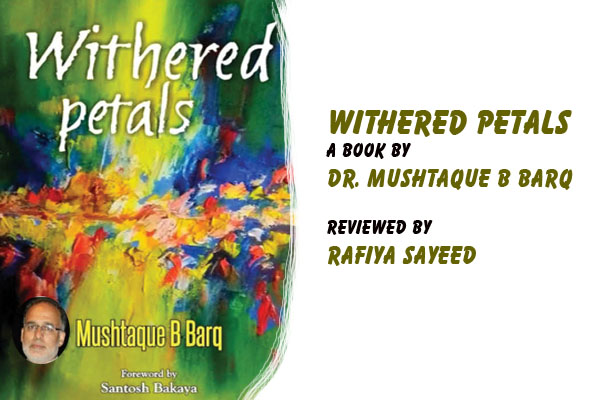
The book, “Withered Petals” by Dr. Mushtaque B Barq is an intriguing and compulsive collection of multilayered poems divided into 4 sections. The book is not monotonous, but as dark as the terrifying clouds and as vivid as the appealing rainbow. The anthology is a postmortem of the unsolved Kashmir conflict, a tapestry of soulful strings, and a reflection of the mystical existence of self and its accretion.
The poems dynamically interpret the broken, bruised and betrayed tale of Kashmir. They rue the days of violence. The poems are laced with words like bullets, pellets, hartal, unknown graves, concertina and AFSPA; the vocabulary common to Kashmiris, it adds elements of pathos to the story. The poem, ‘Eve’ justifies why the poet has chosen the title- ‘Withered petals’. The petals symbolise Kashmir withered by the military might and political conspiracies. The poet quotes,
“I am eve of this garden
Devoid of Adam
I am eve of this Dale
Much alone and tormented
Ravished by military might”.
The poems are a juxtaposition of paradox and symbolism to create a vivid and emotional experience for the readers. The poems are crafted with strong metaphors, unique irony and uncommon structure, to expose the grim truth of the conflict, the grief and loss, the bitterness of the turmoil and tyranny, and witness the folly and woes of hapless people in the valley. As the poet puts it:
“For normalcy is a myth here”
“I do consider having dual nationality
A citizen of peace and refugee of conflict.”
“How long shall this summer summon us
To be beaten by hate dwelling deep down in their spines”.
The series ‘Nonets’ speak loudly about the fear, uncertainty, torture, and dark silence. The lines are the scars of the distorted silhouettes of the wailing valley. Each nonet is adorned with rich imagery and superb alliterations, bringing into light the naked reality of the unending turmoil. I quote one of the nonets that deeply moved me.
“For them a game to enjoy power well in place means all and over
we vote, we lament and rest
after all a lot the best
for we ponder not
what we in past
did receive
except
blood!”
The poet shares his strong link to Sufism, taking the reader on a spiritual walk through a series of poems called ‘SAKI’. It prompts a reader to ponder the deeper meaning and insights of divine love and to reflect on inner self.
Tell me O saki! Dear saki
“Springs where this awareness from”
“Pratyaksa is the source”, he whispered.
The poems are mystical and have a complex structure based on elements of metaphysical poetry. They require deep understanding as they blend different thoughts and question the existence and philosophy of human life. These poems are sensitive, intellectual, reflective and relatable.
The poet has introduced a new form of short poems, Septarefbin in a separate section. The series has 6 poems each with seven beats. The binary used in the first two lines tells the tone of the poems. It is satirical and sarcastic, with depth of humour and darkness. Like in these lines:
“Wish, gush of fair fragrance
Sigh, of grievance a rush
Between wilder winds and woods
Ah! Torn hem’s obeisance.”
The poems, ‘Thy half moon chin’ and ‘I want to keep on going’, are my favourite poems from the book that need a necessary mention. The poems are nostalgic and relatable, revealing the unconditional love and care of mother.
The magic played with the words compels the reader to read and reread loudly to get a sense of the rhythm, voice and structure of the poems. The book renders powerful, connecting and communicating images; to convey a message, evoke a response from the reader, and lit the spark of mystical musings.
Kudos to the poet
Keep the ink flowing.
ABOUT THE REVIEWER
Rafiya Sayeed is a poet and educator. A poet at heart since childhood, she writes English poetry and also composes lullabies and children songs in regional languages. Her work has been featured on various online literary platforms and magazines, reflecting her deep love for poetry.
