

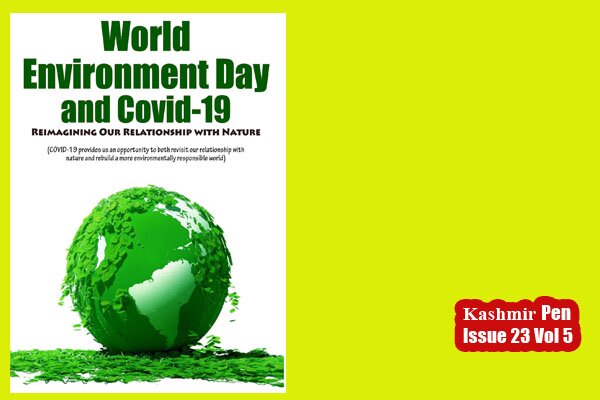
COVID-19 provides us an opportunity to both revisit our relationship with nature and rebuild a more environmentally responsible world.
The coronavirus pandemic is an urgent call to appreciate all the ways that we are dependent on nature and to combat species loss and environmental degradation. We are called to remember that we are polluting the planet and destroying habitats upon which we all depend.
We sometimes forget that we exist within a web of life. This web is a complex, interconnected system in which each part plays an important role. When one component is changed–or removed–the entire system is affected.
Nature prevents and responds to some of the most pressing challenges faced by humans today. It purifies the air we breathe, cleans the water we drink, and produces the variety of foods we require to stay healthy and resist disease. It enables medical researchers to understand human physiology; and provides substance for developing medicines. It even helps mitigate the impact of climate change by absorbing carbon, reducing air pollution and helping to cool cities.
Human action has reduced biodiversity and modified wildlife population structures and at an unprecedented rate. In the last 50 years, the human population has doubled; the global economy has almost quadrupled and global trade has increased by approximately ten times. Today, it would take 1.6 Earths to meet the demands that humans make on nature each year; and more species are at risk of extinction than ever before.
The emergence of COVID-19 has underscored the fact that when we destroy biodiversity, we destroy the system that supports human life. The more biodiverse an ecosystem is, the more difficult it is for one pathogen to spread rapidly or dominate; whereas, biodiversity loss provides opportunity for pathogens to pass between animals and people.
Human actions, including deforestation, encroachment on wildlife habitats, intensified agriculture, and acceleration of climate change, have upset the delicate balance of nature. We have changed the system that would naturally protect us, and have created conditions that allow particular pathogens–including coronaviruses–to spread.
Today, it is estimated that, globally, about one billion cases of illness and millions of deaths occur every year from diseases caused by coronaviruses; and about 75 per cent of all emerging infectious diseases in humans are zoonotic, meaning that they are transmitted to people by animals. Nature is sending us a message.
COVID-19 provides us an opportunity to both revisit our relationship with nature and rebuild a more environmentally responsible world. Addressing zoonotic disease emergence requires addressing its root cause–primarily, the impact of human activities. As the global population approaches 10 billion, we need to better understand the web of life in which we live and appreciate that it functions as a whole system. It is time to reimagine our relationship with nature and put nature at the heart of our decision-making.
With COVID-19 pandemic continuing to spread, national and local governments are urged to treat waste management, including medical, household and other hazardous waste, as an urgent and essential public service in order to minimise possible secondary impacts upon health and the environment.
Impact of COVID-19 Lockdown on Environment:
Air Quality:
After the lockdown was put in place in many countries, there was lesser travelling done by people, whether it be by their own cars, or by trains and flights. Even industries were closed down and not allowed to function. This in turn led to the pollution in the air dropping significantly, as there was a marked decline in nitrous oxide emission.
Water Quality:
Since there were no boats, whether they be fishing or pleasure ones, plying on the rivers and waterways, the water has cleared up. In areas like Venice, the water became so clear that the fish could be seen and there was better water flow. No doubt, because of the lesser human footfall even the oceans are recovering and marine life is thriving.
Effect on Wildlife:
Again where fish is concerned, the lockdown has seen a decline in fishing, which means that the fish biomass will increase after over-fishing almost depleted it. Apart from that, animals have been spotted moving about freely where once they would not dare to go. Even sea turtles have been spotted returning to areas they once avoided to lay their eggs, all due to the lack human interference.
Effect on Vegetation:
Plants are growing better because there is cleaner air and water, and because yet again there is no human interference. With everything at a standstill, plants are allowed to thrive and grow and produce more coverage and oxygen. Less litter also means lesser clogging of river systems, which is good in the long run for the environment.
With hope in our hearts to surpass the hard times, we shall move to a future of refined lifestyle choices to preserve Mother Nature and hope to be working cumulatively to restore our planet earth from the destruction that had been caused over the several years.

