
Way back in the year 2016 when Medicines Sans Frontier (MSF) and Government Medical College (GMC) Srinagar came up with first ever study on mental health in Kashmir, the toll taken by years of conflict on minds of people became more evident than ever. Even though study focused on distress rather than disorders it was evident that “huge mental health morbidity” in Kashmir was a reality. The Institute of mental health and neurosciences (IMHANS) followed with another study which showed while majority of people in conflict ridden Valley were coping and resilient, still 11.3 percent population was having mental illnesses, which was higher than national average of 7.3 percent. While affected could be of any age group, young minds, experts feel, are vulnerable and suffer consequences of violence and fluid family structures the most.
Suicides are a reality in Kashmir as much as in other parts of world. Recognized as serious mental health problem, suicide ranks as 9th leading causes of death in developed world. Although Kashmir has lowest suicide rates in India – 0.5 per 10 lakh – over last few years, data reveals, there has been spurt in suicides, attempts to suicides and deliberate self harm. “The situation warrants public health measures to bring down mortality because of suicide. Better understanding of risk factors and magnitude of effect of known risk factors among general population is crucial to design measures about suicide prevention programs.
Since 5 August 2019 ,followed by Covid 19 crises it has been difficult for people to access health facilities, and hospitals have reported a drop in patient numbers.Even in a normal situation, few people access mental healthcare, in particular. About 44.5% fewer patients visited the Institute of Mental Health and Neuro Sciences (IMHANS), Srinagar, in August, when compared to July, but this data is inconclusive as the number of patients was even lower in May.
On the other hand, in recent times, more patients have been visiting general out-patient departments (OPD) with symptoms of anxiety and reporting palpitations since 5 August, said a general physician working at the Baramulla district hospital, who did not want to be identified. Such patients are referred to the psychiatric OPD. Chemists outside the hospital said there was an increase in the demand of antidepressant and anti-anxiety medicines, especially in the 16-30 years age-group.
Srinagar’s old town, where IMHANS is, has more restrictions on movement than other areas, which has led to a fall in the number of patients.
Years of strife left a generation traumatized. India’s clampdown disrupted daily life. Now the battle against the coronavirus has further isolated and scarred a people with little access to help.
More than a year after India revoked Kashmir’s semiautonomous status and brought the region fully under its authority, doctors here say a state of hopelessness has morphed into a severe psychological crisis. Mental health workers say Kashmir is witnessing an alarming increase in instances of depression, anxiety and psychotic events.
Hard data is difficult to come by, but local medical professionals say they are seeing a rise in suicides and an increase in already disturbingly high rates of domestic abuse.
A nationwide lockdown that India imposed across the country in recent weeks to fight the coronavirus has worsened the problem, the medical professionals say. Police officers block roads with coils of glistening concertina wire. Any residents who step out of their homes, especially in Kashmir’s towns and cities, risk getting beaten up.
Doctors and researchers say the Kashmir Valley, tucked into the Himalayas, has few resources to cope. This area has been mired in conflict for decades with its majority-Muslim population agitating for independence or at least more autonomy from India, which is majority Hindu and controls most of Kashmir. Pakistan controls a smaller slice.
Even before the events of recent months, decades of violence between Indian security forces and Kashmiri militants had taken a physical and mental toll on the region and its people. Nearly 1.8 million Kashmiris, or nearly half of all adults, have some form of mental disorder.Nine of 10 have experienced conflict-related traumas. The figures are much higher than in India, according to other surveys.
Every season of turmoil in Kashmir brings a new kind of pain. One season is marked by the corpses of teenage boys felled by Indian forces. Another brings an epidemic of dead eyes, as Kashmiris refer to protesters left blind after being struck in the eyes by pellets fired by police officers. This past year will be remembered for the crackdown. In August, the Indian government suddenly stripped away statehood from Jammu and Kashmir, which had been India’s one Muslim-majority state. Security forces flooded the area, cut off roads, shut down landlines, cellphone lines and the internet, and arrested thousands of Kashmiris, from students to top elected officials. Some have been released, but many remain in jail. Though some phone and internet service have been restored, they remain nothing close to pre-crackdown levels. Many Kashmiris, who used social media to socialize because it was dangerous to hang out in the streets, now feel completely isolated. Children have remained out of school for months. Because of the military crackdown and then the coronavirus lockdown, students have been in school only a few weeks. COVID-19 are adding new pressures for children with pre-existing issues or those in vulnerable home environments, unable to attend school. Slow internet and disrupted mobile phone connections also block access to teachers to upload lectures.Sometimes, it takes a day or two to download a single video lecture.
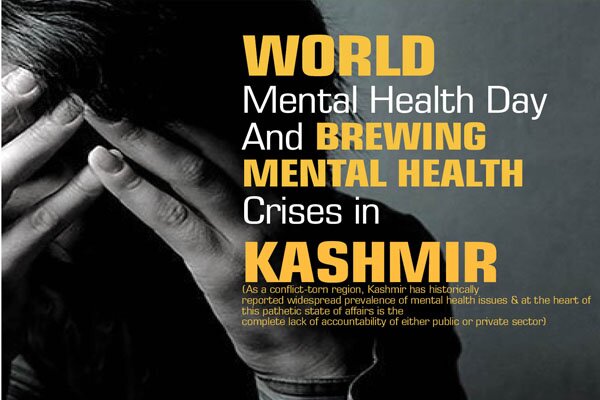
To be precise , it can be said that at the heart of this pathetic state of affairs is the complete lack of accountability of either public or private sector, and the absence of stewardship role of state in ensuing justice and quality of health care for all its citizens.
ADVERTISEMENT
World mental Health Day &Brewing Mental Health Crises in Kashmir
ADVERTISEMENT


Leave Comment

ADVERTISEMENT