

SANJAY PANDITA
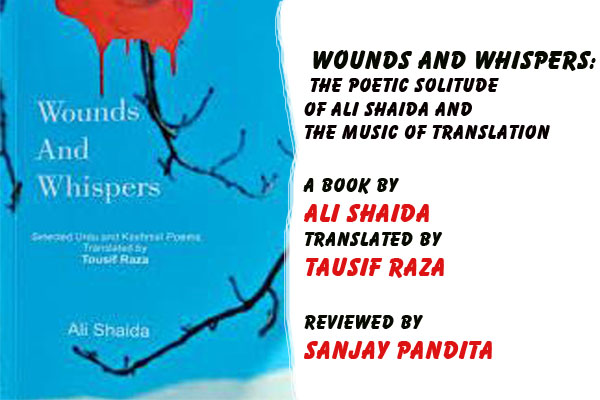
There are poets whose words arrive like thunder—resounding, assertive, and unrestrained—and there are others whose art moves within the stillness between heartbeats. Ali Shaida belongs unmistakably to the latter order: a poet of inward calm, of silences distilled into sound, of emotions disciplined by reflection. His verse does not proclaim; it breathes. In Wounds and Whispers, his poetry emerges as a fragile architecture of feeling, built from dust, breath, and remembrance. Tousif Raza’s English translation of this collection extends that architecture into another realm, allowing readers unfamiliar with Urdu to sense the pulse and cadence of a voice that vibrates with quiet luminosity.

ALI SHAIDA
What renders this collection extraordinary is not the novelty of its themes—for love, death, time, and longing have been poetry’s oldest companions—but the serenity with which Shaida transforms these eternal subjects into revelations of beauty. Each poem feels carved out of silence, polished by restraint, and illuminated by the subdued glow of contemplation. His diction is unadorned, his rhythm slow and meditative, and yet every word carries an aftertaste of eternity.
The poem (“The Next Season of Breath”) announces both the tone and temper of Shaida’s poetic world. The poet begins with a line that reads like a whispered revelation: “Maut ka ghar koi sarāe nahīn”—“The house of death is no inn.” In this aphoristic declaration lies the paradox of existence: to die completely, one must first learn how to live fully. The rhythm of the Urdu here is deliberate and ceremonial, as if each syllable were balanced against the breath of life itself. Shaida’s approach to death is neither fearful nor fatalistic; he treats it as an inevitable unfolding, a quiet extension of life’s own design. His imagery—autumn’s yellow turning to rust, the harmonium’s music buried in silence, mist dissolving into distance—suggests transition rather than termination.

TOUSIF RAZA ( TRANSLATOR)
The poem’s metre, free yet internally musical, mirrors the rhythm of breathing. The recurring verbs—walking, waiting, surrendering—create an undercurrent of pilgrimage. And yet, amid solemnity, tenderness glimmers:
“Zindagī main tujhe salām kartā hoon / tu ne mujhe marna sikhā diyā.”
It is gratitude, not despair, that closes this meditation. Death here becomes a teacher, not an enemy; to have learned to die is to have mastered the art of living.
Tousif Raza’s English translation of this poem exemplifies fidelity without servitude. “House of death beckons no entrance, but a mere departure called forth” maintains the meditative syntax of the original while preserving its spiritual poise. Raza listens to the Urdu rather than merely transferring it. His translation breathes at the same pace as Shaida’s lines; his pauses echo the sighs hidden within them. The compact music of Urdu can never be fully replicated in English—its vowels and cadences resist direct conversion—but Raza compensates with lyric restraint. He succeeds in translating not just meaning but feeka—that subtle lingering flavor of feeling that defines Shaida’s idiom.
If one poem contemplates mortality, another, (“The Knock of Autumn”), reflects on impermanence. Here, Shaida turns the pages of existence and finds dust where once there was light.
“Zindagī khulā saheefa hai / waraq waraq pe lafzon ke parinde chehchaā rahe hain.”
“Life is an open manuscript, and on every leaf, birds of words are chirping.”
This metaphor, luminous and tender, fuses sanctity with fragility, the sacred with the ephemeral. The poem unfolds like an elegy for the vanishing world: pages gather dust, words fade, colors lose their brightness. Yet Shaida does not lament decay; he accepts it as part of the cosmic rhythm. Even in fading, there is grace.
His imagery—stars as punctuation marks, the sun reclining upon dew, the moaning of pages—reveals a painter’s sensitivity to tone and texture. Every object in his verse breathes. Paper becomes life, wind becomes time’s whisper, and light becomes a prayer. His diction, enriched by classical resonance—saheefa, lo, waraq—anchors the poem in spiritual vocabulary. The final line, “Pat jhar ki dastak saaf sunāi de rahi hai,” arrives like a soft knock of fate upon consciousness: inevitable, intimate, and eternal.
Raza’s English translation preserves this lyric melancholy with remarkable care. “Life is an open but a holy book, with words whispering like birds on each leaf” echoes both the imagery and rhythm of the Urdu. His use of alliteration—“words whispering”—recalls the rustle of pages. He avoids domesticating the sacred; the reverence of the original remains intact. Even in the final line—“The last chapter of the weather unfolds before the eyes; the knock of autumn is clear”—the echo of mortality endures. Raza’s strength lies in his discretion. He does not impose interpretation; he allows meaning to bloom from silence.
The poem (“The Mount”) shifts the tone toward introspection. It is brief, austere, yet weighty.
“Lafzon ko roz naye maafi deta hoon.”—“Every day, I forgive my words anew.”
The simplicity of the line belies its depth. Shaida sees himself as kohkan, a mountain carver, chiseling meaning from the hard rock of speech. Words, for him, are not effortless gifts but heavy stones shaped through labor and patience. The poem’s rhythm mirrors this physical act: each line a stroke of the chisel—precise, echoing, and deliberate.
There is spiritual humility in this act of forgiving one’s words—a recognition of language’s imperfection and the persistence of the poet’s faith. “Main hona chahta hoon” (“I want to be”) is not an assertion of ego but a yearning for existential clarity. Poetry, for Shaida, becomes a way of being—a mode of chiseling one’s inner mountain into form.
Raza’s translation—“Forgiving them daily anew, breaking the cliffs of brightness”—renders the tactile and luminous qualities beautifully. His phrase “cliffs of brightness” mirrors roshanāī ki chattānen, keeping the contrast of hardness and light intact. English, though lacking Urdu’s musical elasticity, captures the poem’s meditative poise. Both versions remind us that art is not spontaneous revelation but the slow carving of silence into form.
With (“To the Threshold of Pain”), Shaida enters the mystical terrain of longing, where the boundary between the human and the divine dissolves. The opening—“Dur tak dasht-e junoon mein tashnagi ke lams the”—unfolds a mirage shimmering under an invisible sun. The diction unites sensuality with spirituality: thirst becomes touch, desire becomes devotion. The poem maps the Sufi journey from separation to union, from illusion to realization.
Shaida’s desert is not only geographical but psychological—a vast landscape of the self seeking its own meaning. His images—footsteps fading, dreams borrowed from the beloved’s eyes, mirrors of fragmented selves—evoke the great mystical metaphors of Persian and Urdu traditions. Yet Shaida’s expression remains distinctly modern: introspective, stripped of ornament, and alive with vulnerability. The rhythm of the poem undulates between yearning and surrender, its repetition mimicking the rhythm of breath in prayer. The final act—inscribing words on the mirror and urging them to abandon aimlessness—transforms writing into worship, and pain into revelation.
Raza’s translation carries this mystical cadence with graceful restraint. “Into the wilderness of madness afar, the touch of thirst pervaded” echoes the soft alliteration and inner rhythm of the Urdu. His phrasing—“a puzzle of color and scent,” “venture into the deserts of Najd”—retains the spiritual undertone without over-translation. Where Shaida’s Urdu breathes in the idiom of Rumi and Shah Latif, Raza’s English hums with the mystic register of Blake and Yeats. Two tongues, two traditions—meeting in the same inner silence.
The poem (“Two Drops of Tears”) returns from the metaphysical to the intimate. After meditations on death, time, and divinity, Shaida closes with a song of love and loss.
“Tere rāston pe chalte chalte / āhein bhi dhadakna bhool gayi.”
The music of these lines is unmistakably lyrical, the metre gentle as dusk. The poem captures the exhaustion of devotion—the lover wandering endlessly, forgetting even how to sigh.
The central image—the river flowing through the beloved’s village—serves as the eternal witness of love. When two tears fall into it, they merge with nature itself, transforming sorrow into continuity. The simplicity of this image conceals immense emotional power. Shaida’s tone remains dignified; he avoids melodrama, preferring restraint. The repeated invocation of “tujhe” weaves an incantatory rhythm, as if calling across distances of time and loss. The diction is pure, direct, and timeless.
Raza’s translation, titled “Glistening Tear Drops,” honors the tenderness of the original. “Walking along your paths, forgetting even the echoes of sighs” preserves its emotional gentleness. While English cannot replicate the beher—the metrical weight—of Urdu, Raza’s tone conveys its ache. His rendering of “That river that passes through your village, my two tears fell into it” captures both the image and its quiet universality. Even where he softens a phrase, as in “lines on my hands started to intertwine,” the moderation enhances emotional resonance. The closing line—“You will forget to laugh too”—hangs in the air like a fading note of remembrance.
Across these poems, one perceives Ali Shaida’s mastery: his control over tone, his painterly command of imagery, and his rare harmony between intellect and emotion. He is a poet of restraint and reflection. His metaphors are born from thought, not embellishment; his rhythm from contemplation, not rhetoric. His poetry breathes in the cadence of silence, each line echoing the measure of human breath. His imagery—fading leaves, trembling dew, the harmonium’s mute sigh—draws from nature but belongs to the inner world. There are resonances of classical mystics in his work, yet his sensibility remains unmistakably modern, introspective, and Kashmiri in temperament—soft, melancholic, and suffused with remembrance.
Stylistically, Shaida’s craft unites the lyric grace of classical Urdu with the reflective freedom of modern azād nazm. He employs repetition as mantra, silence as rhythm, and image as revelation. The absence of rhyme enhances his musicality; it forces the reader to listen to pauses and breaths. The emotional tonality of his language bears the fragrance of the valley—its melancholy, its tenderness, its enduring beauty.
Tousif Raza, as translator, navigates this delicate landscape with rare humility. He recognizes that translation is not duplication but dialogue. His English versions echo rather than imitate, allowing the spirit of the original to breathe within a new linguistic body. His diction is lyrical but measured; his tone contemplative rather than explanatory. Though some losses are inevitable—the liquid sonority of Urdu, its musical compression—Raza compensates with poise and fidelity. His translations stand as meditative poems in their own right, yet the ghost of Urdu lingers, like fragrance after rain.
In Wounds and Whispers, the poet and translator together construct a bridge between two languages, two musicalities. Shaida’s Urdu sings in the lower register—deep, resonant, born of solitude. Raza’s English responds like an echo from another valley—soft, distant, but faithful. Between them flows the same river of emotion. The wounds of one tongue become whispers in another. Reading this bilingual dialogue feels like listening to rain on both sides of a window—the same rhythm, two different sounds, each completing the other.
At a time when much contemporary poetry seeks noise and novelty, Ali Shaida’s work insists on quiet. It reminds us that poetry’s highest task is not to dazzle but to deepen. His words are not torches that blind but lamps that endure, glowing steadily through the night. Tousif Raza’s translations ensure that this glow reaches beyond linguistic boundaries, touching those who might never read Urdu yet can still feel its music.
Together, poet and translator affirm that art, when born of sincerity, transcends both wound and whisper. It becomes breath itself—the next season of it.
The writer is a poet, columnist and critical analyst, can be reached at: sanjaypanditasp@gmail.com

