

By Shazia Shah | Kashmir Pen
SRINAGAR, April 4:
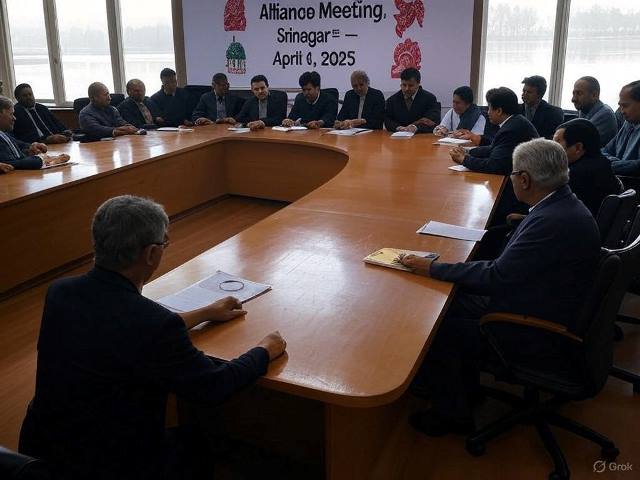
In a significant political assertion, key alliance partners of Jammu and Kashmir convened a high-level meeting in Srinagar on Thursday and passed two powerful resolutions that directly challenge recent decisions of the central and Union Territory administrations.
The resolutions—first, opposing the Waqf Amendment Bill, and second, condemning the recent transfer orders issued by the Lieutenant Governor’s administration—reflect growing unease among regional political groups over what they describe as the continued erosion of democratic and institutional autonomy in Jammu and Kashmir.
Resolution 1: Opposition to Waqf Amendment Bill
The alliance unanimously passed a resolution rejecting the proposed Waqf Amendment Bill, branding it as a calculated move targeting Muslims and other minorities. The bill, currently under debate, is viewed by the alliance as a deliberate attempt to centralize control of Muslim religious endowments (Auqaf), bypassing the traditional and community-based structures that have managed these affairs for decades.
The leaders warned that the bill, if passed in its current form, would lead to “disempowerment of community institutions” and violate the constitutional guarantees of religious and administrative freedoms.
“This amendment is not just legislative overreach—it is a direct assault on the autonomy of religious institutions,” a senior Peoples Democratic Party (PDP) leader said during the meeting.
Civil society groups and religious scholars have also raised concerns about the broader implications of the bill, which could lead to bureaucratic control over Waqf properties and educational trusts, undermining their community service missions.
Resolution 2: Condemnation of LG’s Transfer Order
The second resolution expressed strong disapproval of the recent transfer orders issued by the office of the Lieutenant Governor. The alliance alleged that the transfers, especially within the education and health departments, were made without transparency, local consultation, or merit-based assessments.
“This pattern of arbitrary administrative actions is alienating public servants and causing unrest within institutions,” said a member of the alliance’s coordination committee, who asked not to be named.
The resolution demanded a review of recent transfers and called for the restoration of democratic accountability in administrative decisions.
Tanvir Sadiq: “Cordiality Should Not Be Mistaken for Weakness”
Addressing reporters after the meeting, Tanvir Sadiq, National Conference (NC) MLA and prominent political voice, emphasized the alliance’s commitment to democratic principles and the aspirations of the people.
“We have passed resolutions urging the Government of India to respect the will of the people. While we maintain a cordial relationship with the LG, this should not be mistaken for weakness,” Sadiq said.
He stressed that democratic institutions in Jammu and Kashmir must not function at the mercy of unilateral executive decisions.
Background: Centralization, Autonomy & Public Sentiment
These resolutions come at a time when public sentiment across Kashmir is increasingly vocal about the perceived disempowerment of local institutions since the abrogation of Article 370. Critics argue that recent policy decisions reflect a centralized approach that sidelines elected representatives and regional voices.
Political analysts believe that the alliance’s statements signal a more coordinated opposition to New Delhi’s Kashmir policy, especially on issues involving cultural, religious, and administrative autonomy.
“The opposition to the Waqf Amendment Bill may become a rallying point,” said Prof. Altaf Raina, a political analyst at Kashmir University. “It touches upon issues of religious identity, local governance, and minority rights—all of which resonate deeply in the region.”
Voices of Concern from the Community
Social activists and community leaders have echoed the alliance’s stance, urging the government to withdraw or revise the Waqf Bill in consultation with stakeholders.
“The sanctity of religious endowments must not be tampered with. These institutions are pillars of community support, education, and culture,” said Moulana Aslam Nadvi, a prominent cleric and former member of the Waqf Board.
Similarly, teachers’ associations and administrative unions have also expressed unease over the increasing frequency of politically influenced transfers.
“These orders affect not just individual officers but the functioning of entire departments,” said Abdul Majid Rather, President of the Jammu and Kashmir Teachers’ Coordination Committee.
The Road Ahead: Coordinated Resistance or Symbolic Protest?
While the resolutions have no binding legislative power, political observers say they reflect a growing consensus among Kashmir’s regional parties to jointly resist what they view as a pattern of marginalization and over-centralization.
Whether this marks the beginning of a renewed political movement or remains a symbolic protest remains to be seen.
For now, the message is clear: Jammu and Kashmir’s regional political players are attempting to reassert their relevance and representational authority in a space increasingly dominated by administrative orders and top-down governance.
