

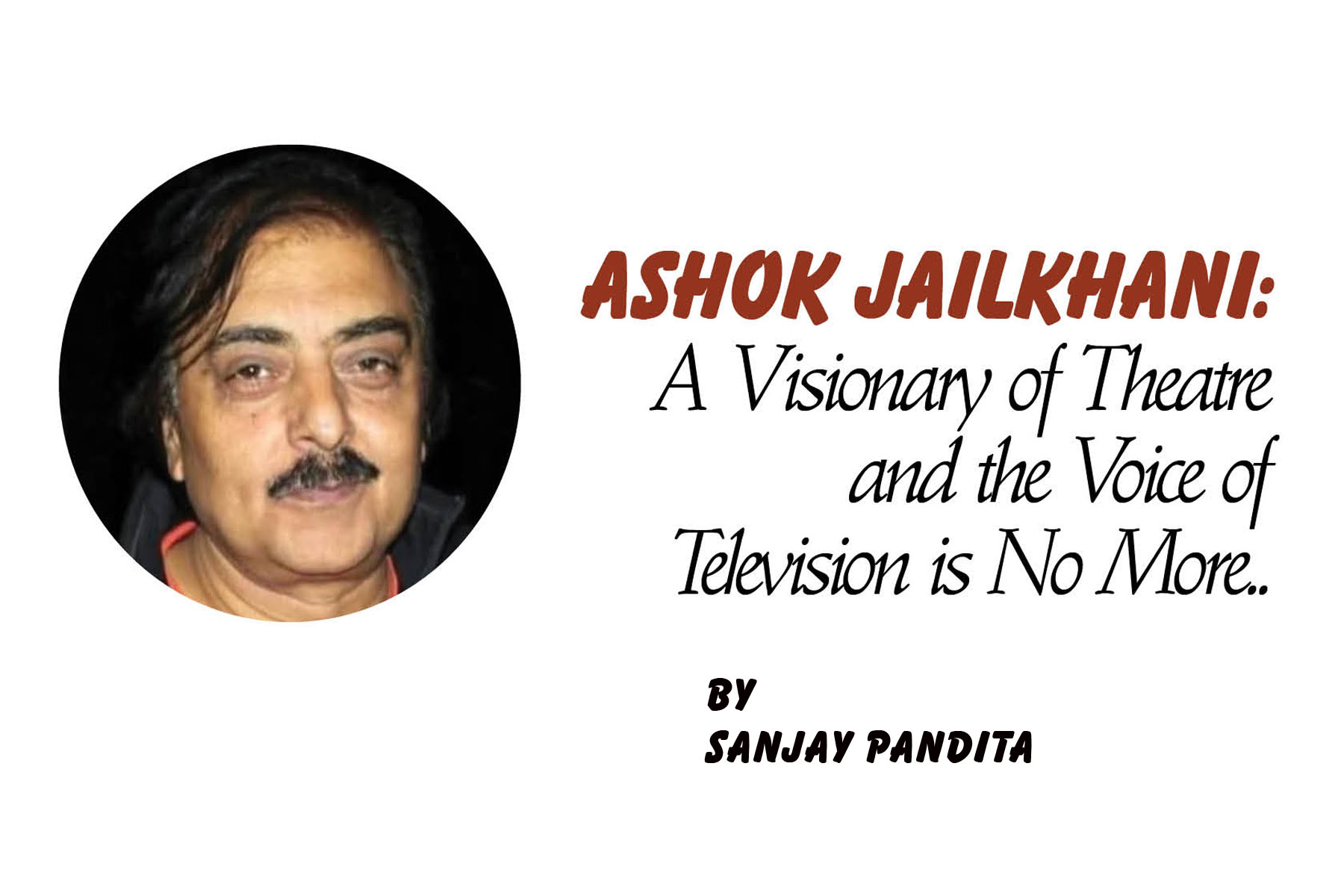
SANJAY PANDITA
The curtain has fallen on a remarkable life, yet the echoes of his voice, the precision of his craft, and the depth of his vision will continue to resonate across time. Ashok Jailkhani, who bid farewell to this world on 29 August 2025 in Delhi, was far more than a distinguished name in the realms of broadcasting, theatre, and television—he was a movement in himself. An institution in the truest sense, he carried the torch of Kashmiri theatre into modernity, infused television with an uncommon artistic sensibility, and enriched generations of actors, writers, and producers with his wisdom and mentorship.
From the narrow lanes of Aali Kadal in Srinagar to the highest echelons of Doordarshan, where he retired as Additional Director General, his journey was not just a chronicle of personal triumphs. It was the story of how passion, discipline, and imagination, when fused in rare harmony, can transform the cultural landscape of an entire region and inspire countless others to dream beyond boundaries.

Born in 1953, in a modest Kashmiri household, Ashok was cradled by the rhythms of Srinagar’s bustling core. His father, M. L. Jailkhani, was himself a household name, and the young boy inherited a sensibility tuned to art, words, and performance. By the time most teenagers were still searching for direction, Ashok had already found his. At sixteen, he entered the world of theatre, drawn irresistibly towards the stage where words transform into living emotions. The Rangmunch Dramatic Club, under the leadership of M. L. Saraf, became his first training ground. There, he performed in Grand Rehearsal by Pushkar Bhan and Talash by A. K. Rehbar—his tentative steps towards a life that would forever remain intertwined with theatre.
But Ashok was never one to remain confined to established circles. In 1970, barely out of his teens, he co-founded Vasant Theatre with a few like-minded dreamers. This was no small feat in a Valley where resources were scarce, and audiences were still evolving in taste. With Vasant Theatre, Ashok not only acted but also directed plays, crafting productions that would later be remembered as milestones in Kashmiri theatre. The range of plays he touched was astonishing: from Vijay Tendulkar’s Giddh to Badal Sircar’s Evam Inderjeet, from Surendra Verma’s poetic Surya Ki Antim Kiran Se Surya Ki Pehli Kiran Tak to Ali Mohammad Lone’s Chinar. His choice of texts was never random. He chose works that unsettled, questioned, and illuminated. He was among the first in Kashmir to bring avant-garde Indian drama to the local stage, giving Tagore Hall audiences in Srinagar a taste of theatre that, until then, one could only expect in Delhi’s Kamani or Mumbai’s Prithvi.
If theatre was his first love, television soon became his canvas. In 1972, at just eighteen, Ashok was selected for television production and trained by experts from the BBC. It was a rare opportunity, and he absorbed every lesson like a sponge. Unlike many who treat television as mere entertainment, Ashok saw in it the possibility of art, a space where drama could be reimagined for a wider audience. Over the decades, he produced and directed close to two hundred plays, serials, and telefilms. His television productions were not just programs; they were cultural events that drew families together, created public discussions, and lingered in the collective memory of Kashmir.
Who can forget Harud, a serial so popular that the streets of Srinagar would empty during its broadcast? Shops downed shutters, people postponed errands—television became a communal ritual because Ashok knew how to strike a chord with the soul of his audience. His Shabrang too broke new ground, weaving stories that resonated with the cultural and emotional textures of Kashmir. He adapted Akhtar Mohi-ud-din’s classic Daryai Hund Yezare into the English telefilm Trespassers, demonstrating his ability to bridge cultures without diluting authenticity.

In all of this, Ashok was never merely a director or producer—he was also an actor, a performer who could hold the stage with the intensity of his dialogue delivery. His presence in plays like Begur Bana or Raheen was magnetic, his performances so finely measured that even decades later, fellow actors recalled lines he had spoken on stage as though they had been etched into memory. His dialogue from Panchi Aise Aate Hain—“Aise hi aaiye meri zindagi ka ant, ki ant sa lage hi naa”—still echoes in the ears of those who heard it.
What set him apart, however, was not just his artistry but his vision as a leader. Ashok Jailkhani rose through the ranks of Doordarshan with an unusual blend of creativity and administrative acumen. He headed Doordarshan Kendra Jalandhar and Chennai, started the Jammu division of DDK, and as ADG, led national channels like DD Sports, DD Urdu, DD Kashir, and DD Bharti. His stewardship was not bureaucratic; it was inspirational. Under him, drama departments thrived because he infused them with his own theatrical discipline. He believed in experimentation, in breaking conventions, in giving space to younger voices. Many actors, producers, and directors who later made a name for themselves in Kashmir and beyond credit him as their mentor.
His contributions did not go unnoticed. Ashok received the State Award from the Government of Jammu and Kashmir for being an “Outstanding Media Person.” He was conferred with the prestigious Bhartendu Harishchandra Award by the Government of India for his book on television production, co-authored with Maharaj Shah. He also received national awards from Doordarshan for his outstanding work as a station head in both Jalandhar and Chennai. Yet, beyond the glitter of awards, it was his enduring influence that mattered more—the way he shaped Kashmiri theatre, television, and broadcasting into institutions of integrity and imagination.
Ashok was not only a practitioner but also a teacher. He authored An Introduction to Theatre, a book so well-regarded that it became part of the postgraduate curriculum in Kashmir University. His book on television production, written in Hindi, was incorporated into syllabi on mass media, ensuring that his knowledge reached classrooms and shaped future communicators. In his writings, just as in his productions, clarity of thought met depth of experience.
His contemporaries and juniors describe him in words that glow with reverence. Dr. Sohan Kaul called him a genius who introduced modern sensibilities to Kashmiri theatre. Mushtaq Bala remembered how his sharp editorial suggestion—to condense a three-episode serial on Zain-ul-Abidin Badshah into a one-hour film—transformed the project into an award-winning landmark. Actor Suraj Raina recounted how Ashok’s words of encouragement during his mother’s illness became a mantra of survival. Ravinder Kaul, the cultural critic, described him as the most competent person to rise to Doordarshan’s top positions. Kamal Razdan spoke of how Ashok’s productions gave Kashmiri actors the aura of national stars. And Maharaj Shah, his long-time colleague, remembered him as a guide and friend whose silence was as eloquent as his words.
What emerges from all these voices is a portrait of a man who was at once demanding and compassionate, visionary and practical. On the sets, he was calm, allowing actors to explore their roles with freedom, but never compromising on the integrity of the production. He replaced the old-fashioned grandeur of stage sets with nuanced lighting and sound, proving that innovation mattered more than spectacle. His productions were thus not only technically refined but also emotionally profound.
The story of Ashok Jailkhani is also the story of Kashmir’s cultural evolution. The 1970s and ’80s were a golden age of Kashmiri theatre, with Tagore Hall as its epicenter. Ashok was one of the torchbearers of this renaissance, bringing plays that forced audiences to question feudalism, gender dynamics, and the very meaning of existence. But the 1990s brought turmoil. Theatre dwindled as violence consumed the Valley, Tagore Hall was reduced to ashes, and artists were forced to seek other platforms. Television became the refuge, and Ashok ensured that its productions did not lose the soul of theatre. Even as private production houses mushroomed, often compromising quality for quick profit, he raised his voice for integrity and lamented how genuine artists were being sidelined.
He was acutely aware of the challenges facing media. In later years, he often reflected on the future of television, radio, and theatre in Kashmir. He recognized that cinema and OTT platforms posed formidable competition, but he believed in the resilience of television as a medium of community and intimacy. For him, radio too had a unique place because it carried fewer distractions, more imagination. He argued that innovation and relevance were the keys—formats must evolve, policies must adapt, and yet the essence of storytelling must never be lost.
Even after retirement, Ashok continued to write, reflect, and inspire. He often hinted at compiling a book of anecdotes from his long career—a treasure of behind-the-scenes memories with actors, directors, politicians, and sportspersons he had encountered. He had lived a life so full of art and humanity that every chapter of it could become a story in itself.
And now that he is gone, what remains is not silence but resonance. His serials are still spoken of with nostalgia, his plays remembered with admiration, his books studied with respect, and his personality recalled with affection. For those who shared the stage with him, he was a commanding actor. For those who worked under him, he was a mentor. For those who knew him personally, he was a gentle but inspiring presence.
Ashok Jailkhani was more than a dramatist, director, or broadcaster. He was a bridge between Kashmir’s rich tradition of oral storytelling and the modern mediums of stage, television, and film. He was a reminder that art can survive turmoil, that creativity can outshine censorship, that sincerity can leave an indelible mark on collective memory.
Today, as Kashmir mourns one of its greatest cultural sons, we also celebrate the gift of his life. The curtain has fallen, yes, but the performance continues—in every actor he trained, in every play he directed, in every viewer who was once spellbound by Harud or Shabrang. For as long as Kashmir remembers its theatre and television, the name of Ashok Jailkhani will not fade. He has joined the pantheon of those rare individuals whose art does not merely entertain but transforms, and whose life does not merely pass but lingers, like an eternal stage bathed in light.
The writer can be reached at: sanjaypanditasp@gmail.com

