

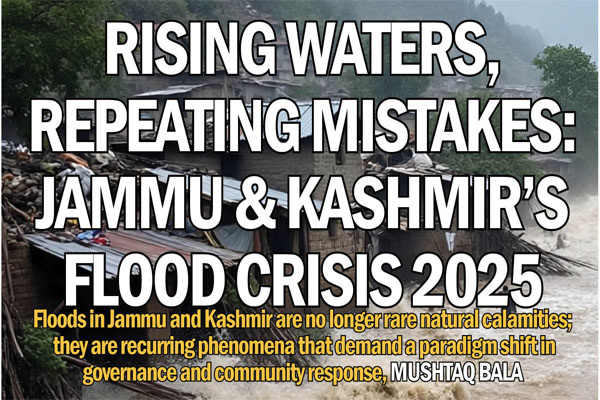
MUSHTAQ BALA
The specter of floods has once again cast its shadow over Jammu and Kashmir. The 2025 deluge in parts of Jammu has already unleashed devastation, with rivers swelling dangerously and low-lying areas submerged. In the Kashmir Valley, the Jhelum is rising rapidly, inching toward danger levels. For the people of the region, the unfolding scenes revive haunting memories of the catastrophic floods of 2014 and the recurring flood episodes that continue to expose our vulnerabilities.
The Present Crisis
As of this week, Sangam has already crossed the flood alert mark while water levels at Ram Munshi Bagh remain under close watch. In Jammu, torrential waters have swept through homes, roads, and farmlands, leaving destruction in their wake. The Tawi River, often underestimated, has once again demonstrated its ferocity. Rescue teams are on high alert, sandbags are being deployed, and weak spots along embankments are being monitored. Yet, the anxiety among the population is palpable.
Families living near riverbanks are being evacuated, schools have been converted into temporary shelters, and roads leading to rural hamlets are cut off. Farmers, whose paddy fields were ready for harvest, now see their hard work disappearing under muddy waters. Traders in low-lying Jammu markets count losses as shops remain inundated. The fear is not just about immediate damage but also about whether the lessons from past tragedies were ever fully acted upon.
The 2014 Deluge: A Stark Reminder
The floods of September 2014 remain among the darkest chapters in the region’s recent history. The Jhelum breached its embankments, engulfing Srinagar city and vast rural stretches. Lal Chowk, the heart of the city, turned into a watery graveyard of businesses and homes. Thousands were displaced, and critical infrastructure including hospitals, schools, and communication networks was paralyzed.
Relief poured in from across India and beyond, but the systemic lapses that allowed such a disaster to escalate were never fully addressed. The absence of robust drainage infrastructure, unchecked urbanization, and rampant encroachments on floodplains worsened the crisis. Committees were formed, recommendations made, and promises issued — but implementation remained sluggish.
The 2024 Floods: Another Warning
Barely a year ago, Kashmir faced another round of severe flooding. Although the scale was not as catastrophic as 2014, the floods of 2024 exposed the same old weaknesses: fragile embankments, clogged waterways, and poor coordination between agencies. This time, response teams were faster, but damage to agriculture, property, and livelihoods was still significant. For many residents, it felt like déjà vu.
Where Do We Stand in 2025?
Despite the passage of more than a decade since 2014, our flood preparedness remains largely reactive. Every year, when monsoon rains intensify, the cycle of alerts, emergency meetings, and makeshift defenses resumes. But the core structural changes — strengthening embankments, desilting water bodies, enforcing floodplain zoning, and modernizing forecasting systems — remain under-implemented.
Unlike states such as Kerala, which after the 2018 floods adopted a comprehensive disaster mitigation framework involving technology, zoning, and community preparedness, J&K still lags behind. The lack of political consensus, bureaucratic delays, and competing priorities have kept flood management on the back burner.
Human Cost of Neglect
It is easy to talk in numbers, but behind every statistic is a human story. In Jammu, a young mother carries her children through waist-deep waters to reach a relief camp. In Pulwama, an elderly farmer mourns his paddy crop — his only source of livelihood — destroyed days before harvest. Students preparing for competitive exams now sit in classrooms converted into makeshift shelters. For them, floods are not just about water levels; they are about disrupted lives, lost dreams, and fragile futures.
Lessons and Remedies
If the 2014 disaster and the 2024 floods were not enough reminders, the ongoing crisis in 2025 should compel us toward immediate, tangible reforms:
Strengthening River Management – Comprehensive desilting of the Jhelum, Tawi, and their tributaries must be prioritized, along with scientific embankment fortification.
Reviving Wetlands – Wetlands such as Hokersar, once natural shock absorbers, must be restored and protected from encroachments.
Urban Planning Reforms – Unregulated construction on floodplains must be stopped, and encroachments removed with political will.
Modern Forecasting Systems – Investment in real-time satellite monitoring and early-warning systems can save lives and property.
Community Preparedness – Flood safety drills, local volunteer networks, and awareness campaigns are vital for resilience.
Institutional Accountability – Disaster management cannot remain an annual ritual. Dedicated agencies must be empowered, funded, and held accountable.
Long-Term Climate Strategy – With climate change intensifying rainfall patterns, adaptation planning must be mainstreamed into policy.
Floods in Jammu and Kashmir are no longer rare natural calamities; they are recurring phenomena that demand a paradigm shift in governance and community response. The waters may recede in the coming weeks, but if the 2014 and 2024 lessons remain unheeded, 2025 will be remembered as yet another year when nature’s warnings were ignored.
The resilience of our people is remarkable, but resilience cannot substitute for preparedness. What we need is a vision where safety, sustainability, and accountability guide our response. The time to act is not tomorrow — it is today.
Mushtaq Bala is Editor-in-Chief of Kashmir Pen, an award-winning filmmaker, cultural commentator, and advocate for peace through narrative media.

