

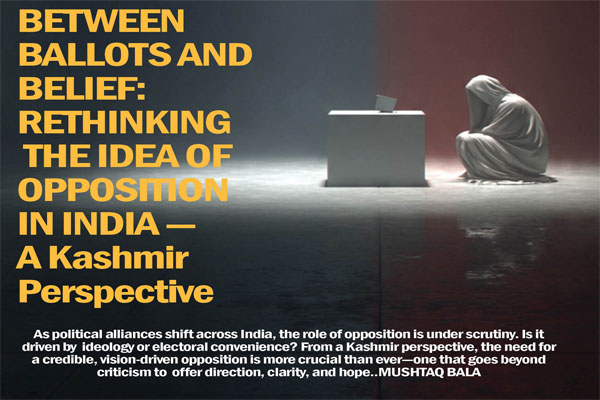
As political alliances shift across India, the role of opposition is under scrutiny. Is it driven by
ideology or electoral convenience? From a Kashmir perspective, the need for a credible,
vision-driven opposition is more crucial than ever—one that goes beyond criticism to
offer direction, clarity, and hope..MUSHTAQ BALA
MUSHTAQ BALA
In the theatre of democracy, the opposition is not merely a counterweight—it is a conscience. It questions, critiques, and, when necessary, corrects the course of governance. Yet, in contemporary India, the idea of opposition appears to be undergoing a subtle but significant transformation—one that raises important questions not just nationally, but in regions like Jammu & Kashmir where political nuance carries deeper implications.
Recent political developments across the country have once again brought the opposition’s role into sharp focus. Alliances are being forged and fractured with remarkable fluidity, often driven less by ideological coherence and more by electoral arithmetic. The emergence of coalitions such as the INDIA bloc was initially seen as an attempt to consolidate voices against a dominant political force. However, the absence of a clearly articulated common vision has led many to wonder: is today’s opposition united by belief, or merely by the ballot?
For Jammu & Kashmir, this question is not abstract—it is deeply personal.
Historically, the region has witnessed complex political alignments, shaped by its unique socio-political fabric. The idea of representation here has always been layered, where identity, governance, and aspirations intersect. In such a context, the role of a credible and principled opposition becomes even more vital. It is not enough to oppose; one must also propose.
At present, there appears to be a perceptible vacuum in structured political discourse. While voices of dissent exist, they often lack cohesion, direction, and sustained engagement with ground realities. The danger in such a scenario is twofold: on one hand, governance risks becoming insulated from critique; on the other, public trust in democratic processes begins to erode.
A meaningful opposition must rise above reactionary politics. It must articulate a vision that resonates with people’s lived experiences—employment, education, cultural preservation, and social harmony. For Kashmir, this includes addressing the aspirations of its youth, safeguarding its pluralistic ethos, and ensuring that development does not come at the cost of identity.
Equally important is the need for clarity. Is the opposition in India preparing for long-term ideological engagement, or is it confined to short-term electoral alignments? The answer to this question will shape not just the future of national politics, but also the democratic health of regions like Jammu & Kashmir.
There is also a larger philosophical concern at play. Democracy thrives not on unanimity, but on informed disagreement. When opposition becomes fragmented or opportunistic, the quality of that disagreement diminishes. What remains is noise without narrative.
And yet, there is reason for cautious optimism.
Across India—and indeed within Jammu & Kashmir—there exists a politically aware and increasingly discerning citizenry. People are no longer passive recipients of political messaging; they are active evaluators. They seek authenticity, accountability, and above all, sincerity of purpose.
For the opposition, this is both a challenge and an opportunity.
The challenge lies in rebuilding credibility. The opportunity lies in redefining its role—not as a perpetual adversary, but as a constructive alternative. This requires introspection, ideological clarity, and a willingness to engage beyond electoral cycles.
As India navigates its evolving political landscape, the question is no longer whether an opposition exists, but whether it matters in the way it should.
For Jammu & Kashmir, the stakes are particularly high. In a region where every political shift carries emotional and historical weight, the need for a thoughtful, grounded, and visionary opposition cannot be overstated.
Between ballots and belief, the future of Indian democracy may well depend on how this balance is restored.
Summary:
As political alliances shift across India, the role of opposition is under scrutiny. Is it driven by ideology or electoral convenience? From a Kashmir perspective, the need for a credible, vision-driven opposition is more crucial than ever—one that goes beyond criticism to offer direction, clarity, and hope.
Mushtaq Bala is Editor-in-Chief of Kashmir Pen, an award-winning filmmaker, cultural commentator, and advocate for peace through narrative media.

