

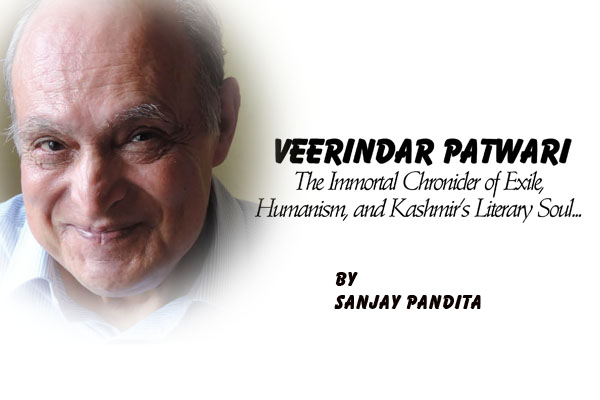
SANJAY PANDITA
The passing of Veerindar Patwari is not simply the death of an accomplished writer; it is the fading of a luminous literary constellation whose brilliance illuminated the vast horizons of Urdu, Kashmiri, Hindi, and English literature for more than six remarkable decades. His departure has created an irreplaceable void in the cultural and literary consciousness of Kashmir and beyond, for he was not merely an author but a custodian of collective memory, a philosopher of human suffering, and an unwavering voice of resilience in the face of displacement, loss, and civilizational rupture.
With his final breath, an extraordinary chapter in literary history closes, but his words remain eternal—alive in libraries, in hearts, and in the enduring spirit of those who understand literature as both witness and resistance. Veerindar Patwari belonged to that rare class of writers whose lives themselves become literature, whose pain transforms into prose, and whose artistic devotion transcends generations.
Born in the historic and culturally vibrant town of Sopore in Kashmir, Veerindar Patwari was the eldest son of Late Pandit Prem Nath Patwari, revered in literary circles as Masroor Kashmiri—a distinguished school teacher, poet, and one of the most celebrated contributors to Kashmiri literature. His father’s name carried immense literary prestige, particularly through his acclaimed work Venu Posh, which remains an important part of Kashmiri literary heritage.
Thus, Veerindar was born not merely into a family but into a living literary tradition. His childhood unfolded in an environment enriched by poetry, scholarly discourse, cultural awareness, and artistic refinement. The Patwari household was not simply a residence—it was a sanctuary of language and literature, where creativity was nurtured and intellectual curiosity flourished. Under the profound influence of his father’s literary brilliance, Veerindar inherited a deep reverence for words and developed an emotional and philosophical sensitivity that would later define his own extraordinary body of work.
From an early age, he displayed a rare ability to observe life with unusual depth. The socio-cultural realities around him, the changing landscapes of Kashmir, and the moral complexities of society all became part of his inner creative reservoir. Though his formal education led him into civil engineering, Veerindar Patwari’s heart remained inseparably connected to literature. He pursued his engineering studies with diligence, eventually graduating as a civil engineer and embarking on a successful professional career that culminated in his retirement as Executive Engineer in 1998.
Yet even while immersed in the demanding world of engineering and public service, his literary spirit remained unextinguished. This extraordinary balance between profession and passion became one of the defining features of his life. While he built physical structures as an engineer, he simultaneously constructed emotional and philosophical worlds through literature. His life stands as a remarkable testament to the possibility of harmonizing practical responsibility with artistic excellence.
Veerindar Patwari began his literary journey in 1965, and over the next sixty years, he emerged as one of the most prolific and respected literary figures of his time. His output was astonishing not merely in quantity but in thematic richness, linguistic versatility, and artistic depth. He authored more than 300 short stories in Urdu, numerous plays, telefilms, radio dramas, Kashmiri narratives, English stories, poetry collections, and philosophical works. His literary creations found place in more than sixty prestigious national and international journals and magazines, including Shair, Aajkal, Aiwan-e-Urdu, Biswin Sadi, Pehchan, Imkan, Khushboo Ka Safar, Rozen, and many others.
Patwari’s literary genius lay in his unique ability to express profound truths through deceptively simple language. His prose was elegant without pretension, philosophical without obscurity, and emotionally powerful without melodrama. His stories often explored social realism, political crises, displacement, human suffering, moral ambiguity, and the silent tragedies of ordinary lives. Each story served as a reflection on existence itself—revealing the fractures within society while preserving the dignity of the human spirit.
His characters were deeply rooted in realism, reflecting the socio-political complexities of contemporary life. He never compromised with the essential integrity of storytelling, and his narratives consistently maintained artistic authenticity even when addressing painful or controversial subjects. His frankness, courage, and social consciousness distinguished him from many contemporaries.
The tragic displacement of Kashmiri Pandits in 1990 profoundly shaped Patwari’s literary consciousness. Forced exile became both a personal wound and a collective historical trauma that permeated much of his later work. Yet rather than succumbing to despair, Veerindar Patwari transformed displacement into one of the most powerful literary themes of his career. His writing became a repository of memory, preserving the cultural, emotional, and spiritual dimensions of a lost homeland.
In Patwari’s literature, exile is not merely geographical—it is existential. It represents the disintegration of roots, identity, and belonging, while simultaneously affirming the resilience of cultural memory. His works stand as a literary archive of Kashmiri Pandit suffering and survival, making him one of the most important chroniclers of this painful chapter in modern history.
Among his numerous published books, several stand as milestones in Urdu literary tradition: Farishtey Khamosh Hain (1981), Aakhri Din (1983), Doosri Kiran (1986), Bechain Lamhoon Ka Tanha Safar (1988), Aawaz Sargoshyun Ki (1994), Kab Bhore Hogi (2000), Ek Adhoori Kahani (2002), Ufaq (2003), Insaan (2006), Alam (2007), Dayerey (2009), Afatoon Ke Daur Main (2012), Lalarukh (2013), Tamashayi, and his deeply moving masterpiece Meri Kashti Luta Do.
Meri Kashti Luta Do represents perhaps the purest distillation of Patwari’s literary soul. It is a cry of exile, a lament for lost roots, and a philosophical meditation on identity, memory, and cultural erosion. The title itself carries immense symbolic power, encapsulating the tragedy of displacement while simultaneously asserting the enduring human desire to reclaim one’s past.
Beyond print literature, Patwari’s contribution to dramatic arts was equally extraordinary. His radio dramas broadcast through All India Radio—including Aur Dharti Sulagti Rahi, Hum Dono, Sham Se Sahar Tak, and Zamin Jal Rahi Hai Aasman Ubal Raha Hai—demonstrated his mastery of dialogue, social realism, and emotional complexity. His television plays and telefilms such as Maa, Ghar, Nai Kiran, Chhallawa, Babujee, and Sailaab further showcased his versatility and narrative brilliance.
His teleserials in Kashmiri and Urdu, including Taqdeer, Hubba, Intezaar, Dard, and Sazza, remain important contributions to Indian broadcasting history. Additionally, his scriptwriting for films and documentaries like Mohabat Mohabat, Irrigation in J&K, and Awaaz reflects his broader engagement with visual storytelling and socio-cultural documentation.
Patwari’s immense literary achievements earned him numerous prestigious honors, including awards from Bihar Urdu Academy, Delhi Urdu Academy, Jammu & Kashmir Urdu Academy, and Harmony India. Yet despite these accolades, many literary observers continue to believe that official institutions failed to fully recognize the monumental scale of his contribution. Nevertheless, true literary greatness transcends institutional acknowledgment, and Veerindar Patwari’s legacy remains secure within the deeper realms of literary history.
His work has also been the subject of significant academic scholarship, with multiple MPhil dissertations conducted at Jammu University, Hyderabad University, and Delhi University. Such scholarly attention underscores the enduring intellectual significance of his writings.
What perhaps most distinguishes Veerindar Patwari is his unwavering devotion to literature until the very end of his life. Even in old age, when physical decline often silences creative energies, Patwari remained passionately committed to writing and cultural preservation. His literary mission was never motivated by personal fame but by a profound responsibility toward language, heritage, and humanity.
He was, above all, a writer of conscience—a humanist whose compassion extended beyond communal or political boundaries. His stories consistently emphasized justice, empathy, moral awareness, and the enduring dignity of human life.
Today, as we mourn his passing, we also celebrate a life lived with extraordinary purpose. Veerindar Patwari’s journey was one of artistic courage, intellectual honesty, and spiritual resilience. He transformed personal tragedy into universal literature and ensured that the voice of exile would never be erased.
In his words, Kashmir’s rivers continue to flow.
In his characters, humanity continues to struggle.
In his memory, literature continues to resist oblivion.
Veerindar Patwari may have left this world, but his literary flame shall continue to illuminate generations yet unborn. He remains immortal—not because he lived, but because he wrote with such truth that death itself cannot silence him.
He was not merely a writer.
He was Kashmir’s conscience, Urdu’s devoted craftsman, and humanity’s enduring storyteller.
The writer can be reached at sanjaypanditasp@gmail.com

