

SANJAY PANDITA
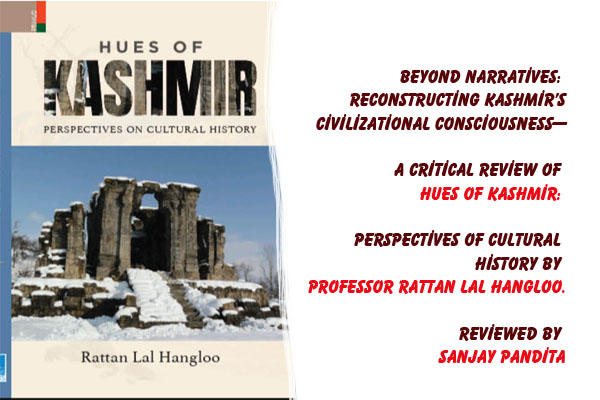
The writing of Kashmir’s history has, for more than a century, remained one of the most contested intellectual enterprises in South Asian hi storiography. Few regions have attracted such sustained scholarly attention while simultaneously remaining vulnerable to ideological appropriation. Political narratives, religious identities, colonial interpretations, nationalist discourses, and contemporary geopolitical concerns have all sought to define Kashmir through their respective lenses, often reducing a civilization of remarkable antiquity and cultural complexity to a chronicle of conflicts and contested sovereignties. Against this backdrop, Professor Rattan Lal Hangloo’s Hues of Kashmir: Perspectives of Cultural History emerges as an ambitious and intellectually stimulating attempt to relocate the discourse from the immediacy of politics to the deeper and more enduring currents of cultural history. It is a work that consciously distances itself from conventional historical writing by privileging civilizational processes over political events and cultural evolution over dynastic succession.

Professor Rattan Lal Hangloo
From the very outset, the book makes it evident that the author is less interested in recounting what happened than in understanding why Kashmir evolved into one of the most distinctive centres of intellectual and spiritual life in Asia. This distinction is significant because it transforms the narrative from a descriptive account into an interpretative exercise. Professor Hangloo approaches history not as a sequence of isolated events but as an organic process through which geography, ecology, migration, religion, philosophy, literature, and social institutions interacted continuously to shape the consciousness of a people. Such an approach places the work within the broader tradition of cultural historiography while simultaneously challenging the predominance of political history that has long overshadowed the study of Kashmir.
One of the foremost achievements of this volume lies in its methodological orientation. Unlike many historical studies that privilege rulers, battles, and administrative structures, Hangloo directs the reader’s attention towards ideas, beliefs, cultural practices, and philosophical traditions. His concern is not merely to document the past but to investigate the forces that enabled Kashmir to evolve into a civilization distinguished by extraordinary intellectual vitality. The author repeatedly reminds us that civilizations are not created by political authority alone; they are equally fashioned by systems of knowledge, artistic expression, collective memory, and spiritual inquiry. Consequently, the book invites readers to examine Kashmir not simply as a geographical region but as an evolving cultural organism whose identity was forged through centuries of interaction between indigenous traditions and external influences.
The central thesis that underpins the work is both bold and persuasive. Professor Hangloo argues that Kashmir’s identity cannot be explained through racial origins or ethnic continuity. Instead, it emerged from a prolonged process of cultural assimilation in which peoples of diverse origins gradually relinquished exclusive affiliations to become participants in a shared civilizational experience. This argument challenges simplistic notions of ethnic purity that continue to influence popular understandings of history. According to the author, successive waves of Aryans, Scythians, Parthians, Greeks, Central Asians, Turks, and numerous other communities entered Kashmir over many centuries. Yet rather than remaining isolated cultural entities, they gradually became integrated into a common social and cultural framework rooted in the land itself. Thus, Kashmiri identity was constructed not upon bloodline but upon cultural participation.
This interpretation represents one of the book’s most important historiographical interventions. Identity is presented neither as static nor as inherited; it is understood instead as the cumulative outcome of historical experience. Such a perspective resonates with modern approaches to cultural history that emphasize interaction, adaptation, and synthesis rather than exclusivity and separation. In presenting Kashmir as an inclusive civilization capable of assimilating diverse traditions without losing its own distinctiveness, Professor Hangloo provides an alternative framework through which the region’s past may be interpreted with greater historical sensitivity.
The author’s discussion of religion further strengthens this interpretative framework. Rather than treating religion as an isolated domain of faith, he examines its intimate relationship with society, politics, and cultural formation. His analysis of early Shaivism, Buddhism, Tantra, and their subsequent transformations demonstrates that religious traditions in Kashmir evolved not in isolation but through continuous engagement with changing social realities. Particularly noteworthy is his refusal to romanticize these traditions. While acknowledging their immense philosophical contributions, he also examines their institutional limitations, their entanglement with political authority, and their occasional departure from the ethical ideals they originally espoused.
Among the most intellectually stimulating sections of the work is the discussion concerning the evolution of Shaivism. Professor Hangloo interprets Shaivism not merely as a theological doctrine but as an important cultural force that contributed significantly to the consolidation of Kashmiri society. According to his analysis, the shared symbolism and metaphysical vision associated with Shaivite traditions enabled diverse communities to participate in a common cultural order despite differences of language, ethnicity, and regional origin. At the same time, he carefully distinguishes between the philosophical richness of Shaivism and the institutional practices that gradually became associated with it. His critique of ritualism and excessive tantric domination reflects an admirable scholarly objectivity that refuses to transform historical analysis into cultural glorification.
Equally significant is his interpretation of the emergence of Trika philosophy. Rather than presenting it as merely another school within Indian metaphysics, Hangloo situates its development within the broader context of social instability and intellectual transformation. He argues that philosophical innovation frequently arises during periods of historical uncertainty, when inherited systems of thought prove inadequate for addressing new realities. Trika thus emerges not simply as an abstract doctrine but as a profound attempt to reconcile metaphysical inquiry with the evolving needs of society. This interpretation illustrates one of the book’s recurring strengths—its ability to connect intellectual history with wider processes of cultural and social change.
The same analytical depth characterizes the author’s treatment of Buddhism. Instead of portraying Buddhism and Shaivism as mutually exclusive traditions, Professor Hangloo highlights the complex interaction that existed between them over many centuries. The transition from Buddhist predominance to the resurgence of Shaivite thought is presented not as a sudden rupture but as a gradual historical process involving adaptation, dialogue, and transformation. Such interpretations challenge binary readings of Kashmir’s religious history and instead emphasize continuity amidst change. In doing so, the author demonstrates how civilizations often evolve by absorbing and reinterpreting earlier traditions rather than simply replacing them.
This emphasis upon continuity is perhaps the defining feature of the entire volume. Whether discussing philosophical schools, religious institutions, literary traditions, or social formations, Professor Hangloo consistently argues that Kashmir’s civilization developed through processes of accommodation rather than exclusion. The Valley’s remarkable ability to assimilate external influences without surrendering its cultural individuality forms the intellectual foundation upon which the remainder of his historical narrative is constructed.
The continuity that Professor Hangloo identifies reaches perhaps its most compelling expression in his discussion of Kashmir’s intellectual traditions. One of the distinguishing characteristics of the book is its insistence that philosophy was never an isolated pursuit confined to monasteries or centres of learning; rather, it constituted the very framework through which society interpreted itself. The author demonstrates that the evolution of Kashmiri thought—from the speculative metaphysics of Shaivism to the experiential wisdom of mysticism—was inseparable from the historical experiences of the people. Ideas were not abstract constructions existing outside time; they were responses to changing political realities, social transformations, and spiritual aspirations. This perspective lends remarkable coherence to the narrative and enables the reader to appreciate Kashmir’s philosophical heritage as an evolving dialogue between tradition and circumstance.
Among the most illuminating chapters are those devoted to the emergence of the Trika system and its eventual dissemination through the spiritual genius of Lal Ded. Professor Hangloo convincingly argues that while Trika philosophy represented one of the highest achievements of Indian metaphysical speculation, it remained largely confined to learned circles until Lal Ded translated its profound insights into the language of ordinary people. This transition from scholastic abstraction to vernacular expression represents, in the author’s estimation, one of the decisive moments in Kashmir’s cultural history. Philosophy ceased to be the privilege of an intellectual elite and became an ethical and spiritual resource accessible to the wider community. It is this democratization of wisdom, rather than the mere formulation of doctrine, that Hangloo regards as one of the defining characteristics of Kashmir’s civilizational development.
The author’s treatment of Lal Ded deserves particular appreciation for the manner in which it avoids both hagiography and reductionism. She is neither presented merely as a Shaivite saint nor appropriated into sectarian narratives. Instead, Hangloo situates her within the larger evolution of Kashmiri intellectual life, emphasizing her role as a bridge between metaphysical speculation and lived experience. Her vakhs become, in his interpretation, not simply mystical utterances but profound interventions in a society burdened by ritualism, social inequality, and institutional rigidity. Through the simplicity of her language and the universality of her spiritual vision, Lal Ded articulated truths that transcended religious boundaries and prepared the ground for a broader culture of mysticism.
The continuity between Lal Ded and Nund Rishi constitutes another important dimension of the book’s argument. Professor Hangloo presents the relationship between these two towering personalities not as evidence of religious rivalry but as an illustration of cultural continuity. Mysticism emerges as the common ethical language through which Kashmiri society preserved its moral equilibrium amidst recurring political upheavals. By emphasizing compassion, humility, introspection, and the search for the Divine beyond ritual formalism, these mystics nurtured a shared spiritual consciousness that gradually became one of the principal foundations of what later generations came to describe as Kashmiriyat.
It is precisely in his interpretation of Kashmiriyat that Professor Hangloo makes one of his most significant contributions to contemporary historiography. The concept has often been invoked in political discourse, celebrated by some and questioned by others, yet rarely has it been subjected to the kind of sustained historical analysis that this work attempts. The author refuses to treat Kashmiriyat either as a romantic ideal or as a modern political construct. Instead, he traces its gradual emergence through centuries of cultural interaction, philosophical accommodation, and vernacular spirituality. In his formulation, Kashmiriyat is neither an abstract slogan nor a nostalgic memory; it is a historically evolved institution shaped by the cumulative experiences of diverse communities inhabiting the Valley over many centuries.
This interpretation possesses considerable explanatory power because it situates identity within historical processes rather than ideological assertions. By grounding Kashmiriyat in the interaction of Shaivism, Buddhism, Sufism, vernacular literature, and shared social practices, Hangloo restores historical depth to a concept that has often suffered from oversimplification. Whether readers ultimately agree with every aspect of this formulation is secondary to the fact that the book compels a more nuanced engagement with one of the most debated ideas in contemporary Kashmir studies.
Equally noteworthy is Professor Hangloo’s discussion of Kalhana and the Rajatarangini. Historians have long acknowledged Kalhana as one of the earliest historical writers of the Indian subcontinent, yet the author goes beyond conventional praise by examining the methodological sophistication that distinguishes the Rajatarangini from courtly chronicles. Hangloo emphasizes Kalhana’s concern for chronology, evidence, causation, and critical judgement, qualities that place him remarkably close to later historical traditions. More importantly, he argues that Kalhana’s work reflects the existence of a mature historical consciousness within medieval Kashmir—a consciousness rooted in the belief that political authority itself must remain subject to ethical evaluation.
This emphasis on critical inquiry runs throughout the book. Professor Hangloo consistently refuses to idealize any historical period or institution. Shaivism is celebrated for its philosophical brilliance, yet criticized where ritualism obscured its spiritual essence. Buddhism is acknowledged for its ethical and intellectual contributions without ignoring its historical decline. The arrival of Islam is discussed within the broader framework of social transformation rather than reduced to simplistic narratives of either conquest or conversion. Such balance represents one of the hallmarks of mature historical scholarship and significantly enhances the credibility of the author’s interpretations.
The interdisciplinary nature of the work deserves equal attention. History in Hues of Kashmir is never isolated from literature, philosophy, anthropology, sociology, or religious studies. Professor Hangloo moves with remarkable ease across disciplinary boundaries, demonstrating how cultural history necessarily demands an integrated methodology. The discussion of mystic poetry, for instance, is simultaneously literary criticism, philosophical reflection, and historical analysis. Likewise, his examination of religious institutions incorporates insights from sociology and political theory without compromising historical rigour. This breadth of scholarship considerably enriches the work and distinguishes it from narrowly specialized studies.
From a historiographical perspective, the volume occupies an important position within the evolving scholarship on Kashmir. Earlier historians such as Kalhana provided the foundational historical narrative; later scholars including Aurel Stein illuminated textual traditions through meticulous philological work, while historians such as Mohibbul Hasan examined political structures and medieval state formation. Professor Hangloo does not seek to replace these contributions; rather, he extends them by shifting attention towards cultural processes and intellectual history. His work suggests that the history of Kashmir cannot be adequately understood through political chronology alone. It must also account for the evolution of ideas, the resilience of philosophical traditions, and the extraordinary capacity of Kashmiri society to assimilate diversity without surrendering its civilizational distinctiveness.
No serious work of scholarship, however, is beyond critical observation. The intellectual ambition that gives this volume its originality occasionally results in lengthy philosophical excursions that interrupt the historical narrative. Certain arguments concerning early social formations, identity construction, and metaphysical developments would have benefited from greater engagement with recent archaeological discoveries and comparative interdisciplinary research. At times, the density of conceptual discussion may also challenge readers unfamiliar with Indian philosophical traditions. Yet these observations concern presentation rather than substance. They do not diminish the significance of a work that represents one of the most thoughtful attempts in recent years to interpret Kashmir through the lens of cultural history.
Ultimately, Hues of Kashmir: Perspectives of Cultural History succeeds because it restores to Kashmir what political narratives have too often obscured—its extraordinary intellectual inheritance. Professor Rattan Lal Hangloo reminds us that the Valley’s enduring legacy lies not merely in the succession of kingdoms or the turbulence of modern politics but in its unparalleled contribution to philosophy, literature, mysticism, historical writing, and cultural pluralism. His book challenges scholars to move beyond inherited binaries and rediscover the deeper civilizational processes that shaped one of South Asia’s most remarkable cultural landscapes.
In an era when discussions on Kashmir are frequently dominated by immediate political concerns, this volume performs a valuable scholarly service by redirecting attention to the longue durée of history. It demonstrates that civilizations are sustained not by power alone but by ideas, memories, ethical traditions, and the continuous dialogue between the past and the present. In this sense, Hues of Kashmir is more than a study of a region; it is a meditation on the making of civilization itself. It deserves careful reading by historians, literary scholars, philosophers, and all those who seek to understand Kashmir beyond the limitations of contemporary political discourse. Professor Hangloo has produced a work that is intellectually courageous, methodologically innovative, and historiographically significant—a contribution that is likely to occupy an important place in future scholarship on Kashmir’s cultural and intellectual history.
Sanjay Pandita is a poet, columnist & critical analyst , can be reached at sanjaypanditasp@gmail.com

