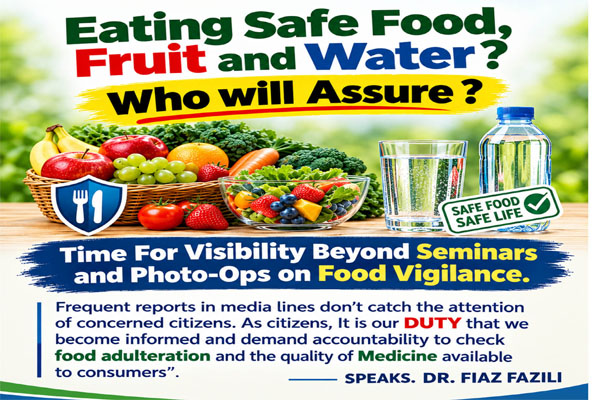
Frequent reports in media lines don’t catch the attention of concerned citizens. As citizens, It is our DUTY that we become informed and demand accountability to check food adulteration and the quality of Medicine available to consumers”. speaks. Dr Fiaz Fazili
DR FIAZ MAQBOOL FAZILI
As usual, my breakfast table was ready: lemon water, bread, honey and tea. I was waiting for an egg curry . It did not come. I called my helper. She returned with a container containing broken eggs.I looked at them. Something seemed wrong—the colour, the smell, the appearance. I wondered: Would I really serve this to my family? This is not the first such experience. In the past few weeks, I have changed shops several times because of concerns about food quality. A few days ago, I developed stomach discomfort despite taking antacids. Was it food? Was it a coincidence? I cannot say. But such experiences inevitably raise a larger question: Are we eating safe food? Milk, bread, eggs, chicken, meat, fruits, vegetables, bottled water, honey, bakery products, cheese, spices and even medicines—we consume these every day with the assumption that they are safe. But how much do we actually know about what reaches our plates?
A friend recently shared photographs from a seminar on food safety and vigilance held at a university. There were speeches, presentations and mementos. I have nothing against seminars. Awareness is important. But after the banners come down and the photographs circulate on social media, what happens next? Do inspections continue? Are samples collected regularly? Are laboratories adequately equipped? Are unsafe products traced back to their source? Are repeat offenders prosecuted? And, most importantly, does the consumer ever receive feedback?
This is where my concern begins, the story/ies recalled.I had earlier written about,” The Problem of Substandard, Adulterated -Unwholesome Food, Fruit and Medicine part 1 and 2; Rising kashmir Oped September 2023”.and again highlighted community healthcare concern “Street Food Vigilance: Who is Responsible for Food Vigilance in Kashmir observer February 2025?” and about the problem of substandard, adulterated and unwholesome food and medicines. Those writings were followed by some encouraging enforcement activity and raids. I was genuinely happy to see the issue move from newspaper columns into the field. But vigilance cannot be an occasional campaign. Food safety cannot operate according to the news cycle.Hopefully, with new leadership and management in Food Safety, as someone shared ,who knows them well we expect more than a handful of inspections, photographs, and continuity on visibility not limited to seminars and press statements.Kashmir needs sustained action—not optics.Adulteration is not merely a commercial offence; it is a public-health threat that concerns every household. Silence, routine inspections, and symbolic action will not solve a problem of this magnitude.We need consistent enforcement, transparent reporting, meaningful accountability, and evidence-based action—not occasional campaigns that disappear after the headlines do.And let the message from the authorities be absolutely clear:This vigilance will not stop. Food safety cannot be treated as a seasonal exercise. The Food Safety Department must remain continuously vigilant, visible, and accountable to the people.
Food adulteration is a public-health and consumer-rights issue. We often hear complaints about adulterated milk, contaminated water, unsafe meat, poor-quality spices, artificially ripened fruit artificial colours, improperly stored foods and expired or mislabelled products. Some complaints are genuine; others circulating on social media may be exaggerated or scientifically unsupported. That distinction itself makes regular scientific testing even more important. We should not frighten people with rumours. We should give them evidence, not to incite panic.For example, dramatic claims about chemicals being routinely injected into fruits and vegetables, or hormones in poultry directly causing particular diseases, require proper scientific evidence before being presented as fact. Similarly, not every stomach problem after a meal proves food poisoning. But uncertainty is not an excuse for inaction. The correct response is testing, surveillance, traceability and enforcement, the ownership the visibility that duty and responsibility on my safe health ensured. If a product is suspected to be adulterated, laboratories—not WhatsApp messages—should tell us what it is actually inside.
Our traditional cuisine deserves particular attention. Kashmiri wazwan, bakery products, sweets, beverages, food additives, colouring agents and other foods should not become vehicles for unsafe or unauthorised colours and additives. Consumers have the right to know what ingredients are being used and whether they comply with food-safety standards. The same principle applies to bottled water., a new entrant to our community and replacing traditional tap water.Kashmir is blessed with natural springs and water resources, yet bottled water has become an increasingly common part of our daily life. How are bottles stored and transported? Are they exposed to excessive heat? Are manufacturing and expiry details clearly displayed? Are batches being sampled? These are not unreasonable questions. And what about medicines? The problem does not stop at food. Substandard and falsified medicines can be even more dangerous because a patient may not know that the medicine is defective. A medicine may contain the wrong quantity of active ingredient, an incorrect ingredient, no effective ingredient at all, or may be improperly manufactured or stored. A falsified product may even imitate a genuine brand. The consequences can be serious. When a medicine fails, the patient may assume that the diagnosis was wrong. More tests may follow. Another doctor may be consulted. Treatment may be changed. Expenses increase. Time is lost. And if a toxic or contaminated product causes harm, the adverse event may be attributed to the disease or to an ordinary drug reaction. Inadequate antimicrobial medicines can also contribute to antimicrobial resistance. So when a patient asks, “Doctor Sahib, why didn’t this medicine work?”, the question should not automatically end with the doctor.
Where is the quality-assurance chain? Who manufactured it? Who imported or distributed it? How was it stored? Was the batch tested? Was it genuine?Healthcare professionals cannot independently laboratory-test every tablet before prescribing it. The regulatory system must provide that assurance.
Saying “Just chill, Doctor Sahib” chalta hai chalney do,kuch nahi hone wala hai , Can be a caring brotherly healthcare advocacy. Sometimes, when I raise these concerns, the response seems to be: “Just chill, Doctor Sahib. “No.This is precisely the time not to chill. But neither should we panic. We need something better: evidence-based vigilance.We need concerned authorities to publish regular information,timely advisory about food and drug sampling, violations detected, actions taken and follow-up results. We need stronger laboratory capacity and adequate manpower. We need risk-based inspections of high-risk establishments. We need proper cold-chain and storage monitoring where required. And we need consumers to participate.
Citizens too should check labels, manufacturing and expiry dates, packaging integrity and storage conditions. Suspicious products should be reported rather than merely circulated on social media. Consumers should retain bills and packaging where possible, because traceability matters. Most importantly, we should stop treating food safety as somebody else’s responsibility. Safe food is a people’s issue.We workday and night for what? For those two morsels of wholesome food that sustain our families. We spend money on medicines because we want health. We therefore have every right to demand that the food we eat and the medicines we take meet established safety and quality standards.
Conferences have their place. Public awareness programmes have their place. Seminars have their place—to analyse root causes, brainstorm solutions, and explore how to do better.
But after the seminar, there must be impact,visibility,checks and balances . After surveillance, there must be testing. After testing, there must be accountability. And after accountability, there must be corrective action. That is the chain that converts visibility into public health. So, when I see a suspicious egg on my breakfast table, I do not want to become a food-science expert overnight. I want a system that allows an ordinary consumer to trust the food supply. I want to be able to ask: Has this product been checked? Is it safe? Who is responsible if it is not? And I want an answer—not another seminar.
What needs research—and who should do it?Kashmir needs a rigorous, independent, population-based investigation(multidisciplinary research ) into whether unsafe food, water and beverages contribute to its major health concerns—particularly cancer, infertility and chronic GIT/IBS disorders, adulteration and pollution related diseases …..The research should: Measure chemical, microbial and nutritional contaminants in commonly consumed food and water. Compare exposure levels with cancer, infertility and GIT/IBS outcomes., measure AQI levels in air at vulnerable areas and surroundings like of “Achan.” Establish evidence-based causal links, rather than assumptions or anecdotes.Identify what is already known, what remains unstudied, and where the evidence is weak.Who? Ideally, a multidisciplinary team led by public-health/epidemiology institutions in Kashmir, working with medical colleges, food-safety and water authorities, environmental laboratories, and independent national/international research institutions—with transparent funding and publication of results.The key question is not “prove food is causing disease,” but: Who will independently investigate whether it is—and provide Kashmir with evidence-based answers? All people deserve safe food and safe medicines. Food vigilance must move beyond speeches and photo-ops and become a continuous, transparent public-health function. Let us not wake up after tragedy or wait for aftereffects of mass harmful toxic or harmful even poisonous ingredients, an outbreak or a public tragedy before we act.In food safety, prevention is not a slogan. It is the responsibility of the entire system.Perhaps the harder question is: “Why do we keep making them powerful by cheering them on? “The answer begins with the mirror. Before we condemn the system, let us examine the small compromises through which we all consumers keep it alive. Because sometimes the greatest service to society is not standing beside the powerful. It is having the courage to stand alone—with the truth.
Why My Pen Does Not Stop…Not another number. Another concern. Sometimes the mirror must be held up—not to accuse anyone, but to help all of us see ourselves more honestly.
— Author , Certified Healthcare Quality Professional working in healthcare quality improvement and safety standards.
—
—