

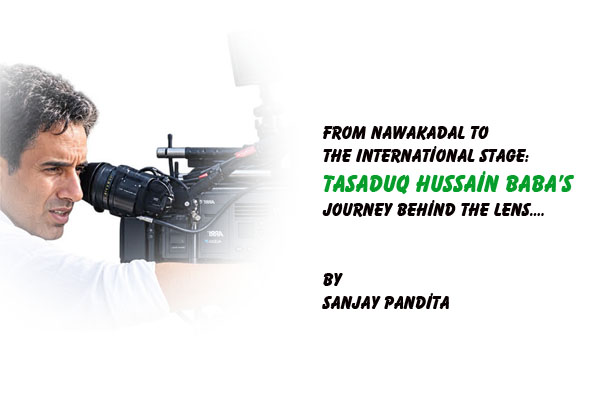
SANJAY PANDITA
There are moments when an award belongs to an individual, and there are moments when an individual’s achievement acquires a significance much larger than himself. Baba Tasaduq Hussain’s Best Cinematography Award at the inaugural International Film Festival of Jammu & Kashmir (IFFJK) 2026 is one such moment for Kashmir. With Naqsh-e-Daur (The Story of Ghulam Nabi Dhar), a filmmaker who began his journey in the old city of Srinagar has earned a place among the distinguished cinematic talent recognised at an international festival.
What makes the honour particularly noteworthy is that it came in the festival’s main international competitive awards, alongside accomplished filmmakers and artists from India and abroad. The Best Film award went to Iranian filmmaker Rasoul Sadr Ameli for Whisper My Name; Husnora Rozmatova received both the Best Director and Best Debut Film awards for The Song Sustoxin; Iranian actor Amin Hayayee was honoured as Best Actor, while Taniya Maniktala received the Best Actress award for Arifa. The Best Sound Design honour went to Victor Brasie of Lebanon and Best Editing to Belgium’s Dieter Diependaele. In this distinguished company, the Best Cinematography award coming to a Kashmiri is a moment that deserves to be celebrated not merely as a career milestone, but as an important statement about the creative possibilities emerging from Jammu & Kashmir.

Tasaduq’s story, however, did not begin at a film festival. It began much earlier, in the familiar lanes of Nawakadal in downtown Srinagar, where his fascination with photography and videography took root during his formative years.
He completed his graduation in Commerce from Gandhi Memorial College, Srinagar, but his growing attraction towards the visual world gradually drew him away from a conventional career path. He pursued postgraduate studies in Journalism and Mass Communication at the Islamic University of Science and Technology, Awantipora, completing his postgraduate education in 2015. By then, the camera had already begun to occupy an important place in his life.
His first lessons in filmmaking came not from the large studios of Mumbai but from Kashmir’s local media environment. Tasaduq worked with local television channels, gaining experience in editing and camera work while also appearing as an anchor and conducting interviews for local programmes. These early assignments may have lacked the glamour associated with the film industry, but they gave him something far more valuable: practical experience and an understanding of how stories are constructed for an audience.
He continued to educate himself beyond the classroom, attending courses and workshops in cinematography, camera work and film editing. The effort reflected a quality that would eventually define his career—he was prepared to learn before expecting recognition.
In 2015, an important door opened when he got the opportunity to work as a set assistant on the Bollywood film Bajrangi Bhaijaan. For a young filmmaker from Srinagar, being part of a major production provided an opportunity to observe professional filmmaking at close quarters. The experience exposed him to the discipline of a large film set and the intricate teamwork involved in translating a script into moving images.
It was another step, not the destination.

Tasaduq gradually moved into television commercials, music videos and advertising productions, building his experience and reputation as a cinematographer. His work expanded into national and international campaigns, and he eventually had opportunities to collaborate with prominent personalities from the entertainment industry, including singer and composer Salim Merchant.
Behind this progression was no overnight transformation. It was a slow accumulation of skill—assignment after assignment, frame after frame, lesson after lesson.
That quality of perseverance finds an especially compelling reflection in the documentary for which he has now been honoured.
Naqsh-e-Daur takes the viewer into the world of Ghulam Nabi Dar, the Padma Shri-honoured master craftsman who has devoted more than six decades to the art of Kashmiri walnut wood carving. Dar’s life is itself a testament to endurance. His craft has been shaped by years of concentration, repetition and painstaking labour. Every design emerges from the patient movement of the chisel; every finished piece carries the imprint of a lifetime spent mastering an inherited tradition.
Tasaduq’s camera captures this world with an understanding that seems particularly appropriate to the story.
The documentary is not simply about a craftsman and his tools. It is about time, dedication and the struggle to keep a tradition alive in a changing world. The ageing hands of the artisan, the texture of the walnut, the movement of the chisel and the quiet concentration of the craftsman become part of a larger visual narrative about heritage and perseverance.
And there is a striking parallel between the man before the camera and the man behind it.
Ghulam Nabi Dar has spent decades refining the art of carving wood. Tasaduq has spent years refining the art of visual storytelling. Dhar’s work demonstrates that mastery is created through countless patient efforts rather than a single act of brilliance. Tasaduq’s own career has followed much the same trajectory—from local television to professional filmmaking, from assisting on a major Bollywood production to working on commercials, music videos and international campaigns.
In that sense, Naqsh-e-Daur seems almost like a meeting of two journeys.
Dar preserves Kashmir’s memory through his craftsmanship; Tasaduq preserves that craftsmanship through cinema.
The Best Cinematography Award consequently acquires a meaning beyond the technical excellence of the images. It recognises the sensitivity with which Tasaduq has translated another man’s lifelong labour into a visual story. More importantly, it comes as the culmination of his own years of learning and perseverance—the very qualities embodied by the subject of his documentary.
There is also something deeply symbolic in the fact that this recognition has come through a story rooted in Kashmir. For decades, Kashmir has been admired by Indian cinema primarily as a landscape: its mountains, rivers, lakes, meadows and seasons have provided a natural backdrop to countless films. Tasaduq’s achievement offers another way of looking at the Valley. Kashmir is not merely a place to be photographed by outsiders; it is also home to artists who can hold the camera, shape the frame and tell their own stories.
That distinction matters.
At IFFJK 2026, Tasaduq’s name appeared alongside filmmakers and artists from Iran, Uzbekistan, Lebanon, Belgium and India. The festival’s international awards recognised different dimensions of filmmaking—from direction and acting to editing and sound. Within that accomplished field, the cinematography honour came to a young filmmaker from Jammu & Kashmir.
For the Kashmiri cinematic fraternity, this gives the award a resonance of its own.
It demonstrates that a creative journey can begin in the narrow streets of downtown Srinagar and travel far beyond the Valley. It demonstrates that formal education, when combined with practical training and persistence, can open doors to an industry that once seemed distant. And it demonstrates that Kashmiri stories, when told with artistic conviction and cinematic skill, can command attention on an international platform.
Tasaduq’s journey is therefore not simply about reaching Bollywood. Bollywood was one stage of the journey; international recognition is another. The larger story is about a young Kashmiri who recognised his inclination towards the visual arts, acquired the skills required to pursue it, accepted the small opportunities that came his way, learnt from each experience and kept moving forward.
That is why the story of Naqsh-e-Daur and the story of Tasaduq Hussain sit so naturally beside each other.
One tells of a craftsman who spent a lifetime perfecting his art.
The other tells of a cinematographer who is still carving his own place in the world of cinema.
And perhaps the most fitting image is that both men work through detail. Dhar reveals beauty hidden inside a piece of walnut; Tasaduq reveals meaning through the frame. One uses the chisel, the other the camera. Both understand that lasting work is never hurried.
For Kashmir, Tasaduq’s Best Cinematography Award at IFFJK 2026 is therefore a significant new marker on its cinematic journey. It is a recognition earned by one filmmaker, but it carries the aspirations of many others who are waiting for their opportunity.
From Nawakadal to Bollywood, and from the local television circuit to an international film festival, Tasaduq Hussain has travelled a considerable distance.
His award now stands as a frame in that journey—a frame in which Kashmir’s talent, perseverance and visual imagination have finally found an international spotlight.
The writer can be reached at sanjaypanditasp@gmail.com

