

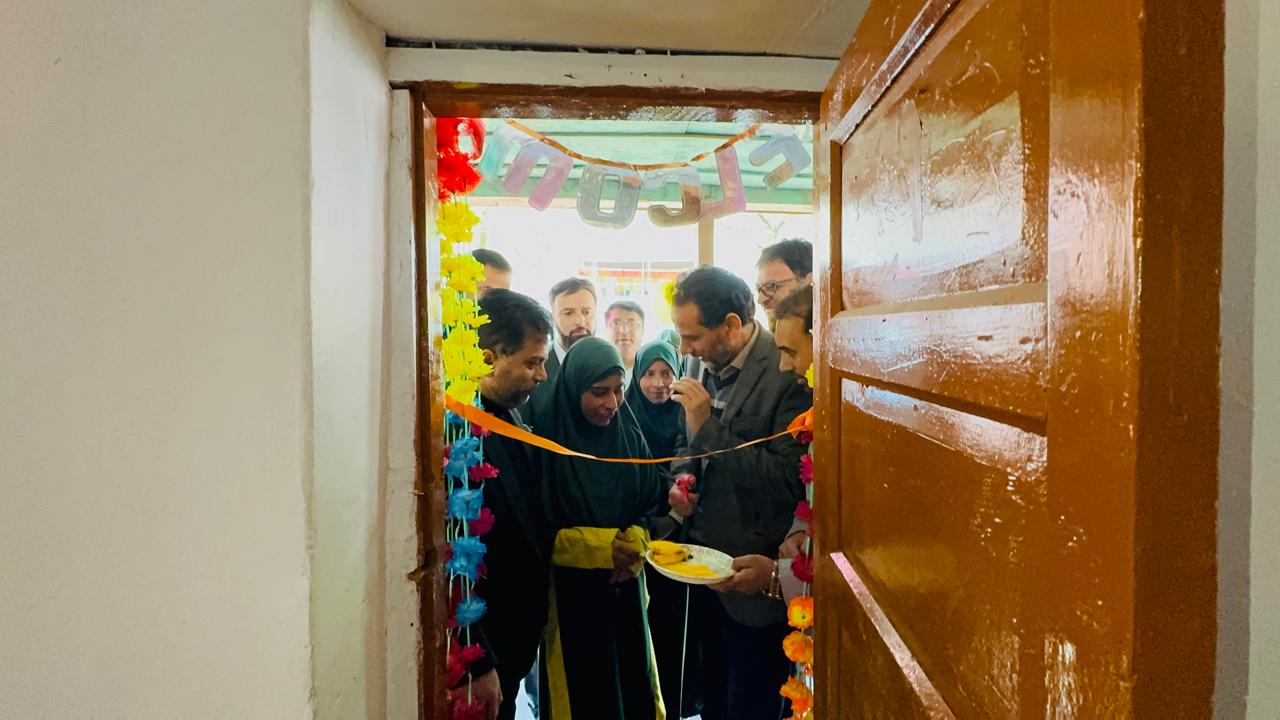
In a moment that eloquently captures the promise of purposeful public-private partnership, the Director, Directorate of School Education Kashmir, as the chief guest, inaugurated state-of-the-art ICT Labs at select government schools in remote regions of Jammu and Kashmir—a transformative addition to the region’s public education infrastructure that brings the power of digital learning within reach of students from marginalized and geographically isolated communities.
The inauguration ceremony was held at Government Middle School Poshkar Khag, Budgam, and was attended by the Director of School Education Kashmir, Shri Naseer Ahmad Wani (JKAS).
The event was attended by Mr. Syed Shabir (JKAS), Joint Director, Directorate of School Education, Kashmir, Ms. Rifat Irfan Qadri, Chief Education Officer, Budgam, Mr. Nawab Mehran Khan, CEO & President, ELFA International; Mr. Iftikhar Ahmad Mir, Senior Vice President, ELFA International;Mr. Malik Abrar Altaf, Chief of Programs and Operations, ELFA International, along with other distinguished dignitaries, education officials, and stakeholders.
The initiative, generously supported by NTT Data under its Corporate Social Responsibility programme and implemented by ELFA International in collaboration with the Directorate of School Education Kashmir, stands as an inspiring testament to what governance, corporate conscience, and community commitment can achieve in concert.
“We believe that access to quality education, enabled by technology, should be within reach of every child—regardless of geography or circumstance. It is our privilege to support ELFA International’s mission in bringing digital learning to underserved communities,” said Ankur Dasgupta, Vice President, Global CSR & India Marketing, NTT Data. “These ICT labs represent our continued commitment to strengthening educational ecosystems in the region, and we are confident that they will play a meaningful role in enhancing learning outcomes and expanding opportunities for students.”
Speaking on the occasion, Nawab Mehran Khan, CEO & President, ELFA International, remarked, “At ELFA International, we view education as the most powerful instrument of social transformation. The establishment of these ICT labs is not merely about introducing technology into classrooms; it is about opening new horizons of opportunity for children who have long been constrained by geography and limited resources. Through this initiative, we aim to nurture curiosity, confidence, and capability among students, ensuring that they are equipped to participate meaningfully in an increasingly digital world.”
The establishment of ICT Labs across five underserved institutions—Government Boys High School Kanthpora Lolab Kupwara, Government Girls High School Dragmulla Kupwara, Government High School Chowgud Kupwara, Government Middle School Poshkar Khag Budgam, and Government High School Trigam Sumbal Bandipora—marks a significant qualitative leap in the standard of education accessible to students in these remote pockets. Equipped with computers, projectors, digital learning software, and curated educational resources, these labs introduce an interactive, audio-visual mode of learning that enhances student engagement, strengthens conceptual understanding, and fosters essential digital literacy skills. By bridging the persistent urban-rural divide in access to technology-enabled education, the initiative ensures that the advantages of modern pedagogy are no longer confined to urban or privately funded institutions. With an investment of Rs 37,48,239, the programme directly addresses structural educational gaps while preparing students for an increasingly technology-driven world.
In his address, the Director of School Education Shri Naseer Ahmad Wani SAID that access to digital tools can significantly improve attendance, enhance student motivation, and strengthen foundational competencies, particularly in hard-to-reach and underserved regions and thanked ELFA International and NTT Data for their endeavours in this direction.
This initiative reaffirms the region’s steady and determined march towards an education ecosystem that is modern in its tools, inclusive in its reach, and transformative in its impact—where geography and economic circumstance no longer define the quality of learning a child can access, and where digital empowerment becomes a cornerstone of social progress.

