Dr Ayash Arif
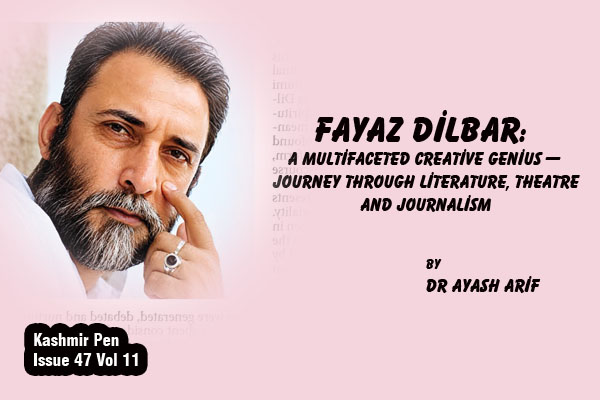
The cultural and literary history of Kashmir has been enriched by personalities whose creative contributions transcend the boundaries of time. Late Fayaz Dilbar was one such distinguished personality whose multifaceted talent, intellectual pursuits and commitment to literature, theatre and journalism made him a remarkable figure in the cultural landscape of Kashmir.
A gifted poet, playwright, journalist, screenwriter and filmmaker, Fayaz Dilbar possessed an extraordinary creative temperament. His journey was not confined to any single discipline of artistic expression. Rather, he explored different dimensions of creativity with remarkable sensitivity, intellectual depth and an understanding of human emotions and social realities.
The Golden Era of Kashmiri Theatre: Where Our Journey Began
The year 1970 marked one of the golden periods in the history of the Kashmiri theatre movement. The cultural landscape of Srinagar was vibrant with theatrical activities, and nearly thirty theatre groups were actively functioning across the city. A significant number of these groups were concentrated in the old city, particularly in the area stretching from Nai Sadak to the downtown localities of Srinagar.
Among the prominent theatre groups of that era were Kalakendra, Navrang Dramatic Club, Vasant Theatre, Abhinav Bharati Theatre, Rangmunch Theatre, Sangermal Theatre, Sangam Theatre and several others. These groups played a remarkable role in nurturing theatrical talent and strengthening the cultural and artistic traditions of Kashmir.
My own association with theatre began during my school days. I was a student of Class 9 at Raghunath Mandir School, where our art teacher, Shri Jawahar Wanchoo, was himself a well-known theatre activist of that period. Having noticed some artistic inclination in me, he encouraged me to participate in school functions, particularly those organised on 15th August to commemorate Independence Day and on 2nd October to celebrate Gandhi Jayanti.
These initial performances gradually developed my interest in acting, and I began looking for a proper theatre platform where I could learn the finer aspects of the art and polish my talent.
Fortunately, Sangam Theatre, one of the prominent theatre groups of Kashmir, was functioning in our neighbourhood. The group had an impressive membership comprising several well-known artists of Kashmir and was headed by one of the stalwarts of the Kashmiri theatre movement, the late JNB Sajood Sailani.
I joined Sangam Theatre as an artist, an association that proved to be an important turning point in my artistic journey. It provided me with the opportunity to work under the guidance of veteran theatre director Shri Pran Chandra and the celebrated actor of that period, the late Virender Razdan. Their guidance, experience and artistic discipline helped shape my understanding of theatre and introduced me to the finer dimensions of stage performance.
It was during this period that I also became closely associated with Fayaz Dilbar, who was then a member of Sangam Theatre. Our shared involvement in theatrical activities gradually developed into a deep emotional bond that extended beyond the stage. We were connected not merely through our passion for theatre but also through a shared commitment to artistic expression and cultural pursuits.
Looking back, I consider those formative years at Sangam Theatre among the most memorable and defining chapters of my life. The theatre movement of the 1970s was not merely about staging plays; it was a vibrant cultural phenomenon that brought together writers, directors, actors, musicians and creative minds under one artistic umbrella. It was an era of dedication, experimentation, camaraderie and collective commitment, when theatre was nurtured more through passion than material considerations.
From Theatre to Journalism: The Beginning of a Remarkable Journey
Fayaz Dilbar’s association with the performing arts began with Sangam Theatre, Srinagar, an important platform in the theatre movement of Kashmir. Theatre was not merely an artistic activity for him; it was a medium of expression, social reflection and human understanding. His involvement in theatre brought him into close association with several creative personalities and gradually shaped his artistic vision.
Apart from being an active theatre personality, Fayaz Dilbar proved himself to be a journalist of exceptional ability. He established his own news agency namely kashmir news bureau and subsequently remained associated with different local newspapers, where he continued to sharpen his journalistic skills and establish his identity as a perceptive and accomplished journalist.
A significant turning point in his professional journey came when the eminent Indian journalist Mr Vinod Dua visited Kashmir in the year of 1985 forthe shooting of a documentary film. By a fortunate coincidence, Fayaz Dilbar got an opportunity to assist him during the shooting. Impressed by his talent, professional understanding and foresight, Mr Dua invited him to Delhi to explore wider opportunities and gain exposure at the national level.
Fayaz Dilbar accepted the invitation, left Kashmir and joined Mr Vinod Dua’s production house in Delhi. This association opened new avenues for his creative development. He not only established his credentials as a journalist but also emerged as an accomplished poet, playwright, screenwriter and filmmaker. His journey from Kashmir to the national media landscape reflected his determination, versatility and creative potential.
A Screenwriter with a Strong Cinematic Vision
Fayaz Dilbar was blessed with a remarkable understanding of cinematic aesthetics. As a screenplay writer, he demonstrated an ability to translate human experiences and social realities into compelling visual narratives. He wrote scripts for Doordarshan and other television channels, making a meaningful contribution to electronic media.
Among his notable television works was Azizan Bhai, a programme written, produced and directed by him for Doordarshan Urdu. The production received an encouraging response from audiences and reflected his command over storytelling, characterisation and the visual language of television.
His creative engagement with electronic media never distanced him from theatre. On the contrary, he continued to write plays, exploring mysticism, human relationships, social inequalities and the complexities of human existence.
His Contribution to Theatre and Playwriting
Among his important theatrical works, DARVESH NAMA occupies a special place. This mystical play draws inspiration from the spiritual relationship between Maulana Jalaluddin Rumi and Shams Tabrizi. Through this work, Fayaz Dilbar explored the philosophy of mysticism, spiritual enlightenment, devotion and the deeper meaning of human existence. He gave these profound philosophical ideas a distinctive theatrical form, making an otherwise complex spiritual discourse accessible through dramatic presentation.
His play GUDIYA NAHI ROYEE GE presents another dimension of his creative personality. Based on the pathetic circumstances of women in a remote village of Haryana, the play explores the social injustices and emotional suffering faced by women, particularly the restrictions imposed on their right to express grief following widowhood. It is a sensitive portrayal of gender discrimination, social conventions and the denial of basic human dignity.
Another significant contribution was his play based on the life of the eminent writer Amrita Pritam. Through this dramatic exploration, he demonstrated his deep interest in literature, the lives of creative personalities and the social and cultural experiences that shape their artistic journeys.
These works collectively reveal the breadth of his understanding of Indian society and its diverse cultural ethos.
The Poet and the Storyteller
As a poet, Fayaz Dilbar possessed a distinct literary sensibility. His first collection of poetry, HARNIS TAPAS ANDER (Under the Scorching Heat), reflected his poetic temperament and his engagement with the emotional and existential dimensions of life.
His subsequent publication, PAKAN DORE FALAQ (So the Life Goes On), is a collection of personal anecdotes and experiences. The book stands out for its narrative quality, observations of human behaviour and reflections on life. It received considerable appreciation among sections of the literary community.
Fayaz had an exceptional command over humour and satire. His observations were sharp, yet his expression remained engaging and often disarmingly humorous. He could discover humour in ordinary situations and present human weaknesses through wit and irony. This quality added another fascinating dimension to his literary personality.
COFFEE HOUSE: A Dream That Remained Unfulfilled
One of Fayaz Dilbar’s most cherished literary ambitions was to publish a book titled COFFEE HOUSE. The project was particularly close to his heart because it was an attempt to document a significant chapter of Kashmir’s intellectual and cultural history.
The Coffee House in Srinagar was once a celebrated meeting place for the intellectual community of the Valley. Writers, poets, journalists, broadcasters, theatre personalities and other distinguished members of society would gather there over cups of coffee and engage in lively discussions on literature, art, culture, journalism and contemporary social issues.
Writers discussed their manuscripts and creative ideas; artists evaluated performances broadcast on local television and radio; theatre practitioners debated productions and performances; journalists exchanged views on professional and social concerns. In many ways, the Coffee House became an informal cultural institution where ideas were generated, debated and nurtured.
Having spent considerable time in the company of eminent literary and cultural personalities of that era, Fayaz Dilbar was uniquely positioned to document those memories. His interactions with distinguished figures such as Ali Mohammad Lone, Akhtar Mohi-ud-Din, H.K. Bharti, Avtar Krishan Rehbar and many others provided him with a rich reservoir of experiences and anecdotes.
He had completed the manuscript of this ambitious project, preserving many of those memorable conversations and experiences. Unfortunately, his untimely demise prevented its publication.
The manuscript of COFFEE HOUSE is therefore not merely an unfinished literary project; it is a valuable cultural document that deserves to be preserved, edited and brought before readers. Its publication would help future generations understand the intellectual atmosphere and creative exchanges that once shaped Kashmir’s literary and cultural life.
A Personality Beyond Professional Achievements
Having been closely associated with Fayaz Dilbar, I had the privilege of witnessing different shades of his multifaceted personality. He was a serious-minded person by nature, deeply committed to his creative pursuits. Yet, his wit, humour and capacity for satire could often take me by surprise.
One of the most admirable qualities of his personality was his uprightness. He was never hypocritical in his conduct or expression. He possessed a rare spirit of accommodation and was always willing to appreciate genuine talent. He would never offer dubious praise or make unnecessary comments about someone whose work he did not find convincing. His observations were candid, his approach was straightforward and his appreciation was sincere.
These qualities made him not only an accomplished creative personality but also a person whose friendship and intellectual companionship were deeply valued.
Our association gradually developed into a bond of affection, mutual respect and friendship. We shared many discussions and debates about literature, theatre, cinema and the future of our cultural institutions. We also nurtured several creative ideas and projects, many of which unfortunately remained unrealised.
KAAF: A Vision for the Cultural Future of Kashmir
Another important aspect of Fayaz Dilbar’s personality was his commitment to the younger generation. His last cherished dream was to establish a comprehensive cultural centre in the building adjacent to his residence, which he had named KAAF.
His vision was to create a professional platform where young and talented people could receive encouragement, guidance and opportunities to showcase their creative abilities. He wanted KAAF to become a meeting point for emerging writers, poets, theatre artists, filmmakers and other creative practitioners.
It was not merely a personal project or a physical cultural space. It represented his larger vision of nurturing talent, promoting artistic excellence and creating opportunities for the younger generation.
Sadly, before this dream could materialise, Fayaz Dilbar bid farewell to this materialistic world. His departure left behind not only an unfinished cultural project but also a responsibility for those who shared his vision and understood its significance.
The real tribute to Fayaz Dilbar would be to take forward the idea of KAAF and explore ways of translating his dream into reality.
An Enduring Legacy
The passing away of Fayaz Dilbar has created a considerable void in the literary, journalistic and cultural circles of Kashmir. For me, however, his demise was not simply the loss of an eminent literary personality; it was a deeply personal loss of a sincere friend, an intellectual companion and a creative genius with whom I had shared countless discussions, disagreements, ideas and dreams.
His contributions across poetry, theatre, journalism, television and filmmaking reflect a rare combination of intellectual curiosity and artistic versatility. His writings were rooted in human experiences, his theatre explored social and spiritual realities, and his journalism reflected his engagement with the world around him.
His unfinished projects, particularly COFFEE HOUSE and KAAF, remind us that the creative journey he began still awaits meaningful continuation.
Fayaz Dilbar may no longer be physically present among us, but his creative legacy remains alive through his writings, productions, memories and the people whose lives he touched. It is our collective responsibility to preserve his manuscripts, document his works and introduce his creative contributions to younger generations.
Great creative personalities do not disappear with their physical departure. They continue to live through the ideas they leave behind, the memories they create and the inspiration they offer to generations yet to come.
Late Fayaz Dilbar was one such personality.
May Almighty Allah grant eternal peace to his soul and give us the wisdom and strength to preserve and carry forward the creative legacy he left behind. Ameen.
Dr. Ayash Arif is a renowned film maker and theatre personality, can be reached at iptvkashmir@gmail.com