

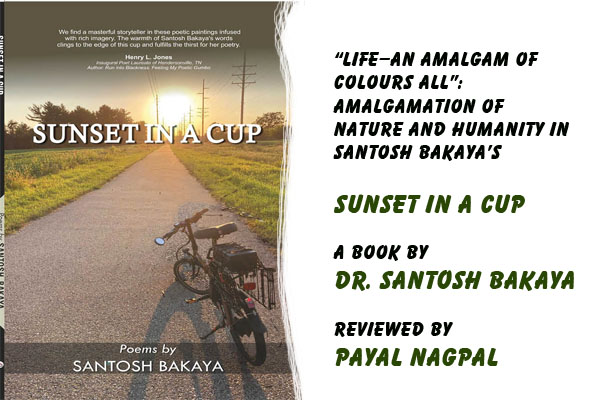
The experience of reading Santosh Bakaya’s Sunset in a Cup is akin to a walk through a dense forest resplendent in its diverse flora and fauna. The collection reminds us of how everything around is infused with life. Each poem in this book connects us with our natural selves, and restores the organic bond between nature and humans. In the current fast-paced world, where everything around is valued for its instant delivery, the poems nudge the reader to leave all quick fixes and look around to appreciate the trees, the birds, the spiders, the flowers, in short, the intricacies in nature. Sunset in a Cup is a collection of seventy-eight poems. Apart from the two introductory poems, the section “Freedom Songs” has five poems and “Song of the Robin and Other Songs” carries seventy-one poems. The introduction to Sunset in a Cup exudes serenity. Writing about her experience of Jaisalmer, Santosh Bakaya notes, “Next morning, I peeped through the window, and saw the bougainvillea creeper fronting our room, drenched in the sun’s warm glow. Tendrils of gold-tinted grass stood upright, like folks flaunting a guile-less conscience.”
Hope, a defining aspect of poems in this collection, is to be found in nature. In “Caprice”, a poem from the section “Freedom Songs”, different colours bring in the capricious hope with playful jollity—“I heard them all—/ the greens, yellows, pinks, purples, reds and blues./ And soon felt the noose around my neck loosening./ The colours spoke-loud, clear and lilting./ they spoke of freedom.” The poem is a reminder of diversity in nature and of how each person is unique in their own way; hope is a bouquet of colours. Some of the poems in this collection reflect on life’s inhuman aspects. In “Sinister Shivers”, the simultaneity of different images from life disturbs—“A sinister looking man with a clump of messy hair/ on his almost bald pate, flicked his pistol/ and gave commands to some scared women”; at the same time, in the neighbouring house, the grandfather tries his hand at a new keyboard gifted to him on his eightieth birthday by his grandson; in yet another house the neighbour “pounded ginger for his morning tea”. In the same breath, one witnesses the mother sparrow hovering protectively around its nest as the eggs are to hatch, “Freedom was just round the corner”. Despite such grim portrayals, the poem, like many others in this collection, ends on a note of hope. In another poem titled, “No Big Deal” the images are dark, “Four deafening gunshots/ Somewhere two tiny tots/ Were caught in the crossfire of hate”. Even as someone sobs and others continue with the din of daily life having “mastered the art of deception” nature is once again both saviour and healer—”It was then—/Then that a bird burst into song from a pine tree./ I heard the notes of bubbling effervescent poetry.”
Resplendent images from nature, especially the rural countryside is visible in many a poem. “The Rabbit in the Myrtle” presents a dense forest—“Ah, was it a rabbit scuttling among the myrtles?/ There were turtle-doves fluttering./ The cypress trees, cluster of crocuses/ bedecked in fine raiment, basking in their own glow./ Petals flaunting their shimmering mettle,/ sundry birds flashing the glimmer of their wings,/ singing long—hibernating songs.” In “The Tired Farmer” the farmer after a long day’s work sits with his wife, next to him is the bulbul, “trying to heal him by her song”. Meanwhile the “scarecrow looks at the two, and smiles a lopsided smile,/ as the paddy fields merrily sway.” There are several Kashmir poems, capturing beauteous places such as the Zabarwan hills and the garrulous Lidder river. The poem “the Last Shikara Ride” is heart rending. In it the petunias, tulips, the great crested grebe are in harmony—“Little did the nightingale know/ that it was our last shikara ride together?/ Then dark, sinister clouds engulfed the moon,/ and the nightingale no longer crooned…and the pain, ah the pain, still so raw, stings incessantly?”
Nostalgia features prominently in Sunset in a Cup. In “A Fractured Reality” the lens shifts from a Kadinsky painting to an old couple, with “love etched in those wrinkles”. The poet wonders if they remember the love they had shared earlier. Now they move, “Hand in gnarled hand, they walk./ An eye fixed on the ticking clock./ tick-tock-tick-tock/ Till it will tick no more. Till they will tick no more./But only the lingering love will tick on.” The poem ends with an image from nature—“The Monarch butterfly sits on the shrub/ and the man tells her how it had perched on her shoulder,/ long-long back, with the same ardour. They both smile.” This poem like several others in this book makes use of literary devices such as rhythm, alliteration and onomatopoeia. In “Smell of Nostalgia” whiffs of nostalgia are experienced through “grimy patches on the window”, “lingering smell of a long gone granny/ caramelizing onions”. What function does nostalgia perform in our lives? And she answers in the form of a question—“Do hooting owls, buzzing bees or rumbling bikes,/ know anything of the lingering smells of nostalgia?/ Do they know that these smells soothe frayed nerves/ on treacherous curves of moonless nights?”
In the later poems there is a sharp contrast between the world peopled by trees, flowers, birds and the modern world with its superficial sheen. The little robin that features in many poems is seen differently through the rheumy eyes of a woman sitting under the lamppost, in “Rheumy Eyes Still Hunt”. The “sepia tints” gain colour with the robin’s song but it gradually turns ancient and the song off-key. As night falls, the “robin’s refrain also falls silent”. The woman in the greys of life underneath the lamppost sees herself as a “pathetic mote”. A sleepy kitten next to her provides comfort. In contrast is the world of the well-heeled women in their stilettoes. Meanwhile the woman with rheumy eyes underneath the lamp post “hunts for the robin perched on her village tree”.
Deeply pensive, the later poems ponder on the precariousness of life. Images of the gnarled hands, night creeping in, the refrain from Simon and Garfunkel song, “Hello Darkness my old friend” appears time and again. In “Just a tendril of grass”, as age catches up, one is reminded of the “conundrum” called life—“ah, age catches up with everyone, not one is left./I sit there unblinkingly thinking/ Life is nothing but a conundrum./ A guitarist strumming incomprehensible notes/ chunks of moments caught in dust motes.” And on a very Shakespearean note in, “The Blizzard”, Bakaya asks “Are we not all ghosts/ creeping from one stage to the next,/ phantom arms, phantom legs,/ phantom thoughts gripping one in a phantom grip/ on this massive stage where everyone plays a part/ and then the curtain falls—as we depart; parts over./ No more hovering, no more cowering”.
At the beginning of this collection, “The Cloud”, reminded us of the nuclear cloud on Hiroshima and Nagasaki, and the end of this collection brings to us a “fleeing family” in the midst of shelling with drones flying around. In “They Trudged on Towards Homelessness”, the image of three strangers walking together—the girl, the old man and the dog—is reassuring and restores faith in humanity. “The old man tightened his hold over the girl/ and the girl held her doll close/ now and then looking affectionately at the dog./ As the threesome walked towards homelessness,/ the drones overhead droned on/ The tendrils of the sun played with girls cheeks.” Togetherness and shared humanity in dark times provides a sliver of hope. Sunset in a Cup is an answer to Bakaya’s question—“Isn’t life an amalgamation of colours all? The book is indeed a testament to the amalgamation of the diverse elements in nature and human life.
ABOUT THE REVIEWER
Dr. Payal Nagpal is Professor in the Dept. of English, Janki Devi Memorial College, University of Delhi. Her areas of interest are Literary Theory, Modern Drama and Indian English Poetry. A theatre person and literary critic, she has authored and edited many books. Her latest poetry collection is titled Memory Keepers. She compiles the India section of Literature, Critique, and Empire Today along with Professor Shyamala A. Narayan.

