

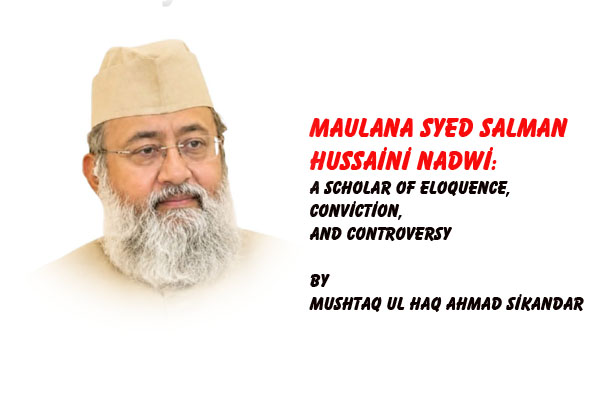
Mushtaq ul Haq Ahmad Sikandar
The passing of Maulana Syed Salman Hussaini Nadwi on 29 June 2026 marks the end of a distinctive and complex chapter in the intellectual and religious life of Indian Islam. He was not merely a cleric or preacher in the ordinary sense, but one of those rare religious figures who lived in the public eye, shaped debates beyond the confines of seminaries, and left behind a legacy that was at once admired, disputed, respected, and feared. He belonged to that generation of scholars who were not content with private piety alone; they sought to intervene in history, to speak to the anxieties of the Muslim community, and to assert the relevance of traditional scholarship in an age of political turbulence, ideological fragmentation, and moral confusion.
To remember him honestly is to remember a man of great learning and great influence, but also a man whose public positions often generated unease. He was a scholar of considerable Arabic and Urdu literary command, a gifted orator, and a prolific writer. He was also a thinker deeply shaped by the Nadwatul Ulama tradition and by the towering personality of Maulana Abul Hasan Ali Nadwi, popularly known as Ali Miyan. From that inheritance, he drew an intellectual vocabulary rooted in reform, moral seriousness, historical consciousness, and concern for the collective destiny of Muslims. But he did not remain merely a passive inheritor of that legacy. With time, he began to develop his own public identity, one marked by sharper edges, stronger interventions, and a more confrontational tone toward the issues that preoccupied him.
My own acquaintance with Maulana Salman Nadwi goes back to 2006, when I had just passed my higher secondary schooling. Even in those early years, his name carried weight. He was a scholar whose speech one listened to with attention, not simply because of the subject matter, but because of the force with which he spoke. I remember hearing him at the College of Education, now known as the Institute of Advanced Studies in Education, and sensing that here was a man who belonged to the world of public intellect. He did not speak like a casual preacher. He spoke like a man conscious of tradition, conscious of audience, and conscious of the responsibility attached to his words. For a young listener, that experience was instructive. It revealed how religious scholarship, when combined with command of language and conviction of purpose, can create a strong emotional and intellectual impression.
Years later, in 2016, I met him again at Nadwatul Ulama, in his office, when I had gone to interview him in connection with the newly started Bridge Course for madrasa graduates initiated by Aligarh Muslim University. At the time, Prof. Rashid Shaz was the Director of the Bridge Course, and the initiative itself represented an important attempt to create a bridge between the seminaries and the modern educational mainstream. I had gone with a Principal Investigator letter, expecting a serious academic exchange. Instead, what I found was hesitation, suspicion, and a kind of guarded resistance. He looked at the letter sceptically. Though he had written on madrasa reform, he seemed reluctant to witness such reform being implemented in practice, especially when it appeared in institutional form outside the familiar world of Nadwa.
That meeting stayed with me because it exposed a deeper contradiction in many scholarly circles: the difference between speaking of reform in theory and accepting reform in reality. He did not answer my questions, and I felt unwelcome. That feeling was not merely personal discomfort; it revealed a larger attitude. At times, scholars who publicly invoke the language of tolerance, dialogue, Sufism, and broad-mindedness can become inwardly rigid when confronted with ideas, people or institutions they do not trust. My meeting with him became a reminder that religious discourse is often full of noble ideals, but those ideals can collapse when challenged by disagreement, institutional rivalry, or political suspicion. In that room, I learned that a scholar’s public image and private disposition do not always coincide.
Yet it would be unfair and intellectually dishonest to define him only by that encounter or by the controversies that later surrounded him. He was, beyond doubt, a serious scholar. He wrote on a number of issues, in both Arabic and Urdu, and he had the ability to engage complex questions with the confidence of someone rooted in texts and traditions. His oratory was one of his most visible strengths. He knew how to hold an audience, how to give shape to historical memory, and how to speak in a way that made religious ideas seem immediate and urgent. Such a quality is not common. Many scholars possess learning; fewer possess presence. Maulana Salman had both.
He was among the students of Maulana Abul Hasan Ali Nadwi, and that connection is central to understanding him. Ali Miyan was not only a teacher for him; he was a formative intellectual presence. Under that influence, Maulana Salman came to value scholarship that was connected to lived religious concerns, communal responsibility, and historical memory. The Nadwi tradition is not merely academic; it is moral, reformist, and deeply aware of the relationship between Islam and society. Maulana Salman carried that sensibility with him. Yet after the death of Ali Miyan in 1999, he increasingly began to assert his own identity. He remained connected to Nadwatul Ulama, where he taught, but he also associated himself with Jamia Syed Ahmad Shaheed and later moved into broader arenas of public engagement. In that shift, one can see the beginning of a more visible independence.
He was especially inspired by the struggle associated with Syed Ahmad Shaheed and Shah Ismail Shaheed, the leaders of the failed movement commonly remembered in history as the Jihad or Tahreek-e-Mujahideen. He saw in them a moral and spiritual model, a force that sought to revive the community by returning to what he considered pure and authentic Islamic teachings. He, like many scholars in that tradition, understood them not through the colonial label of “Wahabi,” but as Naqshbandi Sufis whose concern was purification, discipline, and renewal. This historical sympathy was not incidental; it shaped his thought. It gave his writings a sense of urgency and ideological direction. He believed that Muslims had to recover from internal decline by reconnecting with original teachings and by resisting the distortions introduced through historical drift and local corruption.
At the same time, Maulana Salman was not simply a man of the past. He was engaged with modern educational and political realities. His association with youth-oriented initiatives such as Jamiat Shabaab ul Islam shows that he understood the importance of speaking to the younger generation. He recognized that a scholar who cannot address youth becomes a relic, however learned he may be. That is one reason his name remained relevant for so long. He was not confined to the classroom. He was present in speeches, conferences, institutions, debates, and public controversies. In an age when many religious authorities remain hidden in institutional corners, he remained visible.
Visibility, however, came at a price. He became one of the most controversial Muslim scholars of his time. One of the most debated moments in his public life was his declaration that he was ready to send five lakh youth to assist those fighting in the Middle East as an Indian Muslim youth army. Even more damaging was the praise he reportedly extended to Abu Bakr al-Baghdadi after the proclamation of a so-called caliphate by ISIS. These statements drew intense criticism, and rightly so. A scholar cannot be careless with words when the words in question can be read as legitimising violence, fanaticism, or transnational militancy. His defenders may have interpreted his words as expressions of anguish over Muslim suffering, but the moral problem remained: rhetoric that flirts with militant absolutism does not serve the community well. It confuses passion with principle and outrage with wisdom.
This is where a critical assessment becomes necessary. He may have seen himself as a fearless truth-teller, but truth without prudence can become a form of self-damage. Scholars are not only responsible for what they believe; they are responsible for how their beliefs are communicated and what consequences those communications produce. In his case, many of his strongest statements became sources of embarrassment for admirers and ammunition for critics. That does not erase his learning, but it complicates his memory. Great scholars are not necessarily those who avoid controversy, but they are expected to know the moral weight of the platforms they occupy.
In the last decade and more, especially after the Arab Spring turned into what many describe as an Arab winter, Maulana Salman became increasingly critical of Arab monarchs and their pro-Western political alignments. He condemned what he viewed as anti-Muslim and anti-Islamic policies, and this earned him hostility from some quarters. He was reportedly banned from Arab countries and even denied a visa for Hajj. Whether one agrees with his political reading or not, his position reflected a deep disappointment with the political order of the Muslim world. He had expected moral leadership; what he saw instead was compromise, submission, and strategic silence. His anger came from that disappointment. But again, anger is not the same as wisdom. The prophetic criticism of tyranny becomes less compelling when it turns into a wholesale ideological posture that leaves no room for complexity.
He also grew increasingly critical of the historical conduct of Muawiya and the Umayyad lineage, and his denunciation of Nasibis led some critics to accuse him of neo-Rafidism. That label itself is part of the unfortunate polarisation of contemporary sectarian language. Still, it must be acknowledged that Maulana Salman did not fear criticism. He stood by his positions, even when they isolated him. This stubbornness can be read in two ways. On one hand, it gives him a certain nobility, because he was not a man who easily surrendered his convictions for the sake of approval. On the other hand, it reveals a narrowing of intellectual space, because scholars become most dangerous when they lose the discipline of balance. He often seemed to prefer confrontation to moderation, certainty to ambiguity, and the moral theatre of denunciation to the patient work of persuasion.
At the same time, he should not be remembered as a purely divisive figure. He believed in dialogue in at least some important contexts, especially in relation to the Babri Masjid-Ram Janmabhoomi dispute. In a highly charged atmosphere, where communal emotion often overtook reason, his willingness to engage in dialogue and support negotiation reflected a constructive side of his thinking. That was not a minor feature of his legacy. It showed that he understood the need to prevent open-ended confrontation between communities. He was also a proponent of Shia-Sunni unity, and he spoke strongly against Israel, Zionism, the atrocities in Gaza, and attacks on Iran. In these positions, he aligned himself with a broad notion of Muslim solidarity that crossed national and sectarian boundaries.
And yet even here, the same tension remains. He wanted unity, but his language often carried the intensity of faction. He wanted dialogue, but he sometimes spoke in ways that hardened opposition. He sought reform, but he could distrust the practical forms in which reform appeared. He defended oppressed Muslims, but he sometimes did so through rhetoric that risked deepening suspicion rather than building understanding. This is the paradox that defines his memory.
His death is therefore not merely the passing of a cleric. It is the passing of a voice that mattered, a voice that stimulated agreement, disagreement, admiration, irritation, loyalty, and critique. There are many scholars who are forgettable because they never risk anything. Maulana Salman was not forgettable. He risked a great deal, including his reputation. That is why he remains a subject of discussion. He was a man of learning, but also of temperament. A man of history, but also of immediate response. A man who could inspire devotion in some and deep discomfort in others.
For me, his memory is inseparable from those two meetings. The first, in 2006, when I heard him speak and felt the presence of a serious scholar. The second, in 2016, when I encountered his scepticism and felt the distance between the ideal of scholarship and the politics of scholarly authority. Those experiences together gave me a fuller view of the man: not a saint, not a villain, but a highly influential religious intellectual whose life reflected the strengths and failures of a generation wrestling with modernity, identity, reform, and power.
If one were to write his epitaph in a single line, it might be this: he was a scholar who refused to be ordinary. That refusal made him important, but it also made him controversial. In the end, his life asks us to think carefully about what we ask of religious scholars. Is it enough that they are learned? Must they also be prudent? Must they be courageous? Must they be bridges between tradition and reform, or can they remain guardians of one side alone? Maulana Salman Nadwi’s life does not answer these questions neatly. It makes them harder, sharper, and more urgent.
That is why his death is a genuine loss, even for those who disagreed with him. The Indian Muslim world has lost one of its more forceful and uncompromising voices. And whether one remembers him with admiration, criticism, or both, one cannot deny that he lived with intensity, spoke with force, and left behind an imprint that will continue to provoke discussion for years to come.
M. H. A. Sikander is Writer-Activist based in Srinagar, Kashmir.
First published in newageislam

